How Do You Find the Equation for Sine and Cosine from a Graph?

  • Thread starter Thread starter Ronka
  • Start date Start date
  • Tags Tags
    Graph
Click For Summary
SUMMARY

The discussion focuses on determining the equations for sine and cosine functions from a given graph. The equation format is defined as Y = a sin(bx + c) + d, where 'a' represents amplitude, 'b' is the period, 'c' denotes phase shift, and 'd' indicates vertical shift. The participants successfully derived the sine equation as 2 sin(x - 2) and discussed the values for 'a', 'b', 'c', and 'd', concluding that a = 2, b = 1, c = -2, and d = 0. The conversation emphasizes the importance of analyzing graph characteristics, such as zero-crossings and inflection points, to accurately identify these parameters.

PREREQUISITES
  • Understanding of trigonometric functions, specifically sine and cosine.
  • Familiarity with graph analysis techniques, including identifying zero-crossings and inflection points.
  • Knowledge of amplitude, period, phase shift, and vertical shift in wave functions.
  • Basic algebra skills for manipulating equations.
NEXT STEPS
  • Study the properties of cosine functions and how to derive their equations from graphs.
  • Learn about transformations of trigonometric functions, including shifts and stretches.
  • Explore the concept of periodicity in trigonometric functions and its implications on graph behavior.
  • Practice graphing sine and cosine functions with varying parameters to solidify understanding.
USEFUL FOR

Students studying trigonometry, educators teaching wave functions, and anyone interested in graphing and analyzing periodic functions.

Ronka
Messages
7
Reaction score
0
Find the equation for Sine and cosine from a graph
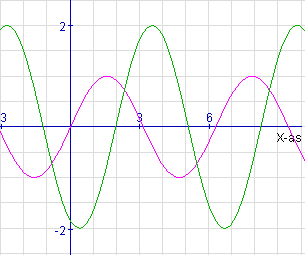
Homework Statement


sin1.gif


The Attempt at a Solution


Hello people, i have had a little problem solving this graph. It looks really easy, but I am still couldn't solve it ?!

a x Sin (bx + c) + d

a = amplitude
b = period
c = phase shift
d = vertical shift

thx in advances.

Edit:

I have solved the equation for the Sine ( thank you folks )
Equation for Sine:
2 sin(1(x-2))

Trying to find the equation for Cosine:
 
Last edited:
Physics news on Phys.org
edited out my answer because i wasn't aware of this rule. way to botch the first post in the forum, eh?

well, to be more helpful without giving an answer:

when you're looking at a graph, it really is rather simple... that purple one sure looks pretty basic, don't you think? pay attention to the places where the line/curve touches the x-axis and where the inflection points are so that you can better figure the stuff out.
 
Last edited:
As you say, it's two graphs of the form Y = a sin(bX + c) + d

So the answer is giving two sets of values for a, b, c and d.

Can you spot any of them? The a and d values are the easiest ones to start with.
 
As it says in the FAQ (https://www.physicsforums.com/showthread.php?t=94379) "Please DO NOT do someone's homework for them or post complete solutions to problems. Please give all the help you can, but DO NOT simply do the problem yourself and post the solution (at least not until the original poster has tried his/her very best)."
 
a = 2
d = 0

b = period remain the same = 2 phi
c = ...

since the graph is shifted to the right, means that it should be -c not +c
c = -2 ?!?
 
Is that the green or the pink you're working on, Ronka?
 
Im trying to find the equation of the green one. the pink one is just Sin(x).

Green ( one period or 2 phi ) :

2 sin(1(x - 2) ?! is this right?
 
Yes to a = 2 and d = 0.

It's pi not phi.

If pink is sin(X) then X is in radians.

Check:
sin(0) = 0
sin(π/2) = 1
sin(π) = 0
OK.

2 sin(1(x - 2) can't be right because the parentheses don't balance.
If you meant 2 sin(1(x - 2)) then it's simpler to write 2 sin(x - 2)
sin(x - 2) is good; it shifts the positive-going zero-crossing of sin(x) to the right.
Yes -- 2 sin(x - 2) looks right.
 
Thanks:

Equation for Sine:
2 sin(1(x-2))

Now i finally understand how to find the equation for Sine
Im now trying to find the equation for Cosine

I'll give it a try first. i'll post when I'm stuck :)

thx!
 
  • #10
Now I don't understand! :smile:

Why are you choosing "2 sin(1(x-2))" in preference to the simpler "2 sin(x-2)"?

Are you wanting to show that b is 1 in "Y = a Sin (bx + c) + d"?
 
  • #11
Just to make myself clear that that the period has been tretched ( i know you could clearly see from the graph ) but it just help me rember :)
 
  • #12
The period hasn't been stretched. If you count the X distance between corresponding points on the green graph (like the maxima, the minima or the positive- and negative-going zero crossings) they are the same as the pink graph.

a = amplitude is stretched by times 2
b = period is unchanged
c = phase shift is -2
d = vertical shift is zero
 

Similar threads

  • · Replies 2 ·
Replies
2
Views
8K
  • · Replies 2 ·
Replies
2
Views
4K
  • · Replies 9 ·
Replies
9
Views
3K
  • · Replies 5 ·
Replies
5
Views
2K
Replies
2
Views
2K
  • · Replies 1 ·
Replies
1
Views
3K
  • · Replies 6 ·
Replies
6
Views
2K
  • · Replies 6 ·
Replies
6
Views
3K
  • · Replies 9 ·
Replies
9
Views
2K
  • · Replies 9 ·
Replies
9
Views
2K