Find the Equivalent Resistance in Complicated Electrical Circuits

Click For Summary
SUMMARY

This discussion focuses on finding the equivalent resistance in complex electrical circuits by identifying resistors in series and parallel configurations. Participants emphasize the importance of labeling components, such as resistors (R1, R2) and connection nodes (A, B, C), to facilitate understanding. The final equivalent resistance for the example circuit is confirmed to be 3 ohms, achieved through a series of simplifications. Redrawing the circuit is recommended to clarify relationships between components.

PREREQUISITES
  • Understanding of series and parallel resistor configurations
  • Familiarity with electrical circuit diagrams
  • Basic knowledge of Ohm's Law
  • Ability to perform algebraic calculations for resistance
NEXT STEPS
  • Learn techniques for simplifying complex resistor networks
  • Study Kirchhoff's laws for circuit analysis
  • Explore the use of circuit simulation software like LTspice
  • Investigate advanced topics such as Thevenin's and Norton's theorems
USEFUL FOR

Electrical engineering students, hobbyists working on circuit design, and professionals involved in circuit analysis and optimization.

Grievery
Messages
3
Reaction score
0
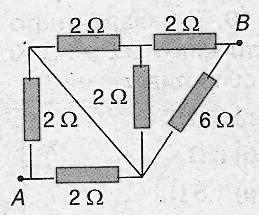
Hi! I have been trying to understand how a "complicated" circiut can be transformed to show which resistors are connected in series and which are parallel... Sometimes I manage to do it but it's often too hard for me because I can't find any sort of algorithm about it. Could anybody show me "step-by-step" how to transform this circuit for example...?
arx1303670379t.jpg

We need to find the equivalent resistance...
Thank you in advance!
 
Physics news on Phys.org
It's always a good idea to label the components in a diagram. In this case your resistors should be numbered R1, R2 etc. This allows people to identify what is being referred to and, if the OP doesit, doesn't waste 2 posts.
Alternatively you can label the connection nodes, A, B, C etc (which you have already started, but not finished).

I will comment (ask) if your diagram is correct since R1 and R2 are (almost) shorted out.

Can you see which resistors I mean by R1 and R2?

Oh and welcome to PF
 
Last edited:
First of all, thank you for the very quick response... I have labeled the resistors... Now, how can I find the equivalent one.
P.S. The answer is 3 ohms.
jdv1303671601e.jpg
 
I find it often helpful to redraw the network to bring out the relationships. Sometimes you have to do this several times to get a clear result.

The attachment shows a sequence of single step series or parallel simplifications leading to the desired result.

Although I agree with the 3 ohm answer I have left you do do some of the work in the intermediate steps.

Hope this helps
 

Attachments

  • net2.jpg
    net2.jpg
    20.2 KB · Views: 468
Last edited:
Well.. thank you once again! :) I hope now I can figure out HOW to do it myself...
 
In sci-fi when an author is talking about space travellers or describing the movement of galaxies they will say something like “movement in space only means anything in relation to another object”. Examples of this would be, a space ship moving away from earth at 100 km/s, or 2 galaxies moving towards each other at one light year per century. I think it would make it easier to describe movement in space if we had three axis that we all agree on and we used 0 km/s relative to the speed of...

Similar threads

  • · Replies 38 ·
2
Replies
38
Views
5K
  • · Replies 2 ·
Replies
2
Views
1K
  • · Replies 31 ·
2
Replies
31
Views
4K
Replies
5
Views
4K
  • · Replies 3 ·
Replies
3
Views
1K
Replies
10
Views
3K
  • · Replies 10 ·
Replies
10
Views
894
  • · Replies 9 ·
Replies
9
Views
3K
Replies
9
Views
2K
Replies
3
Views
2K