Find the position of a proton in an E and B field

Click For Summary

Homework Help Overview

The discussion revolves around the motion of a proton in the presence of electric and magnetic fields, specifically focusing on its helical path and position in the z direction. Participants explore the implications of the magnetic field on the proton's trajectory and the role of the electric field in determining its velocity.

Discussion Character

  • Exploratory, Conceptual clarification, Mathematical reasoning, Assumption checking

Approaches and Questions Raised

  • Participants discuss the equations of motion relevant to the proton's path, questioning the interpretation of the problem, particularly regarding the position at specific times. There is uncertainty about how to incorporate the electric field's effect on the z direction velocity and how to express the position as a function of time.

Discussion Status

Some participants have offered insights into the relationship between the electric and magnetic fields and their effects on the proton's motion. There is ongoing exploration of how to express the z component of the position and the implications of time on the equations derived. Multiple interpretations of the problem are being considered, particularly regarding the initial conditions and the role of time in the kinematic equations.

Contextual Notes

Participants note the potential confusion surrounding the time variable and its impact on the kinematic equations, as well as the need for clarity on the specific questions posed in the problem. There is acknowledgment of the challenge in determining the position of the proton along the z direction without having both time and distance as unknowns.

zehkari
Messages
22
Reaction score
3
Homework Statement
(See Attempt).
Relevant Equations
(See Attempt).
Hello all,

I have a question with the helix path of proton in a magnetic field that I am a bit stuck on.

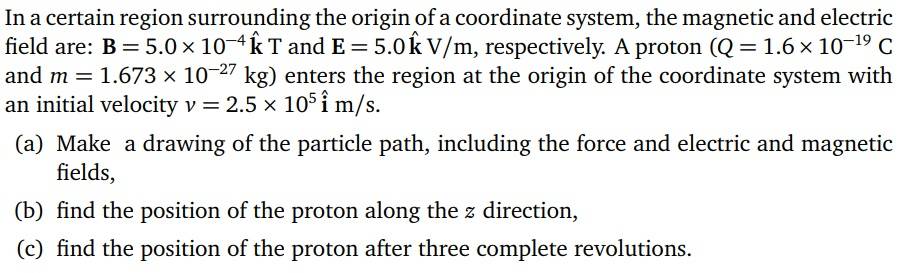
Question:
OQ5oJRa.jpg


Equations:
F = qv X B
F = mv^2/r
d=vt

My Attempt:

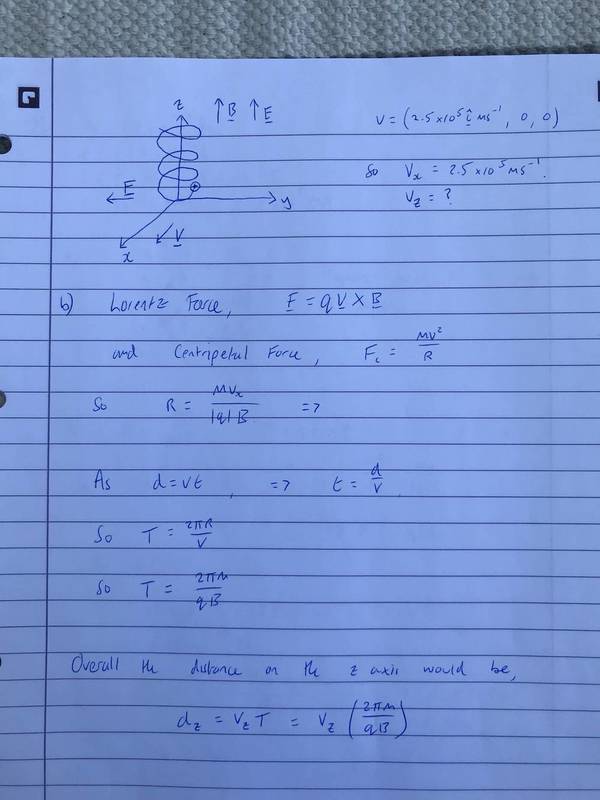
Think the graph drawn is good enough for questions (a). However, I am stuck on (b) and (c).
Firstly I am not entirely sure what question (b) is asking, the position where? At t = 0?
And then I can obtain an equation for the position of the proton after three complete revolutions (c), which is three 'pitches'. But I do not have the velocity in the z direction.

I also think I am overlooking the Electric field here. Which could play a role with the velocity in the z direction.

So I am not sure how to calculate the velocity in the z direction and what question (b) is asking.
dJx7Hx3.jpg


Any help would be appreciated. Thank you for your time.
 
Physics news on Phys.org
zehkari said:
I also think I am overlooking the Electric field here. Which could play a role with the velocity in the z direction.
What would be the motion of the proton if the magnetic field were not there? Would it move in a straight line or accelerate? In this case, you can simply superimpose the motion in the electric-field-only case and the motion in the magnetic-field-only case. (Why?)
 
  • Like
Likes   Reactions: zehkari
kuruman said:
What would be the motion of the proton if the magnetic field were not there? Would it move in a straight line or accelerate? In this case, you can simply superimpose the motion in the electric-field-only case and the motion in the magnetic-field-only case. (Why?)

The motion of the proton in the z direction would be due to the electric field applying a linear acceleration?

So you could say the velocity in the z direction is:

$$v_z = u_z + at$$

So,

$$v_z = at $$

But as ##a = \frac{Eq}{m}##, then,

$$v_z = \frac{Eq}{m}t$$

Displacement could be found with another kinematic equation as well,

$$z = \frac{1}{2}\frac{Eq}{m}t$$

Am I on the right track? I am still confused with adding a time variable to the problem.

Thank you for your time.

*Edit:

Also a quick question, would ##v_z = \frac{E}{B}## work for the velocity? As I thought this only worked when the electric field is perpendicular to the magnetic.
 
zehkari said:
The motion of the proton in the z direction would be due to the electric field applying a linear acceleration?
Yes.
zehkari said:
So you could say the velocity in the z direction is:$$v_z = u_z + at$$So,$$v_z = at $$
Yes.
zehkari said:
But as ##a = \frac{Eq}{m}##, then,$$v_z = \frac{Eq}{m}t$$
Yes, except what you have above is ##a_z##, not ##a##.
zehkari said:
Displacement could be found with another kinematic equation as well,$$z = \frac{1}{2}\frac{Eq}{m}t$$
No. The ##z##-component of the position goes as ##t^2.##
zehkari said:
Am I on the right track? I am still confused with adding a time variable to the problem.
You are on the right track, but what do you find confusing about the time variable? In this case the motion in the ##xy##-plane is independent of the motion in the ##z##-direction.
zehkari said:
Also a quick question, would ##v_z = \frac{E}{B}## work for the velocity? As I thought this only worked when the electric field is perpendicular to the magnetic.
It only works when you have crossed electric and magnetic fields and it is the condition for the particle to emerge move in a straight line through the field region when its velocity is perpendicular to both fields. It is irrelevant to the situation you have here.
 
  • Like
Likes   Reactions: zehkari
kuruman said:
No. The ##z##-component of the position goes as ##t^2.##

Yeah, sorry didn't double check.

kuruman said:
You are on the right track, but what do you find confusing about the time variable? In this case the motion in the ##xy##-plane is independent of the motion in the ##z##-direction.

Question (b) asks to find the position of the proton along the z direction.
Does this mean at ##t = 0##? If so the equations found for velocity and accerlation on the z plane do not work? As I can't think of a way to avoid having both unkown variables of time and distance using kinematics.

kuruman said:
It only works when you have crossed electric and magnetic fields and it is the condition for the particle to emerge move in a straight line through the field region when its velocity is perpendicular to both fields. It is irrelevant to the situation you have here.

Thank you.
 
Hey, I think I have the correct method now:

As,
$$z = \frac{1}{2}\frac{Eq}{m}t^2$$

And the time would be the same as one pitch (T), then,
$$z = \frac{1}{2}\frac{Eq}{m}T^2$$

With substituion,
$$z = \frac{1}{2}\frac{Eq}{m}{(\frac{2m\pi}{bq})}^2$$

For part (c), 3 revolutions would be ##(3T)^2##.

For (b) I obtain a position of 4 meters. Which is slightly smaller than the radius.
 
For (b) you need to provide the ##z## coordinate as a function of time, that is for any time ##t##. You have done that.
For part (c) you need to provide all three components of the position vector.
 
  • Like
Likes   Reactions: zehkari
Thank you.
 

Similar threads

  • · Replies 31 ·
2
Replies
31
Views
2K
Replies
7
Views
2K
  • · Replies 9 ·
Replies
9
Views
2K
  • · Replies 9 ·
Replies
9
Views
2K
Replies
14
Views
3K
Replies
34
Views
2K
Replies
16
Views
2K
  • · Replies 25 ·
Replies
25
Views
2K
Replies
11
Views
3K
Replies
1
Views
3K