Find the rate of change of velocity

Click For Summary

Homework Help Overview

The discussion revolves around a projectile motion problem where the original poster seeks to understand the final displacement and velocity of a projectile launched at an angle. The context includes calculations involving initial velocity, time of flight, and displacement, with a focus on the implications of negative and positive velocity components.

Discussion Character

  • Exploratory, Conceptual clarification, Mathematical reasoning

Approaches and Questions Raised

  • The original poster attempts to clarify the nature of velocity components, questioning the signs of initial and final velocities. They explore the relationship between displacement and velocity, and seek to derive equations related to the parabolic trajectory of the projectile.

Discussion Status

Participants are engaging in a dialogue about the nature of the projectile's motion, with some providing insights into the differentiation of displacement to find velocity. There is an exploration of the conditions under which derivatives can be applied, and a recognition of the distinction between total displacement and the variable functions of time.

Contextual Notes

Participants are navigating assumptions about the projectile's motion, including the effects of gravity and the interpretation of velocity at the apex of the trajectory. There is mention of the need for clarity on the equations governing parabolic motion and the role of time in these calculations.

chucho11028
Messages
9
Reaction score
0
Homework Statement
find rate of change of velocity
Relevant Equations
Vy=vi*sin(angle)
Vx=vi*cos(angle)
Ymax=vi*t-(g*t^2)/2
Xmax=vi*t
Hello everyone,

I have a problem where I have to find the final displacement and final velocity which I have found however, I want to post few variations for that same problem which I am curious. It is more for my own knowledge > I would appreciate any help
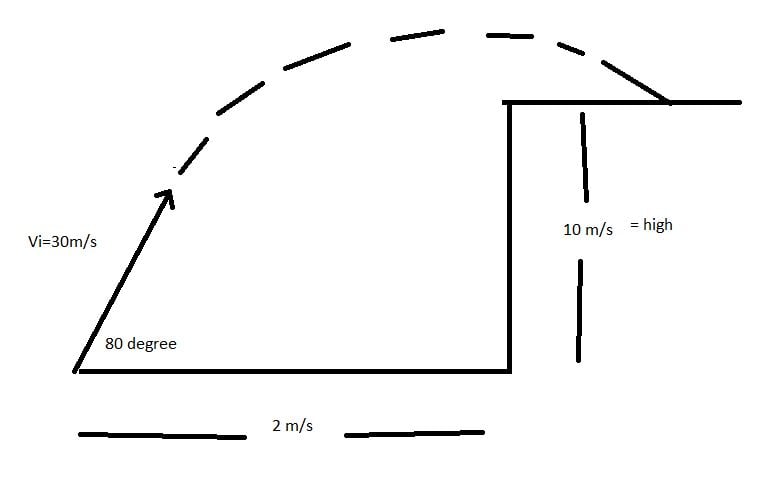
Please follow graph below with data:
canon.JPG


A projectile has been launched with Initial velocity 30 m/s, 80 degree elevation, there is 2 m in the x coordinate and 10 m high

In order to find final velocity I got delta t (second grade equation)

Code:
10=29.54*t-4.9*t^2

so, t= 5.67 seconds

then, total displacement is
Code:
Sx=30*cos80 * 5.67

which is equal to 29.53
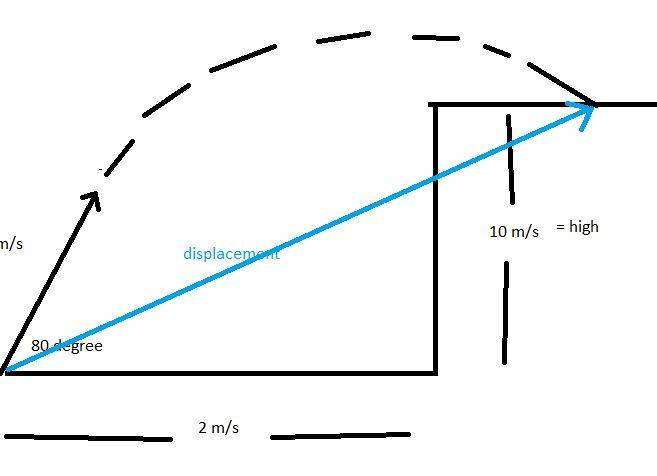
then, I used Phythagoras and I got the relationship between 29.53 and 10 m high to find the displacement
which is 31.18 m
canon2.JPG


you can see the blue line

Then I can find the Vf using this idea

variation of V is equal vf-vi which is equal to g* t

then, my VF will be -26.03 m/s

Here is my question or some questions,

1. I assume is negative because the object is falling down, isn't it?
2. Then, the Vi (initial velocity) is positive because is in opposed direction, isn't it?
3. So, I think the velocity will be zero in the vertex of the parabola, isn't it
4. I think is I derive the equation for displacement , I will get the equation for velocity but what is the exact equation for displacement that represent this exercise ?
5. How can I find the vertex using the derive? Can I take displacement, then put equal to 0 and find the solution? I would need a help for this question
 
Physics news on Phys.org
chucho11028 said:
1. I assume is negative because the object is falling down, isn't it?
2. Then, the Vi (initial velocity) is positive because is in opposed direction, isn't it?
3. So, I think the velocity will be zero in the vertex of the parabola, isn't it
If you mean the vertical component of velocity, and you are taking up as positive, yes.
chucho11028 said:
4. I think is I derive the equation for displacement , I will get the equation for velocity
I'm not sure exactly what you mean.
In the diagram you have marked the start to end displacement with a blue line. That is a constant, not a variable function of time, so deriving that will produce zero.
If you consider the displacement (which is a vector) as a function of time during the flight then, yes, the derivative of that is the velocity vector as a function of time.

But perhaps you mean vertical displacement (height) as a function of time. Deriving that will give the vertical component of velocity, and that will be zero at the apex.
 
chucho11028 said:
Homework Statement:: find rate of change of velocity
Relevant Equations:: Vy=vi*sin(angle)
Vx=vi*cos(angle)
Ymax=vi*t-(g*t^2)/2
Xmax=vi*t

How can I find the vertex using the derive?
You're looking for the event that occurs when the vertical component of the velocity is zero.
 
haruspex said:
If you mean the vertical component of velocity, and you are taking up as positive, yes.

I'm not sure exactly what you mean.
In the diagram you have marked the start to end displacement with a blue line. That is a constant, not a variable function of time, so deriving that will produce zero.
If you consider the displacement (which is a vector) as a function of time during the flight then, yes, the derivative of that is the velocity vector as a function of time.

But perhaps you mean vertical displacement (height) as a function of time. Deriving that will give the vertical component of velocity, and that will be zero at the apex.

Thanks for your response. The blue line is just the total displacement but this is parabolic trajectory, for sure, there are a X and Y component.

So, what it would be the equation for the parabolic trajectory ?
With this equation I think I can implement a derive, isn't it?
So, you mentioned it is not a variable function of time. I know the delta t is 5.67 seconds. So, you mean that it is not correct apply deriving because this time will be constant during the whole process of the displacement ?
or the right questions is:
what it would be the condition or function where we could implement deriving?
Could you please provide some example?

I will appreciate your help
 
chucho11028 said:
what it would be the equation for the parabolic trajectory ?
"The equation" for the trajectory would just be y as a quadratic function of x.
If you differentiate that (with respect to x) it will give you the gradient at any particular point but will not give you a velocity.
If you mean the trajectory in parametric form, with time as the parameter, that will be two equations: y as a quadratic in t and x as a linear function of t. Differentiating those with respect to time will give you velocities.

This has little to do with the total displacement shown by your blue line, nor with the total time you calculated. I struggle to understand what you are trying to do.

Neither do I understand why you would want to "derive" (differentiate) the trajectory with respect to time. The velocity equations are easily obtained directly: vx(t)=Vcos(θ), vy(t)=Vsin(θ)-gt.
 
Last edited:
chucho11028 said:
Could you please provide some example?
Have you looked at the examples in a few different textbooks?
 

Similar threads

  • · Replies 4 ·
Replies
4
Views
1K
  • · Replies 5 ·
Replies
5
Views
3K
  • · Replies 8 ·
Replies
8
Views
1K
  • · Replies 17 ·
Replies
17
Views
3K
  • · Replies 19 ·
Replies
19
Views
2K
Replies
1
Views
2K
Replies
20
Views
2K
Replies
1
Views
3K
  • · Replies 5 ·
Replies
5
Views
2K
  • · Replies 3 ·
Replies
3
Views
1K