- 16,335
- 258
evinda said:We need $\lceil \lg n \rceil-1=2$ comparisons, to find number two, right? (Thinking)
Yup!
So...? (Sweating)
evinda said:We need $\lceil \lg n \rceil-1=2$ comparisons, to find number two, right? (Thinking)
I like Serena said:Yup!
So...? (Sweating)
evinda said:So,we need $n-1+ \lfloor \lg n \rfloor-1=n+ \lfloor \lg n \rfloor -2$ comparisons,right? (Happy)
So, to show that from a given set of numbers with $n$ elements, we can count the second smallest element with $n+ \lceil lgn \rceil−2$ comparisons, can I show it for $n=8$ and then conclude from that the needed number of comparisons for a general $n$ ? Or do I have to do also something else? (Thinking)
I like Serena said:Ah well, I guess you still need to prove it.
How would you prove it? (Wondering)
evinda said:I don't know, maybe using induction? (Thinking)
I like Serena said:Sounds good... (Smirk)
evinda said:For $n=2$,we need one comparison to find the second smallest element.
$$n+ \lceil \lg n \rceil -2=2+\lceil \lg 2 \rceil-2=1 \checkmark $$
Then, we suppose that, when we have $n$ elements, we need $n+ \lceil \lg n \rceil -2$ comparisons to find the second smallest element.
But..what happens if we have $n+1$ elements? Do we have to compare the $(n+1)^{th}$ element with the second smallest, that we found above and pick the smallest of them? (Thinking)
Or can't we verify the formula like that? (Sweating)
I like Serena said:We will have to distinguish two cases for $n+1$.
Let's select a complete binary tree for $n$.
When we add leaf $n+1$, there are 2 possibilities.
Either it fits in the last level, or we need to add a new level to accommodate $n+1$.
What happens in those cases to the number of comparisons for first place, respectively second place? (Wondering)
evinda said:So, don't we consider the tournament tree, proving that we need $n+ \lceil \lg n\rceil-2$ comparisons, by induction? (Sweating) (Thinking)
I like Serena said:Yes we do.
What's stopping you? (Worried)
evinda said:So, when we have $n$ elements, the tournament tree is of this form:
and we suppose that we need $n+ \lceil \lg n \rceil-2$ comparisons, in order to find the second smallest element.
But.. what do we do, when we add the $(n+1)^{th}$ element, to show that in this case we need $n+1+ \lceil \lg{ (n+1) } \rceil-2=n+ \lceil \lg{ (n+1) } \rceil-1$ comparisons, for the finding of the second smallest element? (Thinking) (Sweating)
I like Serena said:In the first case we have a tournament tree that is not a full binary tree, but only a complete binary tree.
evinda said:Could you explain it further to me, why the tournament tree above is not a full binary tree, but only a complete binary tree? (Sweating)
I like Serena said:This is the first of the 2 cases I'm distinguishing.
Either $n$ is of the form $2^k$ or it is not.
If $n$ is not a power of 2, we can set up a tournament tree that is a complete binary tree, but is not a full binary tree. (Wasntme)
evinda said:A binary tree is full if each node is either a leaf or possesses exactly two child nodes.
A binary tree with $n$ levels is complete if all levels except possibly the last are completely full, and the last level has all its nodes to the left side.
Right? (Thinking)
So, if $n$ is not a power of $2$, don't we have then a full binary tree, and not a complete one? (Thinking) Or have I understood it wrong? (Sweating)
I like Serena said:It's the other way around.![]()
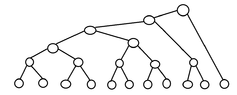
evinda said:For $n=9$, we have, for example, this tournament tree, right?
Why is it a complete binary tree, but not a full one? (Thinking)
I like Serena said:It is neither, because node $\enclose{circle}9$ is really at level 2 instead of on the last level.
The complete binary tree is:
https://www.physicsforums.com/attachments/3209
And it's not a full binary tree since the last level is not fully occupied. (Shake)
evinda said:So, do we have to compare the $(n+1)^{th}$ element with the smallest, that we found, when we had $n$ elements?
If so, then if it is greater, then we need one comparison, right?
And.. if it is smaller than the smallest that we found, do we need again only one comparison, since the new smaller element gets the position of the previous one? (Thinking)
I like Serena said:It's not supposed to be sorted.
It was just easiest to do it that way.
We just need to slide element $(n+1)$ in somewhere so that we still have a complete binary tree.
That is always possible and will take exactly $1$ more comparison to figure out number one.
evinda said:Could you give me an example?(Thinking)
I like Serena said:What example can you think of? (Wasntme)
evinda said:Having the tournament tree for $n$ elements,where can I place the $(n+1)^{th}$ element? (Thinking)
I like Serena said:Two cases.
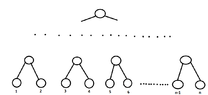
If $n$ is of the form $2^k$, you'll need another level and do what I showed in my tree.
Or if $n$ is not of the form $2^k$, you can add it to the right of the last leaf. (Tauri)
evinda said:So, if we have $m$ elements and we want to create a tournament tree, doesn't all the $m$ elements have to be firstly at the same level, that is the last one?
Because, if we have $n+1$ elements, we compare the $(n+1)^{th}$ element with the smallest that we found before when we had $n$ elements,and pick one of them, and then we only have $n$ elements at the same level..![]()
I like Serena said:No!
That only works if we happen to have a power of 2.
What if we don't? (Wait)
I like Serena said:Huh?
We don't have to compare $(n+1)$ with the smallest.
We only have to add it to the three.
The exact comparisons may change, but the total number of comparisons will be 1 more than it was before. (Wasntme)
evinda said:So, what do we have to do, when we have $n=11$ ? $11$ is not a power of $2$, neither $n-1=10$ is.. (Worried)
So, at the binary tree, that you created, don't we have to compare only $9$ with $1$ ?(Sweating)
I like Serena said:Can you create a tree for that? (Wondering)
I like Serena said:Not really. We can shuffle the leaves around any way we like. (Dance)