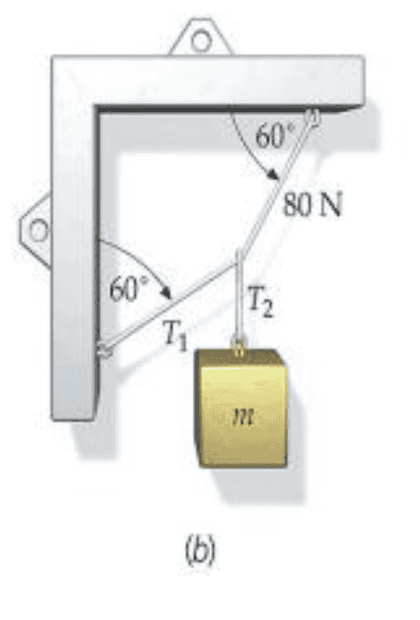
Find the unkown tensions and masses in the situation below

Click For Summary

Homework Help Overview

The discussion revolves around a problem involving the calculation of tensions in a system of cords and the associated masses, utilizing Newton's Laws. The participants are exploring the relationships between the forces acting on the cords and questioning the validity of their approaches and assumptions.

Discussion Character

  • Exploratory, Assumption checking, Conceptual clarification

Approaches and Questions Raised

  • The original poster attempts to calculate the tensions ##T_{1}## and ##T_{2}## using equilibrium equations but expresses uncertainty about the correctness of their procedure. Some participants inquire about the wording of the problem and suggest creating a free body diagram to clarify the forces involved. Others discuss the implications of the angles used in the calculations and the signs associated with the tensions.

Discussion Status

Participants are actively engaging with the original poster's calculations, providing feedback on the methodology and suggesting considerations for equilibrium in both the horizontal and vertical directions. There is recognition of the need for clarity regarding the angles and the resultant forces, but no explicit consensus has been reached regarding the correctness of the original poster's approach.

Contextual Notes

Participants note that the problem assumes the cables have no mass and that gravitational acceleration is set at ##g=9.81\,\mathrm{\frac{m}{s^{2}}}##. There is also mention of potential confusion due to the time of day affecting the original poster's clarity of thought.

Venturi365
Messages
12
Reaction score
3
Thread moved from the technical forums to the schoolwork forums
TL;DR Summary: I don't know if my procedure is correct in this exercise

I've tried to solve this problem but I find my solution unintuitive and I think I might be wrong.

First of all, applying Newton's Laws I calculated the value for ##T_1## like this:

$$
\begin{align}
\sum F_{x} &=0\\
\sin(60) \cdot T_{1}+80\, \mathrm{N}\cdot \cos(60) &=0\\
T_{1}&=\frac{-80\cdot\cos(60)}{\sin(60)}\\
T_{1} &\approx -46,2\, \mathrm{N}
\end{align}
$$

Here's the first thing that looks odd to me, because intuitively ##T_{1}## should be ##80\,\mathrm{N}## too, but It may be just a wrong hypothesis.

Then I apply the same law to the node of the three cords:

$$
\begin{align}
\sum F_{y}&=0\\
T_{1}\cdot\cos(60)+80\,\mathrm{N}\cdot\sin(60)+T_{2}&=0\\
T_{2}&=46,2\,\mathrm{N}\cdot\cos(60)-80\,\mathrm{N}\cdot\sin(60)\\
T_{2}&\approx -46,2\,\mathrm{N}
\end{align}
$$

Which is the same force as ##T_{1}##. Is my method ok or am I wrong at some point?
je7yz.png
 
Physics news on Phys.org
Welcome, @Venturi365 !
What is the wording of this problem?
 
Lnewqban said:
Welcome, @Venturi365 !
What is the wording of this problem?
It asks you to find the values of ##T_{1}##, ##T_{2}## and ##m## supposing that the cables have no mass and that ##g=9,81\,\mathrm{\frac{m}{s^{2}}}##. The wording is just as I wrote it in the title.
 
Could you do a free body diagram for the node of the three cords?
Consider that the node must have a balance of horizontal and vertical forces.
The magnitude of T1 does not need to be 80 Newtons (imagine the extreme case in which the right half of the rope becomes vertical and its tension is equal to mg).
CNX_UPhysics_06_01_StopLight.jpg
 
Last edited:
Venturi365 said:
Which is the same force as T1.
The three forces must balance at the joint. Therefore the resultant of T1 and T2 must be along the line of 'T3'. With these angles, that means it lies on the bisector of the angle between them, implying they are of equal magnitude.

Btw, I find your use of signs quirky. A tension is generally taken to be a magnitude. (You could adopt a convention in which tensions have one sign and compressions the other.) Here, your equations have T1 and T2 negative but T3 positive.

I guess that came from starting with the vectors form, but then you should have measured all angles from the same reference direction, making some trig values negative.
 
haruspex said:
The three forces must balance at the joint. Therefore the resultant of T1 and T2 must be along the line of 'T3'. With these angles, that means it lies on the bisector of the angle between them, implying they are of equal magnitude.

Btw, I find your use of signs quirky. A tension is generally taken to be a magnitude. (You could adopt a convention in which tensions have one sign and compressions the other.) Here, your equations have T1 and T2 negative but T3 positive.

I guess that came from starting with the vectors form, but then you should have measured all angles from the same reference direction, making some trig values negative.

Taking all that in consideration I get the same result:

First I find ##T_{1}## knowing that, at the joint, there's an equilibrium in the ##x## axis in which ##T_{2}## doesn't participate (now with the angles corrected):

$$
\begin{align}
\sum F_{x} & =0 \\
\cos \left(30^\circ\right) ·T_{1}+\cos \left(180^\circ+60^\circ\right) ·80\,\mathrm{N} & =0 \\
\frac{\sqrt{ 3 }}{2}·T_{1}-\frac{1}{2}80\,\mathrm{N} & =0 \\
T_{1} & =\frac{80}{\sqrt{ 3 }} \\
T_{1} & \approx 46,18\,\mathrm{N}
\end{align}
$$

Then, I sum all the tensions in the ##y## axis:

$$
\begin{align}
\sum F_{y} & =0 \\
T_{1}·\sin \left(30^\circ\right) +T_{2}+80\,\mathrm{N}·\sin \left(180^\circ+60^\circ\right) & =0 \\
\frac{80}{2\sqrt{ 3 }}+T_{2}-\frac{80\sqrt{ 3 }}{2 } & =0 \\
T_{2} & =\frac{80\sqrt{ 3 }}{2}-\frac{80}{2\sqrt{ 3 }} \\
T_{2} & \approx 46,18\,\mathrm{N}
\end{align}
$$

And there it is, the same solution, maybe I'm just right and I'm being a paranoid, idk.

I'll calculate the mass, just for fun:

$$
\begin{align}
w & =T_{2} \\
mg & =46,18 \\ \\

& \to \boxed{\; g =9,18\,\mathrm{\frac{m}{s^{2}}} \;} \\ \\

m & =\frac{46,18}{9,18} \\
m & \approx 5,03\,\mathrm{kg}
\end{align}
$$

Thx for the signs advice, I didn't see that.
 
Venturi365 said:
And there it is, the same solution, maybe I'm just right and I'm being a paranoid
I explained in post #5 that with the angles specified it was inevitable the two tensions would be the same.
 
haruspex said:
I explained in post #5 that with the angles specified it was inevitable the two tensions would be the same.

Oh, yeah, I'm so sorry. I've been studying for a long time and rn is 3 am in Spain so my brain didn't translate that correctly, lmao.

Thank you for your patience and taking the time to answer :)
 
Venturi365 said:
Oh, yeah, I'm so sorry. I've been studying for a long time and rn is 3 am in Spain so my brain didn't translate that correctly, lmao.

Thank you for your patience and taking the time to answer :)
No problem, you are welcome.
 

Similar threads

Replies
46
Views
5K
Replies
7
Views
1K
  • · Replies 5 ·
Replies
5
Views
1K
Replies
6
Views
1K
  • · Replies 8 ·
Replies
8
Views
2K
Replies
6
Views
3K
  • · Replies 21 ·
Replies
21
Views
1K
Replies
15
Views
2K
  • · Replies 5 ·
Replies
5
Views
2K
Replies
6
Views
3K