Find unknown values of current in multi-loop circuit

  • Thread starter Thread starter mhrob24
  • Start date Start date
  • Tags Tags
    Circuit Current
Click For Summary
The discussion centers on confusion regarding the sign conventions used in loop equations for a multi-loop circuit problem. The participant questions why the potential drop across the EMF source V2 is added instead of subtracted when moving clockwise, suggesting a potential typo in the professor's notes. They emphasize the importance of consistency in choosing current directions and applying voltage drop signs correctly across different loops. The participant asserts that the final equation for the right loop is incorrect and should reflect the proper sign convention. Overall, clarity on the correct application of Kirchhoff's laws and sign conventions is crucial for solving the circuit equations accurately.
mhrob24
Messages
53
Reaction score
9
Homework Statement
Assign values to the currents in the circuit schematic
Relevant Equations
V = IR
Kirchhoff's rules
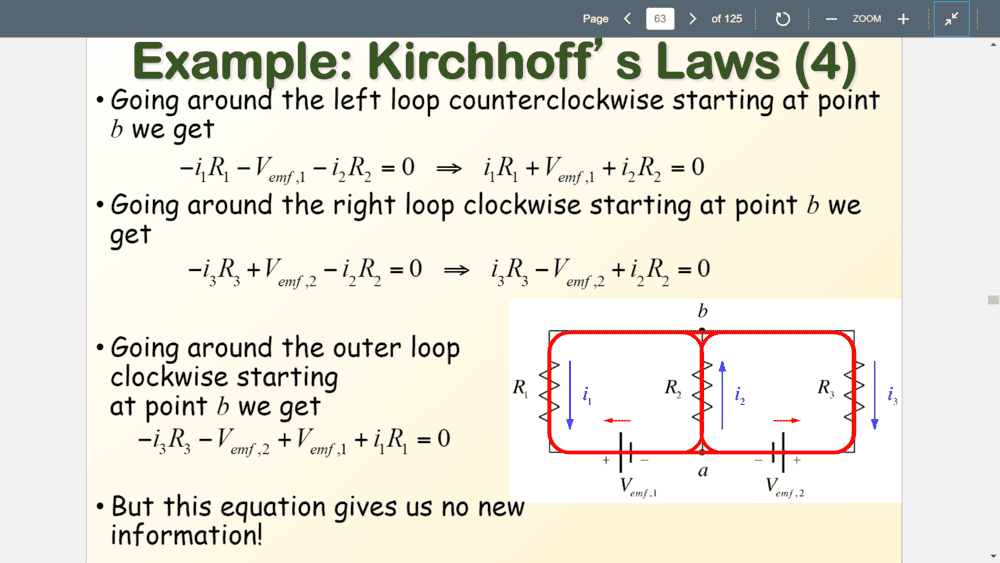
So I'm going over my review questions/notes provided by my professor for the upcoming exam on Tuesday, and I came across an example problem that I THINK might be a typo, but I want to make sure I'm right.
1572112053968.png
I'm not sure why the potential drop when crossing V2 is ADDED to the loop equation for the right loop and not SUBTRACTED. If we're moving clockwise from B, we will cross through the EMF source from the positive to the negative terminal, so the potential should be subtracted from the total potential. Same goes for the left loop when traveling COUNTERclockwise from point b. You will cross through the EMF source V1 from the positive to the negative terminal.
 
Physics news on Phys.org
I agree with his signs for the voltage drops across the batteries..

He is not consistent with his voltage drop signs in the different loops based on the way that he has chosen his currents (btw you only need two). You can choose the currents in any direction you wish but you must be consistent. The convention (as I have always used ) is when you go against the current directions you chose you take the voltage drop as negative and when going from the negative terminal of the battery to the positive it is take and negative and when going from positive to negative you take it as positive. So he is consistent with the signs of the battery voltage drop.

So the first equation is correct although his sign convention is the opposite of mine when going around the left loop.

In the right loop he is inconsistent in his signs for the voltage drop across the resistors compared to the left loop. I disagree with his final equation It should be -i3R3 - i2R2 = V2

In addition you need a node equation for the currents i.e., i1 +13 = i2 , you have three unkowns therefore you need three equat
 
  • Like
Likes mhrob24
gleem said:
In the right loop he is inconsistent in his signs for the voltage drop across the resistors compared to the left loop. I disagree with his final equation It should be -i3R3 - i2R2 = V2

Thank you SO much for clearing that up, honestly. I spent hours trying to figure out how it could be correct. That final equation for the right loop is what was confusing me. Her initial equation for the right loop is :

-i2R2 + V2 - i3R3

and the sign of the V2 is what was confusing me. It should be subtracted since we're crossing over the EMF source from the positive to the negative terminal. So the equation should have been :

-i2R2 - V2 - i3R3 = 0 , or as you put: -i2R2 - i3R3 = V2

Thanks again!
 
Thread 'Correct statement about size of wire to produce larger extension'
The answer is (B) but I don't really understand why. Based on formula of Young Modulus: $$x=\frac{FL}{AE}$$ The second wire made of the same material so it means they have same Young Modulus. Larger extension means larger value of ##x## so to get larger value of ##x## we can increase ##F## and ##L## and decrease ##A## I am not sure whether there is change in ##F## for first and second wire so I will just assume ##F## does not change. It leaves (B) and (C) as possible options so why is (C)...

Similar threads

  • · Replies 48 ·
2
Replies
48
Views
2K
  • · Replies 6 ·
Replies
6
Views
1K
  • · Replies 13 ·
Replies
13
Views
1K
  • · Replies 8 ·
Replies
8
Views
2K
  • · Replies 6 ·
Replies
6
Views
3K
  • · Replies 7 ·
Replies
7
Views
2K
  • · Replies 6 ·
Replies
6
Views
3K
  • · Replies 10 ·
Replies
10
Views
2K
  • · Replies 12 ·
Replies
12
Views
1K
Replies
9
Views
1K