Find Velocity of the wooden block at t=4 sec

Click For Summary

Homework Help Overview

The discussion revolves around determining the velocity of a wooden block at a specific time, given a time-dependent force and the effects of friction. The problem involves concepts from dynamics, specifically Newton's laws of motion and frictional forces.

Discussion Character

  • Exploratory, Assumption checking, Problem interpretation

Approaches and Questions Raised

  • Participants discuss the relationship between the applied force and the resulting acceleration, questioning whether the acceleration can be derived directly from the force divided by mass. There are attempts to clarify the timing of when the block begins to slide and the role of kinetic friction in the calculations.

Discussion Status

The conversation includes various attempts to solve the problem, with some participants expressing frustration over the lack of clarity in the original poster's work. There is acknowledgment of a calculation mistake by one participant, leading to a correct answer, while others inquire about alternative methods for solving the problem.

Contextual Notes

Participants note the coefficients of static and kinetic friction, as well as the mass of the block, which are essential to the problem setup. There is also mention of the specific timing of when the block begins to move, which is a critical aspect of the discussion.

Shivam
Messages
32
Reaction score
2
Homework Statement
An initially stationary wooden block with a mass of 2kg is pulled horizontally along a time dependent force f(t)i. The coefficient of static and kinetic friction between the block and the table are 0.5 and 0.25 respectively. F(t) as a function of time is shown, then find

(i) if initial velocity of the block is zero, its velocity at 4 seconds will be ?
Relevant Equations
F=ma, f=(mu)N
Here's the given F-t graph
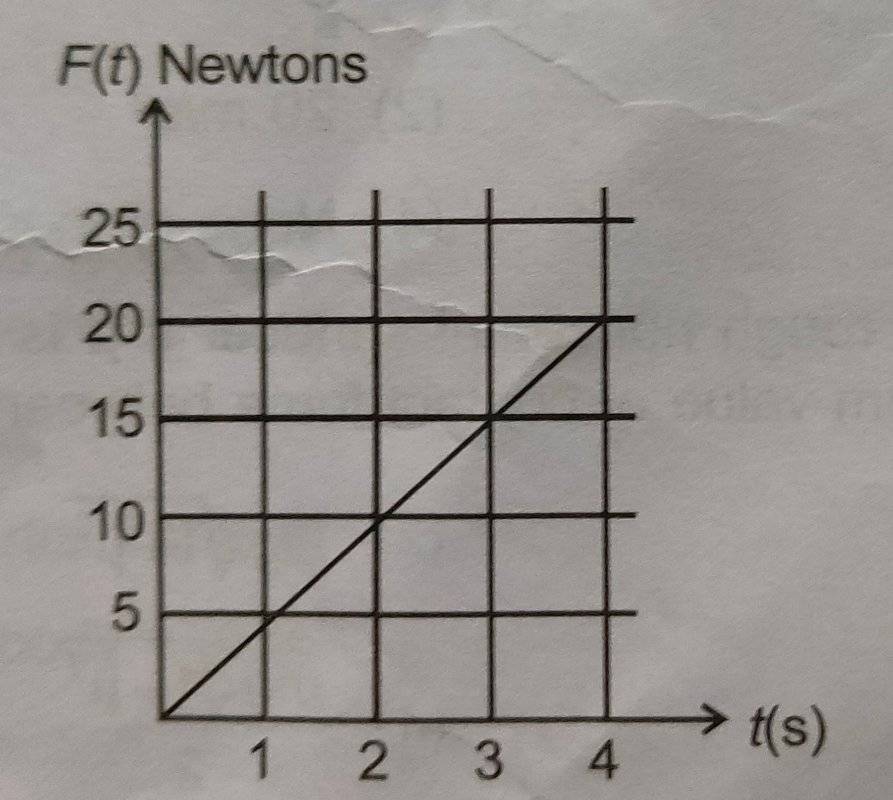
245621


My Attempt...
Fsmax=10N & Fk= 5N
I made equatiom F=5t-5 ( by seeing Force force and Counteracting kinetic friction)
reduced the formula to a=(5t-t)/2 wrote a=dv/dt and solved it but got wrong answer.
 
Physics news on Phys.org
Shivam said:
Problem Statement: An initially stationary wooden block with a mass of 2kg is pulled horizontally along a time dependent force f(t)i. The coefficient of static and kinetic friction between the block and the table are 0.5 and 0.25 respectively. F(t) as a function of time is shown, then find

(i) if initial velocity of the block is zero, its velocity at 4 seconds will be ?
Relevant Equations: F=ma, f=(mu)N

Here's the given F-t graph
View attachment 245621

My Attempt...
Fsmax=10N & Fk= 5N
I made equatiom F=5t-5 ( by seeing Force force and Counteracting kinetic friction)
reduced the formula to a=(5t-t)/2 wrote a=dv/dt and solved it but got wrong answer.
And since you have not shown your work, we'd just be guessing where you went wrong. The statement "wrote a=dv/dt" is NOT showing your work, it's just describing your work.
 
Shivam said:
Problem Statement: An initially stationary wooden block with a mass of 2kg is pulled horizontally along a time dependent force f(t)i. The coefficient of static and kinetic friction between the block and the table are 0.5 and 0.25 respectively. F(t) as a function of time is shown, then find

(i) if initial velocity of the block is zero, its velocity at 4 seconds will be ?
Relevant Equations: F=ma, f=(mu)N

Here's the given F-t graph
View attachment 245621

My Attempt...
Fsmax=10N & Fk= 5N
I made equatiom F=5t-5 ( by seeing Force force and Counteracting kinetic friction)
reduced the formula to a=(5t-t)/2 wrote a=dv/dt and solved it but got wrong answer.
The graph shows the applied force. Is the acceleration actually the graph shown divided by the mass? Does the block start to slide immediately after t = 0?
 
kuruman said:
The graph shows the applied force. Is the acceleration actually the graph shown divided by the mass? Does the block start to slide immediately after t = 0?
I did everything... I thought about this question for 2 hours..
I know block starts to move at t=2 sec
Also at 2 sec kinetic friction(5N) starts to act and that's why I wrote -ve5 in force equation which is reduced by kinetic friction
 
So I take it you are not going to show your work.
 
phinds said:
So I take it you are not going to show your work.
Ok..sorry I'll show...just wait a minute.
 
245627
 
phinds said:
So I take it you are not going to show your work.
I got the answer right this time ... It was calculation mistake, for all this time I thought my method was wrong... Sorry for causing trouble.
Is their is any other method can you tell me, The one you solved with

Answer is 10m/s.
 
Last edited:
Shivam, you really need to learn to use the edit button. It's a bit ridiculous to make 3 or 4 posts in a row instead of just adding to the first one.
 
  • #10
phinds said:
Shivam, you really need to learn to use the edit button. It's a bit ridiculous to make 3 or 4 posts in a row instead of just adding to the first one.
Ok..just tried the edit method... Do u have any other method to solve the problem with ?
 
  • #11
Shivam said:
Ok..just tried the edit method... Do u have any other method to solve the problem with ?
This method is the one to use because you are given the variable force as a function of time. If you were given the variable force as a function of position, then using the work-energy theorem would be more direct.
 
  • Like
Likes   Reactions: Shivam

Similar threads

Replies
1
Views
3K
Replies
18
Views
3K
  • · Replies 10 ·
Replies
10
Views
2K
  • · Replies 9 ·
Replies
9
Views
4K
Replies
2
Views
2K
  • · Replies 4 ·
Replies
4
Views
3K
  • · Replies 7 ·
Replies
7
Views
2K
  • · Replies 11 ·
Replies
11
Views
2K
  • · Replies 4 ·
Replies
4
Views
2K
  • · Replies 7 ·
Replies
7
Views
2K