Finding Constants: Potential and Field Analysis

Click For Summary
SUMMARY

The discussion centers on the application of Gauss's Law in the context of electric fields and potentials between two regions defined by the coordinates a and 2a. The user seeks clarification on whether the potential at point a is V(a) or V(0), and whether the presence of two different electric fields at x=a indicates a surface charge. It is concluded that the potential can be defined as zero at x=0, and the differing fields at x=a suggest a surface charge exists, necessitating a correct application of Gauss's Law to resolve the apparent contradiction.

PREREQUISITES
  • Understanding of Gauss's Law in electrostatics
  • Familiarity with electric field and potential concepts
  • Knowledge of charge distributions and their effects on fields
  • Ability to use LaTeX for mathematical expressions
NEXT STEPS
  • Review the application of Gauss's Law for different charge distributions
  • Study the relationship between electric fields and potentials in electrostatics
  • Learn how to properly define reference points for electric potential
  • Practice solving problems involving surface charges and electric fields
USEFUL FOR

Students and professionals in physics, particularly those studying electromagnetism, as well as educators looking to clarify concepts related to electric fields and potentials.

ermia
Messages
13
Reaction score
0
Homework Statement
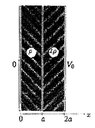
Two infinite conducting plane are a distance 2a away and parrarel. We have constant potentials on the planes. In ##0<x<a## we have charge with density ##\rho## and in ##a<x<2a## with density ##2\rho##. We want to findelectric feild and potential everywhere. And to find the charge density in boundaries.
Relevant Equations
$$\nabla .E=\frac{ \rho}{\epsilon }$$
$$ E=- \nabla V$$
$$Eup -Edown = \sigma / \epsilon$$
I have wrote all feilds and potentials and I want to find the constants.
My first question is " when we say in the a<x<2a the potential is V(x)" then the potential in the a is V(a) or V(0) ( cause it is 0 in our new area) ?
Second one is " when I want to write the gausses law for the point x=a I find two feilds. Does that mean I have another surface charge in x=a?"
 

Attachments
  • Osos.jpg
    Osos.jpg
    26.7 KB · Views: 133
  • Lplk Notes.jpg
    Lplk Notes.jpg
    42.5 KB · Views: 137
Physics news on Phys.org
Potentials are relative to some arbitrary zero. A common convention is to take it as zero at infinity, but that doesn’t work when you an infinite sheet of charge that isn't tending to zero at infinity. Take the potential as zero at x=0.
The potential at any other point can then be found by integrating the field from x=0 to the point. Note that it is necessarily continuous.

There is no surface charge at x=a in the problem.
 
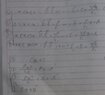
Once I wrote gausses law for the left and write part separately. I found two different feilds in x=a.
One is ##\frac{ \rho a} {\epsilon }## the other is ## \frac{2 \rho a}{ \epsilon }## thus we can conclude that we have a surface charge in x=a. Where am I wrong?
 
ermia said:
Once I wrote gausses law for the left and write part separately. I found two different feilds in x=a.
One is ##\frac{ \rho a} {\epsilon }## the other is ## \frac{2 \rho a}{ \epsilon }## thus we can conclude that we have a surface charge in x=a. Where am I wrong?
You can be wrong in many places. Most likely, you applied Gauss's law incorrectly. Please post your solution showing a clear picture (a) of the Gaussian surfaces that you used and (b) the equations that you wrote based on Gauss's law. Then we can perhaps figure out where you went wrong. We cannot reverse engineer your mistake from your answers.
 
ermia said:
Once I wrote gausses law for the left and write part separately. I found two different feilds in x=a.
Your attachment is illegible. If you want anyone to check your actual working you will need to type it in, per forum rules. Preferably in LaTeX.
The field at any point is due to all the charges present. Find the field due to the charges in (0,a), the field due to the charges in (a,2a), and add them together.
 
haruspex said:
Your attachment is illegible. If you want anyone to check your actual working you will need to type it in, per forum rules. Preferably in LaTeX.
The field at any point is due to all the charges present. Find the field due to the charges in (0,a), the field due to the charges in (a,2a), and add them together.
Thanks. Is my answer right?
$$ \sigma_{left }= 5 \rho a $$
$$ \sigma_{right} = 6 \rho a $$
 
The book claims the answer is that all the magnitudes are the same because "the gravitational force on the penguin is the same". I'm having trouble understanding this. I thought the buoyant force was equal to the weight of the fluid displaced. Weight depends on mass which depends on density. Therefore, due to the differing densities the buoyant force will be different in each case? Is this incorrect?

Similar threads

  • · Replies 2 ·
Replies
2
Views
1K
  • · Replies 12 ·
Replies
12
Views
1K
  • · Replies 22 ·
Replies
22
Views
4K
Replies
9
Views
737
  • · Replies 5 ·
Replies
5
Views
1K
  • · Replies 11 ·
Replies
11
Views
1K
Replies
3
Views
1K
  • · Replies 26 ·
Replies
26
Views
3K