Finding crossing regions between two quadractics

  • Context: Graduate 
  • Thread starter Thread starter rockerman
  • Start date Start date
Click For Summary
SUMMARY

This discussion focuses on finding the intersection lines between two quadratics represented by the equations $f(x) = x'Q_1x$ and $g(x) = x'Q_2x$, where $Q_1$ and $Q_2$ are negative definite matrices. The goal is to determine vectors $w_1$ and $w_2$ that are parallel to the intersection line of these quadratics in a two-dimensional space ($\mathbb{R}^2$). The method involves expressing the equation $x'(Q_1-Q_2)x=0$ in a quadratic form and solving for the ratio $\frac{x}{y}$.

PREREQUISITES
  • Understanding of quadratic forms and their properties
  • Familiarity with negative definite matrices
  • Knowledge of eigenvectors and eigenvalues
  • Basic skills in solving polynomial equations
NEXT STEPS
  • Study the properties of negative definite matrices in linear algebra
  • Learn about quadratic forms and their geometric interpretations
  • Explore eigenvalue problems and their applications in optimization
  • Investigate methods for solving polynomial equations in two variables
USEFUL FOR

Mathematicians, engineers, and data scientists working with optimization problems, particularly those involving quadratic forms and matrix analysis.

rockerman
Messages
13
Reaction score
0
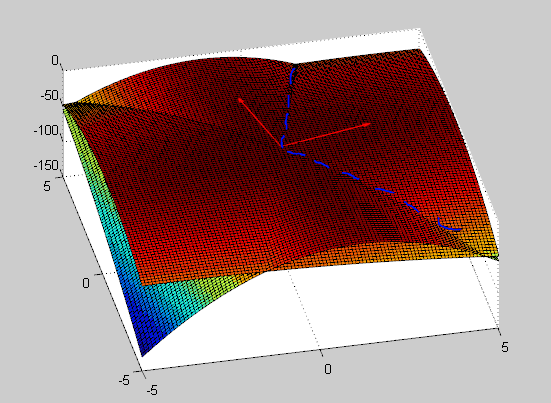
Given two quadratics of the form $f(x) = x'Q_1x$ and $g(x) = x'Q_2x$ and assuming $Q_1$ and $Q_2$ are negative definite matrices, how can I find the lines that are formed by their crossing? here I'm assuming $x \in \mathbb{R}^2$.
4EIjohE.png

up5lbdC.png


I'm interested in finding vectors $w_1$ and $w_2$ that are parallel to the blue dashed line. I also outlined the eigenvectors of $Q_1-Q-2$, they seem to point exact in the middle of each region.
 
Physics news on Phys.org
Write x as (x y)' and label the eight (known) entries of the two matrices, then write out ## x'(Q_1-Q_2)x=0## as an expansion that will be of the form ##\alpha x^2+\beta xy+\gamma y^2##. Then solve for ##\frac{x}{y}##.
 

Similar threads

  • · Replies 30 ·
2
Replies
30
Views
3K
  • · Replies 20 ·
Replies
20
Views
19K
  • · Replies 0 ·
Replies
0
Views
2K
  • · Replies 19 ·
Replies
19
Views
3K
  • · Replies 2 ·
Replies
2
Views
2K
  • · Replies 3 ·
Replies
3
Views
2K
  • · Replies 17 ·
Replies
17
Views
4K
Replies
0
Views
1K
  • · Replies 3 ·
Replies
3
Views
9K
  • · Replies 12 ·
Replies
12
Views
2K