Finding Focus Points of Parabolas in Conic Sections

Click For Summary

Homework Help Overview

The discussion revolves around finding the focus points of parabolas within the context of conic sections, specifically using the general equation of a conic. Participants express confusion regarding how to manipulate the equation to derive numerical values for x and y.

Discussion Character

  • Exploratory, Assumption checking, Mathematical reasoning

Approaches and Questions Raised

  • Participants discuss various methods to express the conic equation in terms of x and y. Some suggest using trigonometric identities to relate the variables, while others question the correctness of algebraic manipulations. There is also a focus on transforming the equation into a recognizable form for parabolas.

Discussion Status

The conversation includes attempts to clarify the algebra involved in manipulating the equation. Some participants provide guidance on correcting errors in the steps taken, while others explore the implications of the derived forms. There is a recognition of the need to arrive at a standard form for further analysis.

Contextual Notes

Participants note the importance of maintaining the integrity of the original equation and express uncertainty about how to proceed with the transformations. There is an acknowledgment of potential typos and the need for careful algebraic handling.

skybox
Messages
37
Reaction score
0
Hi all,

I am having an issue with the following problem. I just don't know how to approach it.

Homework Statement


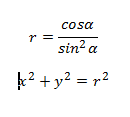
kxL7ZEC.png

Homework Equations


Ax^2 + Bxy + Cy2 + Dx + Ey + F = 0

The Attempt at a Solution


CM3YpiC.png

WF5z5Ay.png


I am confused on how to put this problem in terms of x & y and get numerical values for both x & y. Any guidance would be greatly appreciated :)
 
Physics news on Phys.org
skybox said:
Hi all,

I am having an issue with the following problem. I just don't know how to approach it.

Homework Statement


kxL7ZEC.png


Homework Equations


Ax^2 + Bxy + Cy2 + Dx + Ey + F = 0

The Attempt at a Solution


CM3YpiC.png

WF5z5Ay.png


I am confused on how to put this problem in terms of x & y and get numerical values for both x & y. Any guidance would be greatly appreciated :)

Try putting ##\sin\alpha = y/r## and ##\cos\alpha = x/r## in your equation.
 
LCKurtz said:
Try putting ##\sin\alpha = y/r## and ##\cos\alpha = x/r## in your equation.
Great thank you. That was a big help and is starting to make sense now. Since it is a right triangle, your equations can be used.
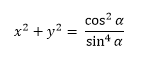
x^{2}+y^{2} = \frac{(\frac{x}{r})}{(\frac{y}{r})^{2}}

\therefore x^{2}+y^{2} = \frac{(\frac{x}{r})}{(\frac{y}{r})^{2}}

\therefore x^{2}+y^{2} = (\frac{x}{r}) * \frac{y^{2}}{r^{2}}

\therefore x^{2}+y^{2} = (\frac{x}{r}) * \frac{r^{2}}{y^{2}}

\therefore x^{2}+y^{2} = ({x}) * \frac{r}{y^{2}}

I am still a little confused on how to get numerical values for x & y. This looks like it can be solved via the unit-circle if I set the right hand side of the equation to 1. Does this look right?

Thanks~
 
skybox said:
Great thank you. That was a big help and is starting to make sense now. Since it is a right triangle, your equations can be used.
x^{2}+y^{2} = \frac{(\frac{x}{r})}{(\frac{y}{r})^{2}}

\therefore x^{2}+y^{2} = \frac{(\frac{x}{r})}{(\frac{y}{r})^{2}}

\therefore x^{2}+y^{2} = (\frac{x}{r}) * \frac{y^{2}}{r^{2}}

That third step is wrong. To divide fractions you "invert and multiply". Also put in ##r^2## on the left side after you fix the right side.
 
Also, I missed that you had put ##x^2+y^2## on the left. That is ##r^2##. Your original equation just has ##r## and you should leave it there.
 
  • Like
Likes   Reactions: 1 person
LCKurtz said:
That third step is wrong. To divide fractions you "invert and multiply". Also put in ##r^2## on the left side after you fix the right side.

Yes that was a typo. I actually do the correct method in step 4.
 
LCKurtz said:
Also, I missed that you had put ##x^2+y^2## on the left. That is ##r^2##. Your original equation just has ##r## and you should leave it there.

I am getting the following:
r = \frac{x}{r} * \frac{r^{2}}{x^{2}}
cos \alpha = \frac{x}{r}/<br /> sin \alpha = \frac{y}{r}<br /> r = \frac{\frac{x}{r}}{\frac{x^{2}}{r^{2}}}<br /> r = \frac{x}{r} * \frac{r^{2}}{x^{2}}<br /> r = \frac{x}{r} * \frac{r^{2}}{x^{2}}<br /> r = \frac{xr}{y^{2}}<br /> r = \frac{xr}{y^{2}}<br /> 1 = \frac{x}{y^{2}}<br /> <br /> Stuck again...now a little confused. Do I need to put this in the form x^{2} + y^{2} = r^{2}
 
skybox said:
I am getting the following:

1 = \frac{x}{y^{2}}

Stuck again...now a little confused. Do I need to put this in the form x^{2} + y^{2} = r^{2}

You want an x-y equation. What's wrong with ##x=y^2##? Now use what you know about xy conics to locate its focus.
 
Great. I think I got it. Since this equation is in the form of:
x=y^{2}
it is a parabola with the general equation of x = a(y-k)^{2} + h. a = 1 and k = 0 in this case. The focus point for a parabola in this form is at (h+p, k) And p = \frac{1}{4a}. Therefore, since a = 1, p=\frac{1}{4}.

The focus point is therefore (\frac{1}{4}, 0)

Thanks LCKurtz!
 

Similar threads

  • · Replies 2 ·
Replies
2
Views
2K
  • · Replies 1 ·
Replies
1
Views
3K
  • · Replies 3 ·
Replies
3
Views
3K
Replies
1
Views
4K
  • · Replies 5 ·
Replies
5
Views
2K
  • · Replies 11 ·
Replies
11
Views
8K
  • · Replies 4 ·
Replies
4
Views
2K
  • · Replies 4 ·
Replies
4
Views
2K
  • · Replies 4 ·
Replies
4
Views
2K
Replies
1
Views
3K