Finding gauge pressure for gas inside light bulb as it heats up

Click For Summary
SUMMARY

The gauge pressure of gas inside a light bulb as it heats up is calculated to be 0.137 atm. The formula used is Pgauge = (nR/V)(Tf - Ti), where Pgauge is derived from the difference between final and initial pressures. The discussion highlights the importance of knowing the initial conditions, specifically that the gas is at atmospheric pressure at 20.0°C. The volume of the gas remains constant during the heating process, allowing for the simplification of the equation.

PREREQUISITES
  • Understanding of the Ideal Gas Law
  • Knowledge of gauge pressure and atmospheric pressure
  • Familiarity with temperature conversions in Celsius
  • Basic algebra for manipulating equations
NEXT STEPS
  • Study the Ideal Gas Law and its applications in thermodynamics
  • Learn about gauge pressure versus absolute pressure
  • Explore the relationship between temperature and pressure in gases
  • Investigate the effects of volume changes on gas behavior
USEFUL FOR

This discussion is beneficial for physics students, engineers, and anyone interested in thermodynamics and gas laws, particularly in applications involving heating gases in confined spaces.

member 731016
Homework Statement
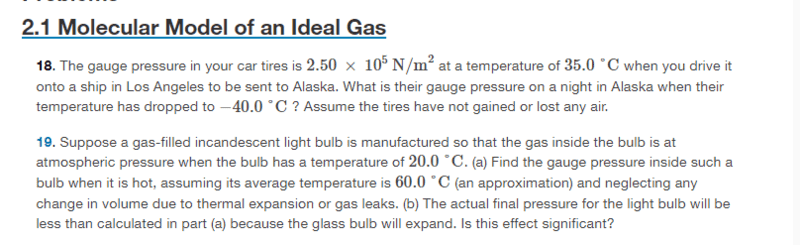
Suppose a gas-filled incandescent light bulb is manufactured so that the gas inside the bulb is at atmospheric pressure when the bulb has a temperature of 20.0°C. (a) Find the gauge pressure inside such a bulb when it is hot, assuming its average temperature is 60.0°C (an approximation) and neglecting any change in volume due to thermal expansion or gas leaks. (b) The actual final pressure for the light bulb will be less than calculated in part (a) because the glass bulb will expand. Is this effect significant?
Relevant Equations
PV = nRT
For this 19(a),
1686978078051.png

The answer is 0.137 atm.

My working is
##P_{gauge} = P_f - P_i##
##P_{gauge} = \frac{nRT_f}{V_f} - \frac{nRT_i}{V_i}##
##P_{gauge} = \frac{nRT_f}{V} - \frac{nRT_i}{V}## since volume does not change
##P_{gauge} = \frac{nR}{V}(T_f - T_i)##

However, I am not sure how to go from here since we do not know the constant volume. Does someone please know how to tackle this?

Many thanks!
 
Physics news on Phys.org
There is a piece of information you have not used. Can you spot it?
 
  • Like
Likes   Reactions: member 731016
haruspex said:
There is a piece of information you have not used. Can you spot it?
Thank you for your reply @haruspex!

No sorry, I cannot spot it.

Many thanks!
 
"the gas inside the bulb is at atmospheric pressure when the bulb has a temperature of 20.0°C"
 
  • Like
Likes   Reactions: member 731016
haruspex said:
"the gas inside the bulb is at atmospheric pressure when the bulb has a temperature of 20.0°C"
Ah, thank you for your reply @haruspex!

I see how the volume of the gas can be found now :)
 
$$\frac{P_f}{P_i}=\frac{T_f}{T_i}$$
 
  • Like
Likes   Reactions: member 731016
Chestermiller said:
$$\frac{P_f}{P_i}=\frac{T_f}{T_i}$$
Thank you for your reply @Chestermiller !
 

Similar threads

Replies
4
Views
2K
  • · Replies 3 ·
Replies
3
Views
2K
Replies
4
Views
2K
  • · Replies 1 ·
Replies
1
Views
2K
Replies
1
Views
5K
  • · Replies 1 ·
Replies
1
Views
2K
  • · Replies 1 ·
Replies
1
Views
2K
  • · Replies 5 ·
Replies
5
Views
3K
  • · Replies 9 ·
Replies
9
Views
2K
  • · Replies 12 ·
Replies
12
Views
2K