Finding periodic potentials from Bloch wave functions

Join the discussion
Registration is free. Ask a follow-up in this thread, or start your own.
10 replies · 2K views
Science Advisor
Insights Author
Messages
1,612
Reaction score
611
TL;DR
Finding a 1d quantum system with potential energy V(x) producing a closed form wave function.
I was thinking about a problem I had considered a long time ago in some thread, finding an example of a wave function ##\displaystyle \psi (x) =e^{iax}\phi (x)## with ##\displaystyle\phi (x)## being periodic with period ##\displaystyle L## and the corresponding Schrödinger equation

##\displaystyle -\frac{\hbar^2}{2m}\frac{d^2 \psi (x)}{dx^2} + V(x)\psi (x) = E\psi (x)##,

such that the

##\displaystyle V(x) = E+\frac{\hbar^2}{2m}\frac{\psi'' (x)}{\psi (x)}##

is a periodic potential with period ##L##, not singular anywhere and has a closed form expression.

Now, I was able to guess a wave function ##\displaystyle \psi (x) = \sin (x) - \frac{1}{4}\sin (2x) + \frac{1}{16}\sin (3x)##, for which the potential is

##\displaystyle V(x) = -\frac{\hbar^2}{2m}\frac{\sin(x) - \sin (2x) + \frac{9}{16}\sin (3x)}{\sin (x) - \frac{1}{4}\sin (2x) + \frac{1}{16}\sin (3x)}##

(when the energy eigenvalue is arbitrarily set to ##E=0##)

and for which the graphs of ##\displaystyle\psi (x)## (red line) and ##\displaystyle V(x)## (blue line) are like in the image (where it is set that ##\hbar^2 /2m = 1##)
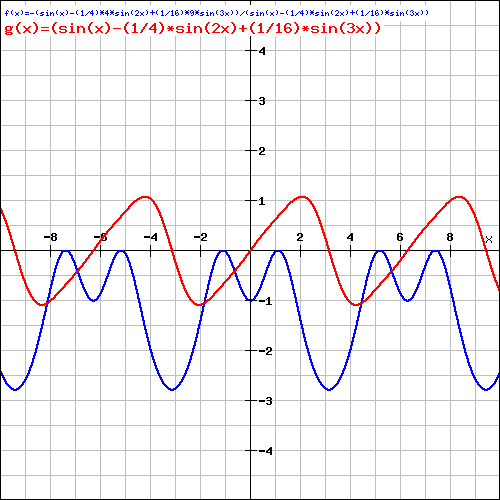
graph.png


The plane wave part of the Bloch wave function, ##\displaystyle e^{iax}##, is just a constant ##1## in this case, which means that ##a=0##.

Had I chosen ##\displaystyle \psi (x) = \sin (x) + \sin (2x) + \sin (3x)##, the potential ##V(x)## would have singular points and not look like a physically possible one.

So, anyone have clues on how it could be seen from the coefficients ##C_k## of ##\displaystyle\psi (x) = \sum\limits_{k=1}^{\infty}C_k \sin (k x)## whether the potential energy producing that eigenstate is also a 'nice' function?
 
Physics news on Phys.org
The only thing that really jumps to mind is trying to figure out a relation between ##\psi## and ##\psi''## such that their zeroes are coincident. The singularities must come from ##\psi## passing through zero. Also, for the taylor series around a zero of ##\psi''## the lowest order term can't have a power of ##x## less than that of the ##\psi##. Maybe you can play around with the series and some of these facts to get a relation on the ##C_k##?
 
Yes, the position of zeroes also came to my mind. If the series contains terms like ##\cos kx## instead of ##\sin kx##, it's more difficult to make them coincide because a zero of ##\cos (x)## is not necessarily a zero of ##\cos (kx)## with ##k\in\mathbb{N}##.

I couldn't find a nonzero value of ##a\in\mathbb{R}## such that the potential energy corresponding to the function ##\psi (x) = e^{iax}\left(\sin (x) - \frac{1}{4}\sin (2x) + \frac{1}{16}\sin (3x)\right)## would be a real valued function, so this probably only happens at individual values of ##a##. The idea of the Bloch theorem is that a periodic ##V(x)## should produce a wave function that is periodic except possibly for the phase, as it is in the case of that ##\psi (x)## with period ##L=\pi##. Maybe I should plot functions ##\psi'' /\psi## for many different values of ##a## and then see where the imaginary part stays small.
 
I'm not addressing your post, but it jumped at me that
hilbert2 said:
##\displaystyle V(x) = -\frac{\hbar^2}{2m}\frac{\sin(x) - \sin (2x) + \frac{9}{16}\sin (3x)}{\sin (x) - \frac{1}{4}\sin (2x) + \frac{1}{16}\sin (3x)}##
has the wrong dimensions.
 
Yeah, the multipliers of ##x## in the ##\sin (kx)## terms should have dimensions of reciprocal length, but the system will be made dimensionless anyway by setting ##\hbar^2 /2m = 1## and this calculation is just to see what form of the function ##\psi## produces an acceptable function ##V##.
 
hilbert2 said:
Yeah, the multipliers of ##x## in the ##\sin (kx)## terms should have dimensions of reciprocal length, but the system will be made dimensionless anyway by setting ##\hbar^2 /2m = 1## and this calculation is just to see what form of the function ##\psi## produces an acceptable function ##V##.
But it should work with dimensions. You can have a normalization constant with dimensions of ##L^{-1/2}## to take care of the dimensions of ##\psi##, but ##\psi''## will not have the right dimensions. It makes me think that the ##\psi## you used is not a proper wave function.
 
If the ##\psi## has terms like ##\sin (kx)## and the ##k## is of dimensions ##1/L##, then the 2nd derivative gets multipliers like ##1/L^2## in front of the terms. I'd usually handle something like this by choosing atomic units by setting ##\hbar = m = 1## and then taking for granted that the ##V(x)## is in units of hartree and ##x## in units of bohr. A more complicated way would be to form a dimensionless length variable ##s## of form ##s = \hbar^\alpha m^\beta e^\gamma \epsilon_{0}^{\delta} x## with ##\alpha ,\beta ,\gamma ,\delta## some rational numbers and a similar dimensionless energy variable. The ##e## and ##\epsilon_{0}## there are the elementary charge and vacuum permittivity. Then the ##\psi (x)## could be written in terms of ##s##.
 
Haborix said:
The only thing that really jumps to mind is trying to figure out a relation between ##\psi## and ##\psi''## such that their zeroes are coincident.
This must be it. We all know that we can't divide by zero.

Looking at your graph of ##V(x)##, your choice of prefactors gives you -1 at ##x=0##. But inputting 0 into ##V(x)## gives you ##-0/0##. I applied l'hospital's rule to $$V(x)=-\frac{C_1\sin{x}+4C_2\sin{2x}+9C_3\sin{3x}}{C_1\sin{x}+C_2\sin{2x}+C_3\sin{3x}}$$as ##x\rightarrow 0## and set it equal to -1. ##C_1## subtracts out and leaves ##C_2=-4C_3##. That is consistent with your prefactors. Looking at your graph for the next value and repeating that same method with $$\lim_{x \rightarrow \pi} V(x) = -11/4$$ gives me a value for ##C_1## when I choose ##C_3=\frac{1}{16}##. However, it does not reproduce your graph and, in fact, gives me poles when plotted.

It's late here. You should probably try the calculation yourself to see if I made a mistake.
 
Dr_Nate said:
Looking at your graph for the next value and repeating that same method with $$\lim_{x \rightarrow \pi} V(x) = -11/4$$ gives me a value for ##C_1## when I choose ##C_3=\frac{1}{16}##. However, it does not reproduce your graph and, in fact, gives me poles when plotted.

If I calculate the ##\lim\limits_{x\rightarrow \pi}V(x)## with L'Hopital, it gets the value

##\displaystyle\lim\limits_{x\rightarrow \pi}\left(-\frac{\sin x - \sin 2x + \frac{9}{16}\sin 3x}{\sin x - \frac{1}{4}\sin 2x + \frac{1}{16}\sin 3x}\right)\\\displaystyle =\lim\limits_{x\rightarrow \pi}\left(-\frac{\cos x - 2\cos 2x + \frac{27}{16}\cos 3x}{\cos x - \frac{1}{2}\cos 2x + \frac{3}{16}\cos 3x}\right)\\\displaystyle =-\frac{\cos \pi .-2\cos 2\pi + \frac{27}{16}\cos 3\pi}{\cos \pi - \frac{1}{2}\cos 2\pi + \frac{3}{16}\cos 3\pi}\\\displaystyle =-\frac{1+2+\frac{27}{16}}{1+\frac{1}{2}+\frac{3}{16}}\\\displaystyle =-\frac{25}{9} \approx -2.78##.

This is clearly the same value as in the graph.
 
I now get ##C_1 = 16 C_3, C_2=-4C_3## given your values at ##x=0## and ##\pi##. This seems like a method that works.
 
Another wavefunction I thought of is an approximation of the cosine function made from alternating downward and upward opening parabolas:

##\displaystyle\psi (x) = \sum\limits_{n\in 2\mathbb{Z}}(-1)^{n/2}(1-(x-n)^2 )\theta (1-|x-n|)##

where ##\theta (x)## is the Heaviside theta function and the graph of which is like

parabola-psi.jpg


Then, because for ##\displaystyle\psi (x) = 1-(x-n)^2##

##\displaystyle\frac{\psi '' (x)}{\psi (x)} \propto \frac{1}{1-(x-n)^2}##

the potential energy ##V(x)## is like a 1D "lattice" of inverse square potential energies

parabola-V.jpg


at least if the "lattice spacing" is made large enough for the ##V(x)## to be very close to zero at the midpoint between two singularities.

Didn't immediately find any applications of this lattice model with a Google search, but that piecewise defined parabola function was a quite curious object.