Finding Tension in Rotating Rod: What is the Function of T(x)?

Click For Summary

Homework Help Overview

The discussion revolves around finding the tension in a rotating rod as a function of distance from the axis of rotation. The problem involves a thin uniform rod with specified length and density, rotating about an axis, and seeks to establish a relationship for tension based on the position along the rod.

Discussion Character

  • Exploratory, Assumption checking, Mathematical reasoning

Approaches and Questions Raised

  • Participants discuss the equilibrium condition of the rod and the derivation of tension as a function of distance. There are questions regarding the integration limits and the interpretation of terms such as density and cross-sectional area. Some participants express confusion about the sign conventions used in the equations.

Discussion Status

The discussion is ongoing, with participants providing insights into potential errors in the original poster's approach, particularly concerning the integration process and the representation of changes in tension. There is a focus on clarifying assumptions and definitions related to the problem.

Contextual Notes

Participants note the importance of correctly interpreting the terms used in the problem, such as density and cross-sectional area, and how these relate to the physical setup of the rod. There is also mention of the need for clarity on the limits of integration in the context of the problem.

manasi bandhaokar
Messages
37
Reaction score
1
a thin uniform rod of length l and density d is rotating with angular velocityω about an axis passing through one of its ends and perpendicular to it.find the tension int the rod as a function of x.(x= dist from axis of rotation).area of cross section = a

attempt at solution:

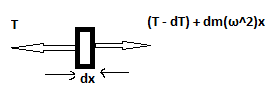
consider a small of length dx at dist x from axis.
upload_2016-4-24_21-45-30.png

for equilibrium of rod T = T-dT + dmω^2 x
dT = dm ω^2 x
integrating
T(x) =(d * a* ω^2 (x^2 - l^2))/2
this is negative of answer.where am i wrong?
 
Physics news on Phys.org
I guess that a and d are the cross-sectional area and the density of the rod, respectively.

Your second equation, the one for dT, seems ok to me. I do not understand how can you obtain your last result from it. What are the limits of your integral?
Seems to me you're missing a sign in the integration, or, equivalently, you are swapping the integration limits.
 
Further to @FranzDiCoccio 's comments, since it is a thin rod I would interpret "density" as meaning mass per unit length. You do not need a variable for the cross sectional area.
 
manasi bandhaokar said:
for equilibrium of rod T = T-dT + dmω^2 x
dT = dm ω^2 x
integrating
T(x) =(d * a* ω^2 (x^2 - l^2))/2
this is negative of answer.where am i wrong?
I think the problem is associated with the minus sign in writing T - dT for the tension at the outer end of dx. The change in the function T(x) as you go from x to x + dx should be written as dT not - dT. The change in the function will be a negative quantity. So, the value of T at x+dx is T + dT where dT is a negative quantity.

By writing the tension at x + dx as T - dT, your symbol dT does not represent the change in the function T(x), it's the negative of the change in T(x).
 
Last edited:
TSny said:
I think the problem is associated with the minus sign in writing T - dT for the tension at the outer end of dx. The change in the function T(x) as you go from x to x + dx should be written as dT not - dT. The change in the function will be a negative quantity. So, the value of T at x+dx is T + dT where dT is a negative quantity.

By writing the tension at x + dx as T - dT, your symbol dT does not represent the change in the function T(x), it's the negative of the change in T(x).
oh!
thanks!
 

Similar threads

  • · Replies 9 ·
Replies
9
Views
3K
  • · Replies 13 ·
Replies
13
Views
3K
  • · Replies 9 ·
Replies
9
Views
2K
Replies
23
Views
2K
  • · Replies 3 ·
Replies
3
Views
3K
Replies
4
Views
2K
Replies
10
Views
3K
  • · Replies 13 ·
Replies
13
Views
2K
  • · Replies 24 ·
Replies
24
Views
4K
  • · Replies 13 ·
Replies
13
Views
4K