Finding the net elongation in a rod due to its own weight

Click For Summary

Homework Help Overview

The discussion revolves around determining the net elongation in a rod due to its own weight, focusing on the effects of tension and stress along the length of the rod. The subject area includes concepts from mechanics and material science, particularly related to elasticity and the behavior of materials under load.

Discussion Character

  • Exploratory, Conceptual clarification, Assumption checking

Approaches and Questions Raised

  • Participants explore the relationship between tension and elongation in the rod, questioning the uniformity of tension and the role of forces acting on differential segments. There are discussions about the definitions of variables and the implications of using unstretched versus stretched coordinates.

Discussion Status

The discussion is active, with participants raising questions about their assumptions and the notation used in the problem. Some guidance has been offered regarding the definitions of variables and the relationships between stress, strain, and elongation. Multiple interpretations of the problem are being explored, particularly concerning the treatment of the rod's segments.

Contextual Notes

There is an ongoing examination of the assumptions regarding the rod's mass density and the implications of gravitational effects on the elongation. Participants are also considering how the definitions of variables impact their understanding of the problem.

Hamiltonian
Messages
296
Reaction score
193
Homework Statement
A rod of uniform cross-sectional area A and length L has a weight W. It is suspended vertically from a fixed support. If the material of the rod is homogeneous and its modulus of elasticity is Y. then determine the total elongation produced in the rod due to its own weight.
Relevant Equations
##Y = \frac{F/A}{\Delta L/L}##
I realized that the tension in the rod is not uniform and found it to be ##T = Wx/L## I found this by splitting the rod into two sections one of length ##x## and the other of length ##L-X## where x is the length from the base of the hanging rod
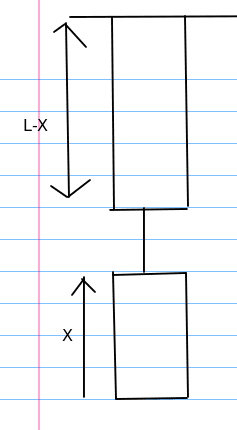
1608822716429.png


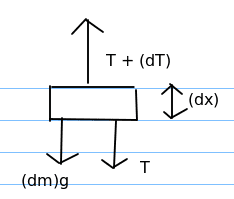
To find the total elongation in the rod I thought we could add up the elongations in tiny segments of the rod of mass ##(dm)## and length ##(dx)## but I am unable to find the extension in the tiny mass
1608823039221.png


The solution states that the stress at the position of this element is produced by the weight of the length ##x## lying bellow it and therefore stress at this section should be ##= Wx/AL## I am unable to see why the tension acting in the upward direction won't play a role in the extension and since this mass is in equilibrium how exactly do we find which force is producing the elongation ##\Delta (dx)##:oldconfused:
 
  • Like
Likes   Reactions: Delta2
Physics news on Phys.org
Maximum tension and local elongation occur at the point where ##x=L##.
Both values gradually get smaller downwards until reaching the value of zero at the lowest end of the rod.

Any differential portion must have a balance of up and down forces.
If up force is ##T_{up}##, down force is ##T_{down}+dmg##; therefore, ##T_{up}>T_{down}##.
 
Lnewqban said:
Maximum tension and local elongation occur at the point where ##x=L##.
so was my assumption that every ##(dm)## of length ##(dx)## gets elongated by a ##\Delta (dx)## wrong?

Lnewqban said:
Any differential portion must have a balance of up and down forces.
If up force is ##T_{up}##, down force is ##T_{down}+dmg##; therefore, ##T_{up}>T_{down}##.
I think I have stated the exact same in my original post..
 
Hamiltonian299792458 said:
so was my assumption that every ##(dm)## of length ##(dx)## gets elongated by a ##\Delta (dx)## wrong?I think I have stated the exact same in my original post..
You did it right. $$\frac{dT}{dx}=\frac{mg}{L}$$so$$T=mg\frac{x}{L}=EA\frac{du}{dx}$$where u is the displacement.
 
Last edited:
  • Like
Likes   Reactions: Delta2
The tricky part with questions like this is to be clear what is meant by x. Is it the position of the element dx when the rod is stretched or unstretched? If stretched then the mass density is not uniform.
 
  • Like
Likes   Reactions: Lnewqban and etotheipi
haruspex said:
The tricky part with questions like this is to be clear what is meant by x. Is it the position of the element dx when the rod is stretched or unstretched? If stretched then the mass density is not uniform.
X is usually the material coordinate, meaning the original undeformed location of each cross section (measured from the bottom in this problem) in absence of gravitational load. x + u(x) is the corresponding location of the cross section x in the deformed configuration of the rod.
 
Hamiltonian299792458 said:
I am unable to see why the tension acting in the upward direction won't play a role
Tension always acts in both directions. It is not so much a force as a pair of equal and opposite forces at each point.
The difference between tension at the lower side of the element and that at the upper side is a second order small quantity for the purpose of finding the strain on the element.

I'm not quite sure how you are using your Δ notation. That's usually a difference, but you seem to be using it as a factor (like, 1+fractional difference).
I recommend using @Chestermiller's notation: x, dx refer to the position and thickness of an element in the unstretched state, while u, du refer to the same element in its stretched state. You then need equations relating: dx, du and T; dx and dT.
 
  • Informative
Likes   Reactions: Hamiltonian
If x and ##x+\Delta x## are the material coordinates of two neighboring cross sections along the rod (distances measured up from the bottom of the rod prior to hanging the rod), the distances measured up from the bottom of these same two neighboring material cross sections after the rod is hanging under its own weight are ##x+u(x)## and ##x+\Delta x+u(x+\Delta x)##, where u is the displacement function (of x) for the cross sections. So the undeformed distance between the two cross sections is ##\Delta x##, and the distance between the same two cross sections after the rod extends under its own weight is ##[x+\Delta x+u(x+\Delta x)]-[x+u(x)]=\Delta x+u(x+\Delta x)-u(x) ##. So the strain in the portion of the rod between the two cross sections is $$\epsilon=\frac{[\Delta x+u(x+\Delta x)]-\Delta x}{\Delta x}=\frac{u(x+\Delta x)-u(x)}{\Delta x}$$In the limit as ##\Delta x## approaches zero, this becomes $$\epsilon(x)=\frac{du}{dx}$$And the stress in the rod at this location is $$\sigma=E\frac{du}{dx}$$where E is Young's modulus of the rod material.
 
  • Informative
Likes   Reactions: Hamiltonian
Hamiltonian299792458 said:
so was my assumption that every ##(dm)## of length ##(dx)## gets elongated by a ##\Delta (dx)## wrong?
...
I agree with your statement.
A practical case in which the stress due to the own weight must be considered is the steel rope used in elevators of very tall buildings.

Copied from
https://www.phoenixmodularelevator.com/elevator-ropes/

Compensating Ropes – Turns out that all of the cable or rope to make an elevator car go up and down is really heavy. This is especially true for really tall buildings. Think about this; a standard one inch elevator cable can weigh 1.85 pounds per foot. As elevator cable makes several trips up and down the hoistway, this weight can really add up. So compensating ropes “compensate” for all the weight of the hoisting ropes on the car or counterweight side. Probably any elevator that exceeds 100′ of travel needs these ropes that are connected to the sling that holds the car and the counterweight frame.”

symmetry-12-00129-g001.png
 
  • Skeptical
Likes   Reactions: Hamiltonian
  • #10
haruspex said:
Tension always acts in both directions. It is not so much a force as a pair of equal and opposite forces at each point.
The difference between tension at the lower side of the element and that at the upper side is a second order small quantity for the purpose of finding the strain on the element.

I'm not quite sure how you are using your Δ notation. That's usually a difference, but you seem to be using it as a factor (like, 1+fractional difference).
I recommend using @Chestermiller's notation: x, dx refer to the position and thickness of an element in the unstretched state, while u, du refer to the same element in its stretched state. You then need equations relating: dx, du and T; dx and dT.
The extension in a tiny mass ##(dm)## of length ##(dx)## is said to have an extension ##\Delta (dx)## I found this notation a bit odd at first but since it was used both by my teacher and my textbook I followed it as well.
Is ##u## supposed to be the position of the mass ##(dm)## in the stretched state and ##(du)## the extension in that element?
also in my notation, I was considering ##x## and ##dx## in the stretched state so I am not sure as to why I would need to care about the position of the element in the unstretched state?
 
  • #11
Hamiltonian299792458 said:
The extension in a tiny mass (dm) of length (dx) is said to have an extension Δ(dx) I found this notation a bit odd at first but since it was used both by my teacher and my textbook I followed it as well.
Ok, I'd not seen that notation before. So what equation can you write for Δ(dx) in terms of dx and T?
Hamiltonian299792458 said:
Is u supposed to be the position of the mass (dm) in the stretched state and (du) the extension in that element?
Yes.
Hamiltonian299792458 said:
I was considering x and dx in the stretched state so I am not sure as to why I would need to care about the position of the element in the unstretched state?
If dx is the stretched length of the element then Δ(dx) makes no sense.
If x is the stretched position, how are you going to write an expression for the weight below it in terms of x?
 
  • Like
Likes   Reactions: Hamiltonian
  • #12
haruspex said:
If dx is the stretched length of the element then Δ(dx) makes no sense.
If x is the stretched position, how are you going to write an expression for the weight below it in terms of x?
I think I got a bit confused your right ##\Delta dx## in the stretched state makes no sense ##x## and ##dx## are defined for the unstretched state.

haruspex said:
So what equation can you write for Δ(dx) in terms of dx and T?

$$Y = \frac{T dx}{A \Delta (dx)} $$

My original doubt was as to why only ##T## is producing longitudinal stress on dm and not the Tension acting in the upward direction shouldn't the equation be
$$Y = \frac{2T dx}{A \Delta (dx)} $$
as the tension acting in the upward direction is ##T + dT##
 
  • #13
Hamiltonian299792458 said:
My original doubt was as to why only T is producing longitudinal stress on dm and not the Tension acting in the upward direction
That's a basic misunderstanding about tension and compression. As I posted, you should not think of these as forces in the ordinary way but as pairs of opposing forces. If I tie a rope to a wall and pull on it with force T then the tension is T all the way along, not 2T. Each element of the rope is subject to a force T in each direction, and we call that the tension.
 
  • Informative
Likes   Reactions: Hamiltonian
  • #14
haruspex said:
That's a basic misunderstanding about tension and compression. As I posted, you should not think of these as forces in the ordinary way but as pairs of opposing forces. If I tie a rope to a wall and pull on it with force T then the tension is T all the way along, not 2T. Each element of the rope is subject to a force T in each direction, and we call that the tension.
ok, I think this makes sense thanks:)
 

Similar threads

  • · Replies 7 ·
Replies
7
Views
3K
  • · Replies 6 ·
Replies
6
Views
3K
Replies
2
Views
2K
Replies
10
Views
3K
  • · Replies 22 ·
Replies
22
Views
4K
  • · Replies 9 ·
Replies
9
Views
3K
Replies
4
Views
2K
  • · Replies 2 ·
Replies
2
Views
2K
Replies
1
Views
6K
Replies
1
Views
1K