Finding the acceleration of the ball in contact with the ground during bouncing

Click For Summary
SUMMARY

The discussion focuses on calculating the acceleration of a ball in contact with the ground during a bounce. The initial velocity before impact is 4.85 m/s, and the velocity immediately after impact is 3.96 m/s. Using the equation v = u + at, the calculated acceleration is -5.56 m/s², indicating that the acceleration is directed upwards. The confusion arises from the sign convention used for velocities before and after the bounce.

PREREQUISITES
  • Understanding of kinematic equations, specifically v = u + at and v² = u² + 2as
  • Knowledge of sign conventions in physics, particularly for motion direction
  • Familiarity with concepts of free fall and rebound dynamics
  • Basic grasp of acceleration due to gravity (g = 9.8 m/s²)
NEXT STEPS
  • Study the application of kinematic equations in different motion scenarios
  • Learn about sign conventions in physics and their implications on calculations
  • Explore the physics of elastic and inelastic collisions
  • Investigate the effects of different heights on rebound velocities
USEFUL FOR

Students studying physics, particularly those focusing on mechanics, as well as educators looking for examples of kinematic applications in real-world scenarios.

Lay1
Messages
44
Reaction score
7
Homework Statement
The ball is dropped from rest from an initial height of 1.2 m. Aft er hitting the ground the ball rebounds
to a height of 0.80 m. The ball is in contact with the ground between B and D for a time of 0.16 s.
Using the acceleration of free fall, calculate
the acceleration of the ball while it is in contact with the ground. State the direction of this acceleration.
Relevant Equations
v²=u²+2as
v= u+at
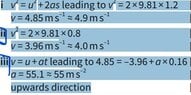
the v before hitting the ground immediately=4.85m/s
the v after hitting the ground immediately= 3.96m/s
I considered the down positive, then
v= u+at
3.96= 4.85+ (a*0.16)
so a= -5.56m/s*s
The answer is 55m/s*s
The parts that I don't get are why it must be -3.96 and why that velocity becomes initial v.
 

Attachments

  • Web capture_20-2-2022_20550_.jpeg
    Web capture_20-2-2022_20550_.jpeg
    19.9 KB · Views: 244
Physics news on Phys.org
Lay1 said:
Homework Statement:: The ball is dropped from rest from an initial height of 1.2 m. Aft er hitting the ground the ball rebounds
to a height of 0.80 m. The ball is in contact with the ground between B and D for a time of 0.16 s.
Using the acceleration of free fall, calculate
the acceleration of the ball while it is in contact with the ground. State the direction of this acceleration.
Relevant Equations:: v²=u²+2as
v= u+at

the v after hitting the ground immediately= 3.96m/s
I considered the down positive, then
v= u+at
3.96= 4.85+ (a*0.16)
If down is positive, what is the velocity of the ball after the bounce?
 
Orodruin said:
If down is positive, what is the velocity of the ball after the bounce?
It is negative for sure. So, why couldn't the velocity come out with minus sign in the first place? Thanks for the reply.
 
Lay1 said:
It is negative for sure. So, why couldn't the velocity come out with minus sign in the first place? Thanks for the reply.
I'm not sure what exactly is confusing you. You are told, I imagine, that the speed immediately before hitting the ground is ##4.85 \ m/s## and the speed immediately after leaving the ground is ##3.96 \ m/s##.

If down is positive, then it's up to you to make the initial velocity ##u = +4.85 \ m/s## and the final velocity ##v = -3.96 \ m/s##. You have to apply your physical understanding of the problem to do this. A god of mathematics isn't going to do that for you.
 
PeroK said:
A god of mathematics isn't going to do that for you.
To paraphrase: There is only one God and his name is Gauss.
 
  • Haha
Likes   Reactions: Delta2
PeroK said:
I'm not sure what exactly is confusing you. You are told, I imagine, that the speed immediately before hitting the ground is ##4.85 \ m/s## and the speed immediately after leaving the ground is ##3.96 \ m/s##.

If down is positive, then it's up to you to make the initial velocity ##u = +4.85 \ m/s## and the final velocity ##v = -3.96 \ m/s##. You have to apply your physical understanding of the problem to do this. A god of mathematics isn't going to do that for you.
I know that after referring to the key. But, I don't understand the part why it doesn't come out with the negative sign even though I applied the upward movement negative.
 
Lay1 said:
I know that after referring to the key. But, I don't understand the part why it doesn't come out with the negative sign even though I applied the upward movement negative.
What's your calculation for the change in velocity if ##u = 3.96 \ m/s## and ##v = -3.96 \ m/s##?
 
Last edited:
PeroK said:
What's your calculation for the chage in velocity if ##u = 3.96 \ m/s## and ##v = -3.96 \ m/s##?
The v immediately after hitting the ground is 3.96
The question is why 3.96 didnt come out with negative sign form the beginning.
The next part I don't get is why 3.96 is initial velocity in the answer key. I have no idea about that.
 
PeroK said:
What's your calculation for the chage in velocity if ##u = 3.96 \ m/s## and ##v = -3.96 \ m/s##?
-7.92
 
Last edited:
  • #10
Lay1 said:
The question is why 3.96 didnt come out with negative sign form the beginning.
The next part I don't get is why 3.96 is initial velocity in the answer key. I have no idea about that.
Can I add a few pointers...

There are 3 separate parts to the motion:
1) ball falls down;
2) ball hits ground, reverses direction, leaves ground;
3) ball travels upwards and reaches max. height.

The final velocity of each part is the initial velocity for the next part. So we need to take care that we are using the different ‘u’s and ‘v’s correctly.

For example ‘v’ (final velocity) for part 2 is ‘u’ (initial velocity) for part 3.

For part 3:

The ball leaves the ground with velocity u and rises to a height 0.80m (where v=0).

Using ‘down is positive’ note that g is positive but the displacement (s) is negative as it is upwards.
v² = u² + 2as
0² = u² + 2*9.8*(-0.8)
u = ±√(2*9.8*0.8)

The value of u can be positive(down) or negative (up). You must decide which - based on your sign convention and your understanding of what is happening.
 
  • Like
Likes   Reactions: Lnewqban
  • #11
Lay1 said:
-7.92
Exactly. That is negative. So the acceleration is negative.
 
  • #12
Lay1 said:
The question is why 3.96 didnt come out with negative sign form the beginning.
You haven't shown your workings that lead to the value of 3.96, but I can guess that you wrote ## v^2 = 0^2 + 2 g 0.8^2 ##. What do you think you should have written that would have led to -3.96, and why?

Lay1 said:
The next part I don't get is why 3.96 is initial velocity in the answer key. I have no idea about that.
The answer key is not well written: for the period when the ball is in contact with the ground the initial velocity is +4.85 m/s and the final velocity -3.96 ms so the equation in part (iii) should be ## -3.96 = 4.85 + 0.16g ## (note that part (ii) is also the wrong way round).
 
Last edited:
  • #13
Lay1 said:
The v immediately after hitting the ground is 3.96
The question is why 3.96 didnt come out with negative sign form the beginning.
The next part I don't get is why 3.96 is initial velocity in the answer key. I have no idea about that.
The answer key is wrong!
 
  • Like
Likes   Reactions: pbuk
  • #14
Steve4Physics said:
Can I add a few pointers...

There are 3 separate parts to the motion:
1) ball falls down;
2) ball hits ground, reverses direction, leaves ground;
3) ball travels upwards and reaches max. height.

The final velocity of each part is the initial velocity for the next part. So we need to take care that we are using the different ‘u’s and ‘v’s correctly.

For example ‘v’ (final velocity) for part 2 is ‘u’ (initial velocity) for part 3.

For part 3:

The ball leaves the ground with velocity u and rises to a height 0.80m (where v=0).

Using ‘down is positive’ note that g is positive but the displacement (s) is negative as it is upwards.
v² = u² + 2as
0² = u² + 2*9.8*(-0.8)
u = ±√(2*9.8*0.8)

The value of u can be positive(down) or negative (up). You must decide which - based on your sign convention and your understanding of what is happening.
Thank you very much. Now I understand.
 
  • #15
PeroK said:
Exactly. That is negative. So the acceleration is negative.
Thanks for the guide
 
  • #16
pbuk said:
You haven't shown your workings that lead to the value of 3.96, but I can guess that you wrote ## v^2 = 0^2 + 2 g 0.8^2 ##. What do you think you should have written that would have led to -3.96, and why?The answer key is not well written: for the period when the ball is in contact with the ground the initial velocity is +4.85 m/s and the final velocity -3.96 ms so the equation in part (iii) should be ## -3.96 = 4.85 + 0.16g ## (note that part (ii) is also the wrong way round).
Yeah, that's why I didnt get the last part. I did the 1st two part by myself because they are also the questions I needed to answer. Thanks for the guide.
 
  • Like
Likes   Reactions: pbuk
  • #17
PeroK said:
The answer key is wrong!
Totally!
 

Similar threads

Replies
4
Views
2K
  • · Replies 14 ·
Replies
14
Views
5K
  • · Replies 13 ·
Replies
13
Views
8K
Replies
5
Views
6K
Replies
3
Views
5K
  • · Replies 9 ·
Replies
9
Views
2K
  • · Replies 4 ·
Replies
4
Views
2K
  • · Replies 3 ·
Replies
3
Views
2K
Replies
40
Views
2K
  • · Replies 21 ·
Replies
21
Views
1K