Finding the center of instantanous rotation

  • Context: Engineering 
  • Thread starter Thread starter Amaelle
  • Start date Start date
  • Tags Tags
    Center Rotation
Click For Summary

Discussion Overview

The discussion revolves around finding the values of AC and BC in a geometric context related to instantaneous rotation. Participants explore geometric and trigonometric approaches, share drawings, and clarify coordinates while addressing a specific problem posed by the original poster (OP).

Discussion Character

  • Exploratory
  • Technical explanation
  • Mathematical reasoning
  • Homework-related

Main Points Raised

  • The OP expresses difficulty in determining the values of AC and BC, seeking assistance.
  • One participant suggests using geometric or trigonometric methods, indicating that the relevant equation may not be sufficient.
  • Another participant confirms the coordinates of points O, D, and B, emphasizing their alignment.
  • Participants discuss the application of the Pythagorean theorem in relation to specific triangles formed by points A, B, C, and D.
  • There is mention of the 3,4,5 and 5,12,13 triangles, with one participant seeking further clarification on these relationships.
  • Another participant notes the artificial nature of the exercise but expresses enjoyment in assisting others.

Areas of Agreement / Disagreement

Participants generally agree on the geometric nature of the problem and the relationships between certain points, but there is no consensus on the specific application of the Pythagorean theorem or the overall approach to solving for AC and BC.

Contextual Notes

Some participants reference specific triangles and relationships without fully resolving the mathematical steps or assumptions involved in applying the Pythagorean theorem.

Amaelle
Messages
309
Reaction score
54
Poster has been reminded to show their work on schoolwork problems
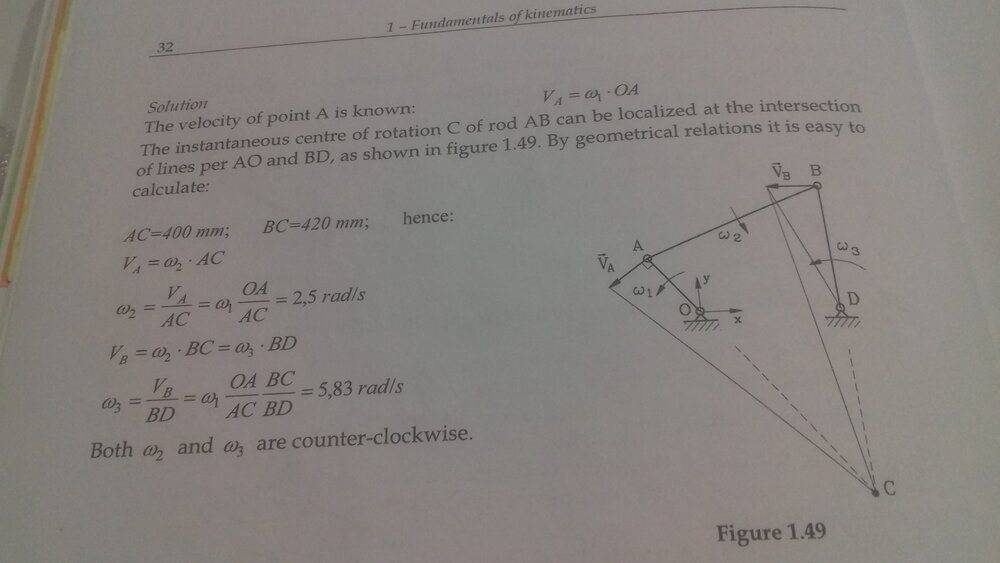
Homework Statement
Look at the image
Relevant Equations
v=w.r
[Mentor Note -- Improved versions of the two pictures are posted in a reply a few posts down]

Good day
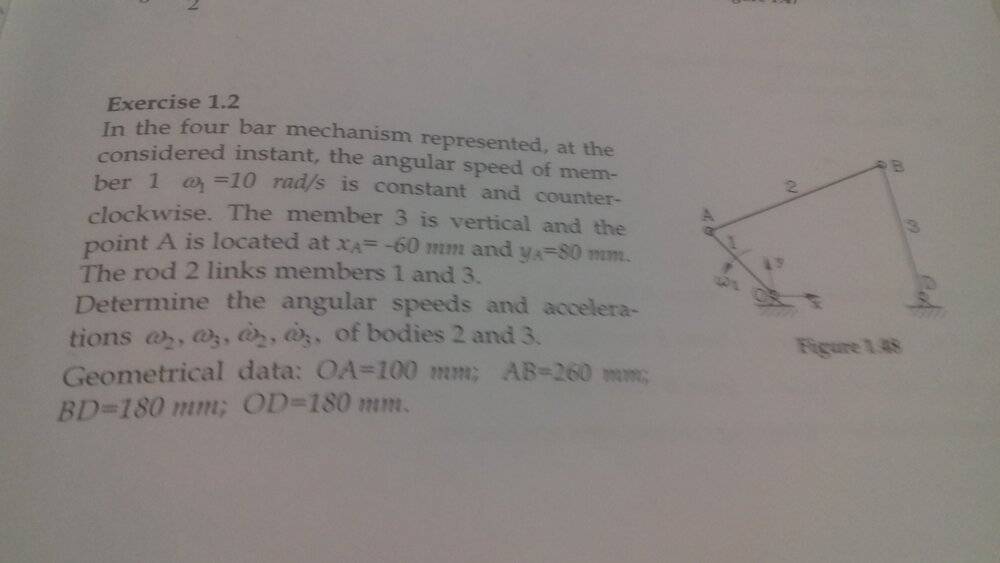
20210113_155316.jpg


and here is the solution
20210113_155346.jpg


I have a problem in finding the value of AC and BC, I couldn't figure it out?
many thanks in advance!
 
Last edited by a moderator:
  • Like
Likes   Reactions: Delta2
Physics news on Phys.org
Amaelle said:
I have a problem in finding the value of AC and BC, I couldn't figure it out?
I don't think your relevant equation is going to help you there. Don't you have anything else in your toolbox ? Something geometrical or trigonometrical, perhaps ? Keep searching !

[edit]ah, from the poor picture I can see they resort to geometry !
Free tip: photograph from above, or better: rendere your own drawing and post !
 
thanks a lot for your reply!
it's certainly something geometric but I couldn't figure it out
 
Here are improved versions of the OP's dark pictures:

DimPage01.jpg


DimPage02.jpg
 
  • Like
Likes   Reactions: Lnewqban and Amaelle
Amaelle said:
thanks a lot for your reply!
it's certainly something geometric but I couldn't figure it out
I made a drawing and needed the coordinates of D. From the picture it isn't all that clear but I guess you can check in your book that (180,0) isn't all that bad...
And what about B :wink: ?

With that settled, things are obvious, right ?
 
not really :wideeyed: can you please be more explicit?
 
My post was actually a question:

Can you confirm that O and D are at the same y-coordinate in your book ? And B and D at the same x ?

To become even more explicit:
Long ago, I learned about Pythagoras. The numbers 3,4,5 and 5,12,13 are still hanging around in my head ...
 
  • Like
Likes   Reactions: berkeman and Amaelle
yes I can confirm that O and D are at the same y-coodinate And B and D at the same x
 
BvU said:
With that settled, things are obvious, right ?
So what is the perpendicular distance from A to BD ?
 
  • #10
60+180=240
 
  • #11
So do you now see the 3,4,5 and 5,12,13 rectangular triangles ?
 
  • #12
thanks for your prompt reply
so let's consider A' as the projection of A on BD
you are talking about the triangles AA'B and AA'C
we know all the values of the triangle AA'B but we only know one value the length AA' for the triangle AA'C
but I still can't see how can we apply that phytagora theorem (except from finding BA')
thanks a lot!
 
  • #13
AD is the hypothenuse of a 3,4,5 triangle. So AA'C is also a 3,4,5 triangle :wink:
 
  • Like
Likes   Reactions: Amaelle
  • #14
so, if I understood well, you are talking about a rule of two rectangular triangles one inside the other , you called 3,4,5 and 5, 12 , 13 , I tried to google it and only find something regarding Fibonacci numbers in Pythagorean triples
I would be very grateful if you give me a link to see that rule

many thanks in advance!
 
  • #15
$$3^2+4^2=5^2$$is known, right ?

1610584299439.png


Since the two red angles are the same, AA' is the 3 of 3,4,5 in AA'C
 
  • Like
Likes   Reactions: berkeman, Lnewqban and Amaelle
  • #16
thank you but the attachement does not open!
 
  • #17
Amaelle said:
thank you but the attachement does not open!
I re-did it. Should be a picture now. But you have your own picture too, right ?
 
  • Love
Likes   Reactions: Amaelle
  • #18
thanks a million! it's clear now
best regards!
 
  • Like
Likes   Reactions: Lnewqban, berkeman and BvU
  • #19
The exercise is very artificial, but I enjoyed helping :smile:
 
  • Love
Likes   Reactions: Amaelle

Similar threads

  • · Replies 1 ·
Replies
1
Views
2K
  • · Replies 10 ·
Replies
10
Views
3K
  • · Replies 7 ·
Replies
7
Views
2K
  • · Replies 12 ·
Replies
12
Views
2K
Replies
1
Views
915
  • · Replies 1 ·
Replies
1
Views
2K
  • · Replies 1 ·
Replies
1
Views
1K
Replies
67
Views
5K
  • · Replies 3 ·
Replies
3
Views
3K
  • · Replies 4 ·
Replies
4
Views
1K