Finding the eigenfunction of momentum

Click For Summary
SUMMARY

The ground state of an infinite square well is not an eigenfunction of momentum, as demonstrated through the analysis of the sine function. The eigenfunction corresponds to the wavefunction, while the eigenvalue represents the observable, specifically momentum in this context. The momentum operator, denoted as P, acts on the eigenfunction, yielding a constant eigenvalue. An example of a valid eigenfunction of momentum is g = exp(i k x), which satisfies the eigenvalue equation P g = hbar k g.

PREREQUISITES
  • Understanding of quantum mechanics concepts, particularly wavefunctions and operators.
  • Familiarity with the infinite square well potential and its implications.
  • Knowledge of eigenvalue equations and their applications in quantum systems.
  • Proficiency in mathematical functions, specifically trigonometric and exponential functions.
NEXT STEPS
  • Study the properties of the momentum operator in quantum mechanics.
  • Learn about the implications of eigenfunctions and eigenvalues in quantum systems.
  • Explore the mathematical derivation of eigenfunctions for various potential wells.
  • Investigate the relationship between wavefunctions and their corresponding operators in quantum mechanics.
USEFUL FOR

Students and professionals in physics, particularly those focusing on quantum mechanics, wavefunction analysis, and operator theory. This discussion is beneficial for anyone seeking to deepen their understanding of eigenfunctions and momentum in quantum systems.

iScience
Messages
466
Reaction score
5
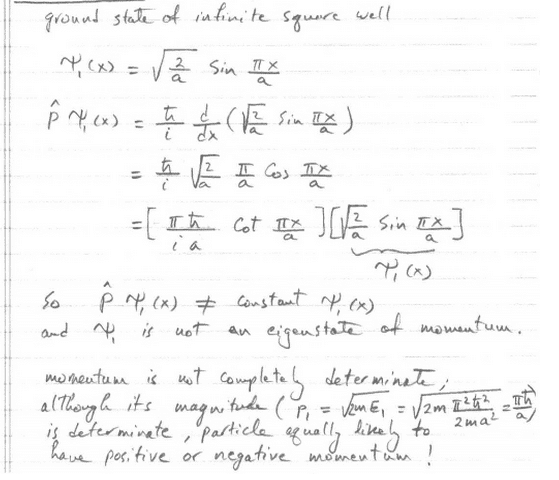
the questions is: is the ground state of an infinite square well an eigenfunction of momentum, if so what is the momentum?

solution:
DjKMb3q.png


i was working it out and i got something different from the solutions, and i don't understand where they're getting the cotangent term from..


and also, please confirm this for me; the eigenvector is the wavefunction, the eigenvalue is the observable (in this case, the momentum), and the eigenFUNCTION is the operator right?
 
Physics news on Phys.org
The eigenfunction is the wavefunction (can also be called an eigenvector) and is the sine function here, the eigenvalue would be the observable (a number), and the operator in this case is momentum. If you have an operator P and a function f, f is an eigenfunction of P if P f = p f, where p is some number. If you take the derivative of sine, you don't get a number multiplying sine back; you get the cotangent term, which is not a constant. So sine is not an eigenfunction of P. An example of something that is an eigenfunction of P would be g = exp(i k x) for example. Then P g = hbar k g.
 
What is cot(x)sin(x)?

The eigenvalue is the constant you get when you act the operator on a eigenvector/eigenstate/eigenfunction/eigenket/eigenmode/eigenface/etc.

The name you use depends on what is the most precise thing to say. For example, you'd say eigenfunction if you were talking about a wavefunction in the position representation, eigenstate/eigenket if you're still in abstract bra-ket notation, and you'd use the word eigenvector if say for example you were in a linear algebra class working out an eigenvalue equation. But also, the word "eigenvector" is technically always correct in any case since when you solve these types of equations, there is a map to some vector space in the abstract sense.

The operator is the momentum operator
The eigenvector is a momentum eigenstate (which you can write in a specific basis to call it an eigenfunction)
The eigenvalue is the momentum
 

Similar threads

  • · Replies 1 ·
Replies
1
Views
2K
  • · Replies 31 ·
2
Replies
31
Views
4K
  • · Replies 14 ·
Replies
14
Views
3K
  • · Replies 4 ·
Replies
4
Views
2K
Replies
6
Views
2K
  • · Replies 1 ·
Replies
1
Views
1K
  • · Replies 6 ·
Replies
6
Views
3K
  • · Replies 9 ·
Replies
9
Views
2K
  • · Replies 1 ·
Replies
1
Views
2K
Replies
1
Views
2K