Finding the g-value in the Boltzmann distribution

Click For Summary
SUMMARY

The discussion focuses on determining the g-value in the Boltzmann distribution for calcium's excited states. The correct electron configuration for the first excited state is identified as 4s1 4p1, leading to three available orbitals and two valence electrons. The participants clarify that the Aufbau principle does not strictly apply to excited states, and the energy levels of the excited states are discussed, emphasizing the importance of understanding microstates and their energy splits. The problem presented involves calculating the percentage of calcium atoms in the first excited state at 2,250K using the Boltzmann distribution.

PREREQUISITES
  • Understanding of electron configurations, specifically for calcium.
  • Familiarity with the Boltzmann distribution and its applications in statistical mechanics.
  • Knowledge of quantum mechanics principles, including microstates and energy levels.
  • Basic grasp of atomic theory and the Aufbau principle.
NEXT STEPS
  • Study the Boltzmann distribution equation and its application to atomic states.
  • Research the energy levels and configurations of calcium using resources like the NIST Atomic Spectra Database.
  • Learn about the significance of microstates in quantum mechanics and their impact on energy calculations.
  • Explore the differences between ground and excited states in atomic physics.
USEFUL FOR

Chemistry students, physicists, and researchers interested in atomic structure, statistical mechanics, and the behavior of elements in excited states.

JoJoQuinoa
Messages
17
Reaction score
0
Hello,

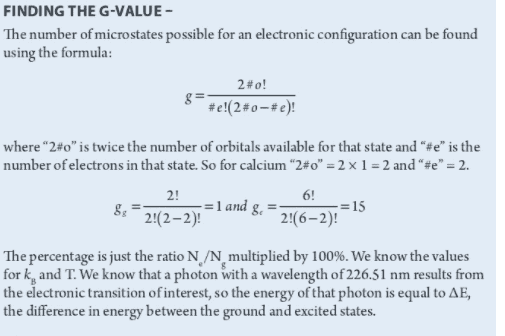
I was wondering if someone could show me how to determine the number of orbitals available for a state and the number of electrons in that state. For calcium in the ground state, the electron config is 1s2 2s2 2p6 3s2 3p6 4s2. For the first excited state I assumed 1s2... 4s1 3d1.
From the solution for g_g, why the number of available orbitals is one when 4s is filled? Shouldn't it be zero?

Thanks!
AAS.PNG
 
Chemistry news on Phys.org
If there were zero available orbitals, where would the electrons go? It doesn't mean "available for other electrons". It means "available for the valence electrons". (All filled subshells have #e = 2#o, so g = 1; you only need to consider the valence electrons.) There is one 4s orbital into which 2 electrons can go to give the configuration 4s2.
 
@mjc123, thank you for your explanation.

That is what I thought originally but when I applied it to the excited state, it didn't work. But I think my electron configuration for the first excited state is wrong. I think it should be ##1s^2...4s^1 4p^1## based on the selection rules. If that's true then #o is 3 in ##4p^1## and there are 2 valence electrons.
 
JoJoQuinoa said:
I think it should be ##1s^2...4s^1 4p^1## based on the selection rules.
Note that even without considering selection rules, ##4s^1 4p^1## is lower in energy than ##4s^1 3d^1##. (The Aufbau rules when filling orbitals do not necessarily apply to finding excited states).
 
I'm not sure what excited state is being referred to - certainly not the first excited state, as 226.51 nm is much higher energy. The expression for ge would suggest a configuration like 4p2, for which #o is 3 and #e is 2. (4s4p would have g = 12; 2 for the 4s electron x 6 for the 4p.) And the 15 microstates of 4p2 don't all have the same energy - they are split into 1S, 3P and 1D states (and 3P is further split into J = 0, 1 and 2 states). So using the g value in the Boltzmann distribution would be problematic.

Can you provide more context for this problem?
 
mjc123 said:
I'm not sure what excited state is being referred to - certainly not the first excited state, as 226.51 nm is much higher energy. The expression for ge would suggest a configuration like 4p2, for which #o is 3 and #e is 2. (4s4p would have g = 12; 2 for the 4s electron x 6 for the 4p.) And the 15 microstates of 4p2 don't all have the same energy - they are split into 1S, 3P and 1D states (and 3P is further split into J = 0, 1 and 2 states). So using the g value in the Boltzmann distribution would be problematic.

Can you provide more context for this problem?
Certainly

Problem: Use the Boltzmann distribution equation to calculate the percentage of calcium atoms that are in the first excited state in a hydrogen -air flame at 2,250K. The line associated with that transition has a wavelength of 226.51 nm.

Further Question: Is it not true that first excitation occurs when 'one' valence electron transition to a higher electronic state?

Thanks!
 
DrClaude said:
Note that even without considering selection rules, ##4s^1 4p^1## is lower in energy than ##4s^1 3d^1##. (The Aufbau rules when filling orbitals do not necessarily apply to finding excited states).

Hi DrClaude,

Is this a common knowledge or is there a set of rules for this? I'm not a chemistry student so I've been using what I can vaguely remember from general chemistry 10 years ago o_O
 

Similar threads

  • · Replies 4 ·
Replies
4
Views
27K
  • · Replies 16 ·
Replies
16
Views
16K
  • · Replies 5 ·
Replies
5
Views
4K
  • · Replies 3 ·
Replies
3
Views
4K
  • · Replies 6 ·
Replies
6
Views
5K
  • · Replies 5 ·
Replies
5
Views
7K
  • · Replies 2 ·
Replies
2
Views
7K
Replies
1
Views
3K
  • · Replies 2 ·
Replies
2
Views
5K
Replies
1
Views
5K