Finding the magnitude (length) and direction (angle) of a vector

Click For Summary
SUMMARY

The discussion centers on calculating the magnitude and direction of a vector using the Pythagorean theorem and the inverse tangent function. The magnitude was correctly calculated as √5, while the angle was initially found to be 63.8 degrees using θ = arctan(-2/-1). However, confusion arose regarding the angle's representation on a graph, leading to an incorrect adjustment to 116.6 degrees. The correct approach involves recognizing the quadrant of the vector and applying the appropriate angle adjustments.

PREREQUISITES
  • Understanding of vector magnitude calculation using the Pythagorean theorem
  • Knowledge of the inverse tangent function (arctan)
  • Familiarity with angle measurement in different quadrants
  • Basic trigonometric principles related to tangent
NEXT STEPS
  • Study vector representation in different quadrants
  • Learn about angle adjustments for vectors in the Cartesian plane
  • Explore the use of polar coordinates in vector analysis
  • Review trigonometric identities and their applications in vector calculations
USEFUL FOR

Students studying physics or mathematics, particularly those focusing on vector analysis and trigonometry. This discussion is beneficial for anyone needing to understand vector magnitude and direction calculations.
Ineedhelpwithphysics
Messages
43
Reaction score
7
Homework Statement
In the Picture
Relevant Equations
Pythagoras theorem, inverse tan function
1697566568581.png

So i found the magnitude which is
(-1)^2 + (-2)^2 = P^2 =
Sqrt(5)

Then I used the inverse tan function to find the angle (direction)
theta = arctan (-2/-1) = 63.8 degrees

Im confused with my 63.8 degrees since the angle in the graph looks greater than 63.4 degrees

I subtracted 180 by 63.8 and got 116.6

Since it's going clock wise it's -116.6

Am i right?
 
Physics news on Phys.org
Ineedhelpwithphysics said:
Homework Statement: In the Picture
Relevant Equations: Pythagoras theorem, inverse tan function

View attachment 333724
So i found the magnitude which is
(-1)^2 + (-2)^2 = P^2 =
Sqrt(5)

Then I used the inverse tan function to find the angle (direction)
theta = arctan (-2/-1) = 63.8 degrees

Im confused with my 63.8 degrees since the angle in the graph looks greater than 63.4 degrees

I subtracted 180 by 63.8 and got 116.6

Since it's going clock wise it's -116.6

Am i right?
You are not right. Remember ##~\text{tan} =\dfrac{\text{opposite}}{\text{adjacent}}.##
 
Ineedhelpwithphysics said:
Homework Statement: In the Picture
Relevant Equations: Pythagoras theorem, inverse tan function

View attachment 333724
So i found the magnitude which is
(-1)^2 + (-2)^2 = P^2 =
Sqrt(5)

Then I used the inverse tan function to find the angle (direction)
theta = arctan (-2/-1) = 63.8 degrees

Im confused with my 63.8 degrees since the angle in the graph looks greater than 63.4 degrees

I subtracted 180 by 63.8 and got 116.6

Since it's going clock wise it's -116.6

Am i right?

Hi,
1698138797220.png

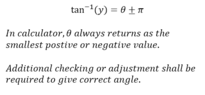
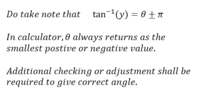
In your case, + or - π will give you the right answer ;)
 

Attachments

  • 1698138521223.png
    1698138521223.png
    6 KB · Views: 152
  • 1698138675768.png
    1698138675768.png
    6.8 KB · Views: 116
The book claims the answer is that all the magnitudes are the same because "the gravitational force on the penguin is the same". I'm having trouble understanding this. I thought the buoyant force was equal to the weight of the fluid displaced. Weight depends on mass which depends on density. Therefore, due to the differing densities the buoyant force will be different in each case? Is this incorrect?

Similar threads

Replies
3
Views
1K
  • · Replies 16 ·
Replies
16
Views
2K
  • · Replies 6 ·
Replies
6
Views
3K
  • · Replies 2 ·
Replies
2
Views
2K
  • · Replies 7 ·
Replies
7
Views
2K
Replies
14
Views
2K
Replies
4
Views
2K
  • · Replies 8 ·
Replies
8
Views
2K
  • · Replies 2 ·
Replies
2
Views
878
  • · Replies 13 ·
Replies
13
Views
2K