Finding the unitary matrix for a beam splitter

Click For Summary
SUMMARY

The discussion focuses on constructing the unitary matrix for a beam splitter in a Mach-Zehnder interferometer. The user struggles with the application of Born's rule and the concept of unitary matrices, specifically regarding the matrix representation of the beam splitter, denoted as ##U_\mathrm{BS}##. The conversation highlights the importance of understanding Fresnel coefficients, with reflectivity ##\rho= \pm \sqrt{.70}## and transmission ##\tau=\sqrt{.30}##, and introduces the matrix method developed by Schwinger for expressing linear transformations in this context.

PREREQUISITES
  • Understanding of quantum mechanics principles, particularly photon behavior.
  • Familiarity with Born's rule in quantum mechanics.
  • Knowledge of unitary matrices and their properties.
  • Basic understanding of Fresnel coefficients and their application in optics.
NEXT STEPS
  • Research the matrix method for beam splitters as developed by Schwinger.
  • Study the application of Born's rule in quantum optics.
  • Learn about the derivation and implications of Fresnel coefficients in beam splitter scenarios.
  • Explore the mathematical properties of unitary matrices in quantum mechanics.
USEFUL FOR

Students and researchers in quantum mechanics, particularly those studying optics and interferometry, as well as anyone preparing for exams involving quantum systems and beam splitter applications.

phb1762
Messages
6
Reaction score
0
Homework Statement
(a) Construct the matrix for a beam splitter with a 70% reflectivity.
(b) By applying this operation twice, calculate the output state of a single photon in the input. Hint: the second beam splitter can be oriented in two different ways.
Relevant Equations
1) Born rule for bipartite states ( as there are 2 possibilities for input and two probabilities due to the 70:30 beam splitter)
2) ket space equations
Hello,
I have some trouble understanding how to construct the matrix for the beam splitter (in a Mach-Zehnder interferometer).

I started with deciding my input and output states for the photon.
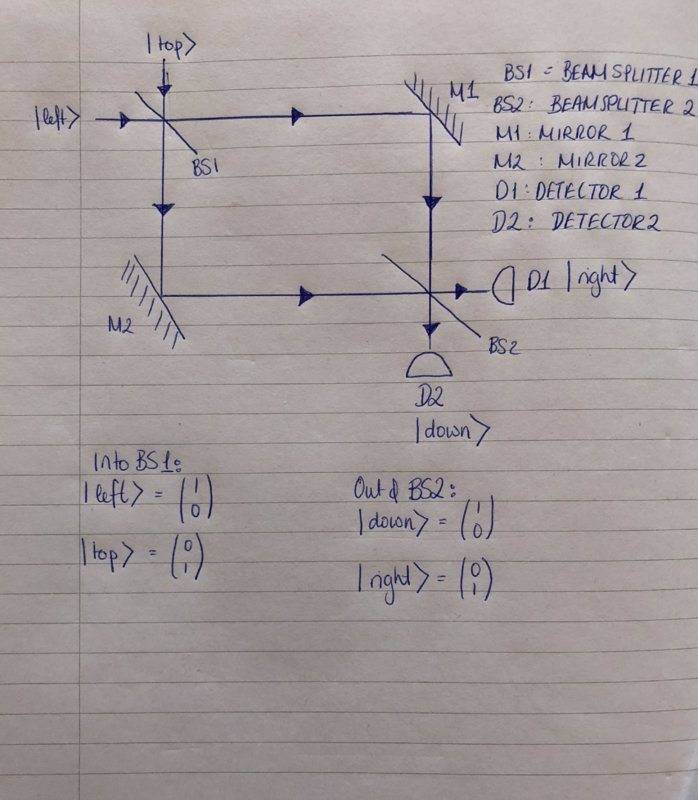
240971


I then use Borns rule, which I have attached below:
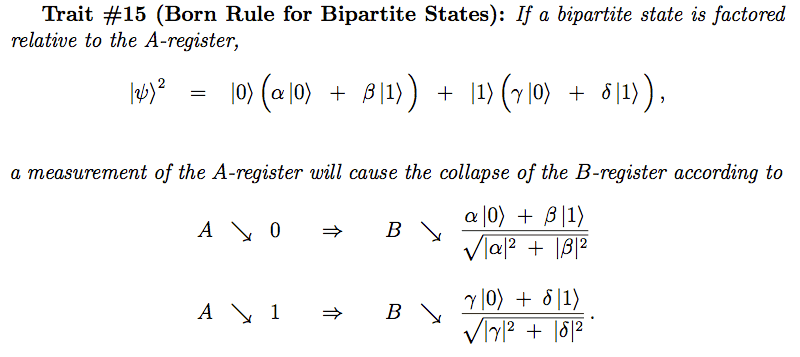
240970

To get the following for the state space of the photon going in:
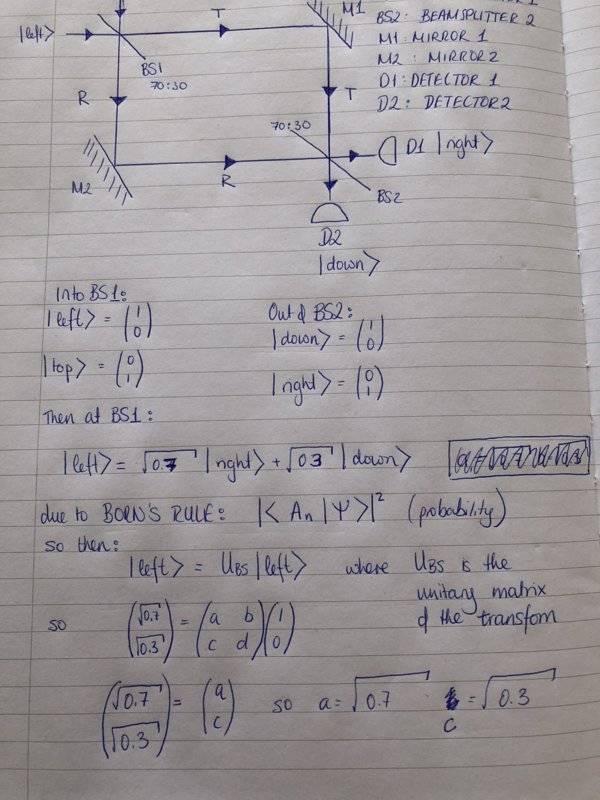
240974

But in the end, I end up with a matrix that doesn't appear unitary:
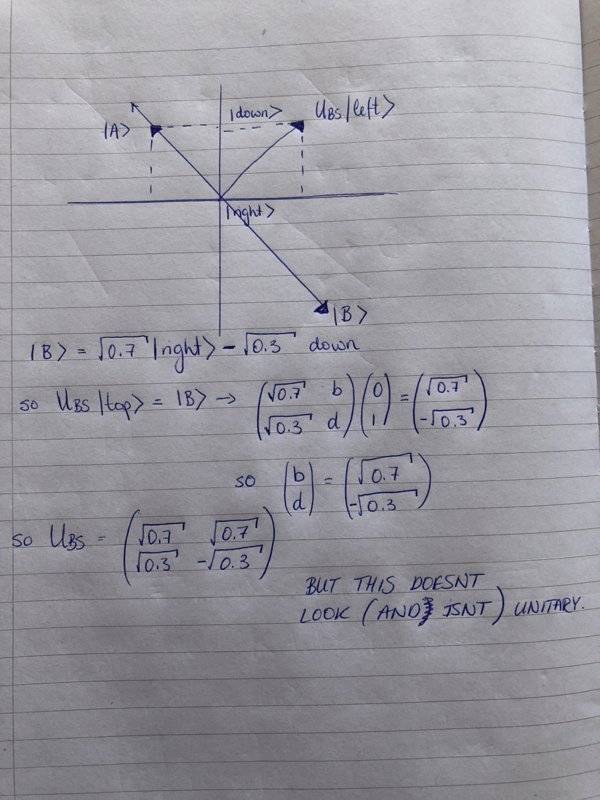
240975


I don’t know where I’m going wrong. We’ve only just started doing Quantum and the lectures are quite difficult for me to understand. I would appreciate any help and advice as I really would like to be able to do these types of questions as I suspect they will be in my exam!

Thanks everyone in advance and sorry for the many photos!
 

Attachments

  • image.jpg
    image.jpg
    67.2 KB · Views: 527
Physics news on Phys.org
Think again about what happens at BS1 when coming in from the top.
 
I really don’t understand where I’m going wrong, I thought that going in from the top should be inverse of the going in from the left?
 
If only BS1 is present, coming in from the top, was is the probability that the outcome is right?
 
Ah, so something like this:
241116
 
phb1762 said:
Ah, so something like this:
Yes. You can check now that ##U_\mathrm{BS}## is unitary.
 
DrClaude said:
Yes. You can check now that ##U_\mathrm{BS}## is unitary.
Thank you so much for your time, that was very helpful!
 
Without looking at it in detail, if it is a dielectric beamsplitter with an anti-reflection (AR) coating on one side, the Fresnel coefficients for the reflectivity will be ##\rho= \pm \sqrt{.70} ## and the transmission (composite) will be ## \tau=\sqrt{.30} ## for both paths. The matrix method is simply a way to express the linear transformation that occurs with the Fresnel coefficients for the electric field amplitudes of the electromagnetic wave for transmitted and reflected components.
I was unaware of the matrix method for beamsplitters (developed by Schwinger) when I wrote this Insights article: https://www.physicsforums.com/insights/fabry-perot-michelson-interferometry-fundamental-approach/
If you can follow the article, you will then understand what the matrix method does.
 

Similar threads

  • · Replies 15 ·
Replies
15
Views
3K
  • · Replies 7 ·
Replies
7
Views
2K
  • · Replies 4 ·
Replies
4
Views
1K
  • · Replies 2 ·
Replies
2
Views
2K
  • · Replies 13 ·
Replies
13
Views
2K
  • · Replies 12 ·
Replies
12
Views
2K
  • · Replies 4 ·
Replies
4
Views
3K
  • · Replies 33 ·
2
Replies
33
Views
3K
  • · Replies 8 ·
Replies
8
Views
3K
  • · Replies 5 ·
Replies
5
Views
2K