Mach-Zehnder Interferometer interpretation

Click For Summary

Homework Help Overview

The discussion revolves around the interpretation of the mathematics involved in a Mach-Zehnder interferometer experiment, specifically focusing on the states of photons and their transformations through beam splitters and mirrors. The original poster expresses confusion regarding their assumptions about the states and the resulting probabilities.

Discussion Character

  • Exploratory, Conceptual clarification, Assumption checking

Approaches and Questions Raised

  • The original poster attempts to define photon states using vectors and matrices, exploring the effects of beam splitters and mirrors on these states. They raise several assumptions about the behavior of the photon states and their probabilities, questioning the validity of their reasoning.

Discussion Status

Some participants provide insights into the mathematical framework, suggesting that the original poster may need to consider the dimensionality of the vector space and the proper treatment of qubits. There is an ongoing exploration of the assumptions made by the original poster, with requests for clarification and simplification of complex concepts.

Contextual Notes

The original poster indicates a limited understanding of the formalism involved, expressing a need for more foundational explanations. They also mention specific assumptions that they believe may be incorrect, seeking guidance on how to approach the problem more effectively.

WWCY
Messages
476
Reaction score
15
HW Template missing as it was moved from another forum
Hi all,

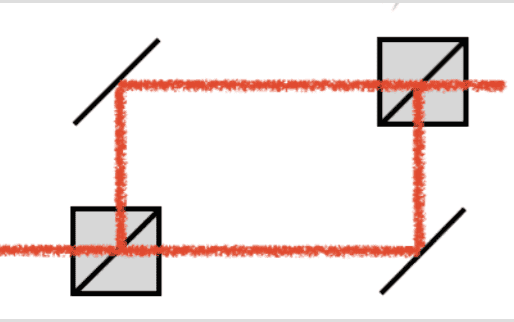
I have a problem trying to interpret the mathematics of this experiment and would like some help. I think it's best I write out all my ideas (and misconceptions) so that I can be corrected. An illustration of the setup is below. Thanks in advance for any assistance!

Let the following vectors represent "right-moving" and "upwards-moving" states of photons respectively
$$|r> \ = (1,0)$$
$$|u> \ = (0,1)$$

A beam of photons purely in the "right" state enters the first beam-splitter (represented by the matrix) and exits in a mix of "r" and "u" states
$$\frac{1}{\sqrt{2}}
\left( \begin{array}{cc}
1 & 1 \\
-1 & 1
\end{array} \right)
%
\left( \begin{array}{cc}
1 \\
0
\end{array} \right)
= \frac{1}{\sqrt{2}} \big ( (1,0) + (0,-1) \big)
$$

Assumption 1: ##\frac{1}{\sqrt{2}}(1,0)## represents the beam taking the right-wards path, and ##\frac{1}{\sqrt{2}}(0,-1)## is the beam moving upwards.

In the setup shown, both beams under go a "state-flip" as they hit the mirrors, and change direction and fly towards the second beam-splitter.

However, just for fun, I only want the "u" beam to hit a mirror, while the "r" beam just keeps flying right.

Assumption 2: I can do this by performing the "flip" on the "u" beam only. The "flipper" is represented by the matrix and the resulting state is
$$
\left( \begin{array}{cc}
0 & 1 \\
-1 & 0
\end{array} \right)
%
\left( \begin{array}{cc}
0 \\
-\frac{1}{\sqrt{2}}
\end{array} \right)
= -\frac{1}{\sqrt{2}} (1,0)
$$

Assumption 3: Because both my beams are now "r" states, the probability of finding them as "r" states should be a sweet 1. And thus, summing the two "r-wards" vectors should give me ##(1,0)##. But
$$\frac{1}{\sqrt{2}} \big[ (1,0) + (-1,0) \big] = 0$$
Assumption 4: I could remove the negative sign from the "u" state vector, since the sign plays no physical significance. But this gives me ##\frac{1}{\sqrt{2}}(2,0)## which does not make sense either.

Assistance is greatly appreciated!
Screen Shot 2018-02-07 at 11.33.28 PM.png
 

Attachments

  • Screen Shot 2018-02-07 at 11.33.28 PM.png
    Screen Shot 2018-02-07 at 11.33.28 PM.png
    9.4 KB · Views: 623
  • Like
Likes   Reactions: Douglas Sunday
Physics news on Phys.org
First, if you want to compute a probability or generally "weigh" your states, you have to square amplitudes before adding them. Second, when the qubit your are focusing on (the direction) is part of a system with a second qubit (the position), you have to properly trace out the other qubit before adding. Otherwise you'll have problems.

For example, the state ##|0\rangle|0\rangle## looks fine, but apply a Hadamard gate to the second qubit and you get ##|0\rangle (\frac{1}{\sqrt{2}} |0\rangle + \frac{1}{\sqrt{2}} |1\rangle)##. If you simply ignore the second qubit, by replacing its kets with 1s, you'd get ##|0>(\frac{1}{\sqrt{2}} \cdot 1 + \frac{1}{\sqrt{2}} \cdot 1) = |0\rangle\cdot\sqrt{2}##. But that's nonsensical. You can't just ignore the second qubit by replacing its kets with the scalar 1! This is exactly what's happening in your example: the first qubit is the direction of the photon and the second qubit is the position of the photon.

To correctly remove the second qubit from the system you have to "trace it out". Convert your kets into density matrices, and http://www.thphy.uni-duesseldorf.de/~ls3/teaching/1515-QOQI/Additional/partial_trace.pdf. The resulting single-qubit density matrix tells you about the first qubit.
 
Strilanc said:
First, if you want to compute a probability or generally "weigh" your states, you have to square amplitudes before adding them. Second, when the qubit your are focusing on (the direction) is part of a system with a second qubit (the position), you have to properly trace out the other qubit before adding. Otherwise you'll have problems.

For example, the state ##|0\rangle|0\rangle## looks fine, but apply a Hadamard gate to the second qubit and you get ##|0\rangle (\frac{1}{\sqrt{2}} |0\rangle + \frac{1}{\sqrt{2}} |1\rangle)##. If you simply ignore the second qubit, by replacing its kets with 1s, you'd get ##|0>(\frac{1}{\sqrt{2}} \cdot 1 + \frac{1}{\sqrt{2}} \cdot 1) = |0\rangle\cdot\sqrt{2}##. But that's nonsensical. You can't just ignore the second qubit by replacing its kets with the scalar 1! This is exactly what's happening in your example: the first qubit is the direction of the photon and the second qubit is the position of the photon.

To correctly remove the second qubit from the system you have to "trace it out". Convert your kets into density matrices, and http://www.thphy.uni-duesseldorf.de/~ls3/teaching/1515-QOQI/Additional/partial_trace.pdf. The resulting single-qubit density matrix tells you about the first qubit.
Hi @Strilanc , thank you for your reply!

Unfortunately I have really only just learned this formalism and I don't understand your post. If you don't mind, could you dumb it down for me?

Perhaps I should have mentioned that I only know stuff like representing states as vectors, transformations as matrices, and the idea that two-state systems can be described by this formalism. Apologies!
 
You don't have two photons in the state ##|r\rangle##. You have one photon in the state ##|r\rangle \otimes |\text{top path}\rangle## and one photon in the state ##|r\rangle \otimes |\text{bottom path}\rangle##. Your vector space needs to be four dimensional, not two dimensional, to account for both the direction and the path. In the larger four dimensional space, you will find that the two vectors no longer add up to zero.
 
Strilanc said:
You don't have two photons in the state ##|r\rangle##. You have one photon in the state ##|r\rangle \otimes |\text{top path}\rangle## and one photon in the state ##|r\rangle \otimes |\text{bottom path}\rangle##. Your vector space needs to be four dimensional, not two dimensional, to account for both the direction and the path. In the larger four dimensional space, you will find that the two vectors no longer add up to zero.

So let's say I wish to perform some transformation on one of the paths, without performing it on the other, how should I go about doing it?

Also, may I know which one of my assumptions were faulty and how I should have approached them instead?

Thank you for your patience.
 
Can anyone assist? Many thanks in advance.
 
Bump.
 
Hi all, I'd be grateful for some assistance regarding these concepts.

Either that or some advice regarding how I should restructure my post will be greatly appreciated!
 

Similar threads

Replies
8
Views
2K
  • · Replies 1 ·
Replies
1
Views
3K
  • · Replies 8 ·
Replies
8
Views
2K
  • · Replies 4 ·
Replies
4
Views
1K
  • · Replies 21 ·
Replies
21
Views
2K
  • · Replies 30 ·
2
Replies
30
Views
2K
  • · Replies 26 ·
Replies
26
Views
2K
  • · Replies 7 ·
Replies
7
Views
2K
  • · Replies 13 ·
Replies
13
Views
2K
  • · Replies 10 ·
Replies
10
Views
2K