Finding total outward flux through a pyramid?

  • Thread starter Thread starter Infernorage
  • Start date Start date
  • Tags Tags
    Flux Pyramid
Click For Summary
SUMMARY

The discussion focuses on calculating the total outward flux through a pyramid using the vector field F = xi - yj + zk. The divergence theorem is applied, confirming that the divergence is 1, which implies the total flux equals the volume of the pyramid, calculated as 1/3. The participants clarify that the normal vectors for the angled faces are i + k and j + k, and provide guidance on determining the limits of integration and the vector dS using the surface parameterization method.

PREREQUISITES
  • Understanding of the Divergence Theorem
  • Familiarity with vector fields and surface integrals
  • Knowledge of parameterization of surfaces
  • Ability to calculate cross products in vector calculus
NEXT STEPS
  • Study the Divergence Theorem in detail with examples
  • Learn about parameterizing surfaces in three-dimensional space
  • Explore vector calculus techniques for calculating surface integrals
  • Investigate the properties of normal vectors in vector fields
USEFUL FOR

Students and educators in calculus, particularly those focusing on vector calculus and surface integrals, as well as professionals working in fields that require fluid dynamics or electromagnetism analysis.

Infernorage
Messages
24
Reaction score
0
Homework Statement
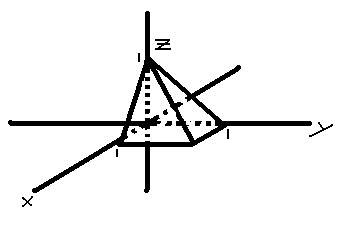
Let F=xi-yj+zk and the pyramid be as shown below. Find \iint\limits \,F\bullet dS as a surface integral over all five faces.
pyramid.jpg


The attempt at a solution
I first solved it using the divergence theorem. The divergence was just 1, so the answer should just be the volume of the pyramid, which is 1/3, right?

I think that the normal vectors of the two angled faces are i+k and j+k, but I don't understand how to find the dS or the limits of integration since no real equation was given for the surface. Tried doing the surface integrals of the two angled faces assuming that the two angled faces were the intersection of the surfaces z=1-x and z=1-y, but my answer is not coming out to 1/3. The flux through the non-angled faces (left, back, and bottom) should just be zero, right? I don't know whether I am just not seeing it or what, but can you guys help me out? Thanks in advance.
 
Physics news on Phys.org
Infernorage said:
Homework Statement
Let F=xi-yj+zk and the pyramid be as shown below. Find \iint\limits \,F\bullet dS as a surface integral over all five faces.
pyramid.jpg


The attempt at a solution
I first solved it using the divergence theorem. The divergence was just 1, so the answer should just be the volume of the pyramid, which is 1/3, right?

Yes, that looks correct.

I think that the normal vectors of the two angled faces are i+k and j+k, but I don't understand how to find the dS or the limits of integration since no real equation was given for the surface.

Tried doing the surface integrals of the two angled faces assuming that the two angled faces were the intersection of the surfaces z=1-x and z=1-y, but my answer is not coming out to 1/3.

In the xy plane draw the diagonal from (0,0,0) to (1,1,0). That is the line y = x in the xy plane and the two triangles it forms lie directly under the two slanted faces. So if you express the integrals in terms of x and y, you can read the limits in the xy plane.

As for calculating the vector dS, if you express the surface as a vector function R(x,y), using x and y as the independent variables you can use the formula

\int\int_S \vec F \cdot d\vec S = \pm\int\int_R \vec F \cdot \vec R_x \times\vec R_y\,dxdy

where the sign is chosen so the direction of Rx X Ry agrees with the orientiation of the surface.

For example, the front slanted plane x + z = 1 can be written:

R(x,y) = < x, y, 1-x >

Just use the formula above and express everything in terms of x. Read the limits from the xy plane. Similarly for the other slanted plane.

The flux through the non-angled faces (left, back, and bottom) should just be zero, right?

That's right. I presume you know why, and if this is a homework problem, you should explain why.
 

Similar threads

  • · Replies 6 ·
Replies
6
Views
2K
  • · Replies 1 ·
Replies
1
Views
1K
  • · Replies 1 ·
Replies
1
Views
1K
  • · Replies 9 ·
Replies
9
Views
1K
  • · Replies 3 ·
Replies
3
Views
2K
  • · Replies 7 ·
Replies
7
Views
3K
  • · Replies 8 ·
Replies
8
Views
2K
  • · Replies 3 ·
Replies
3
Views
2K
  • · Replies 1 ·
Replies
1
Views
5K
  • · Replies 6 ·
Replies
6
Views
2K