Finding where the gravitational field strength is 0

Click For Summary
SUMMARY

The discussion focuses on determining the point where gravitational field strength is zero using the equation g = (Gm)/r². Participants explore the relationship between two masses, m1 and m2, and their distances from a point of interest. The solution involves manipulating the equation to isolate variables and potentially using fractional distances to simplify calculations. The final advice emphasizes solving for 'a' as a fraction of the total distance 'r' to facilitate the problem-solving process.

PREREQUISITES
  • Understanding of gravitational force equations, specifically g = (Gm)/r²
  • Knowledge of algebraic manipulation and solving quadratic equations
  • Familiarity with concepts of mass and distance in gravitational fields
  • Basic understanding of fractions and ratios in mathematical contexts
NEXT STEPS
  • Study the derivation of gravitational field strength equations
  • Learn about quadratic equations and their solutions
  • Explore the concept of gravitational equilibrium points
  • Investigate the application of fractional distances in physics problems
USEFUL FOR

Students studying physics, particularly those focusing on gravitational forces and field strength calculations, as well as educators looking for problem-solving strategies in gravitational field scenarios.

HornetHades
Messages
2
Reaction score
0
1. Homework Statement

NDdr7pR.png

Homework Equations


g = (Gm)/r2

The Attempt at a Solution


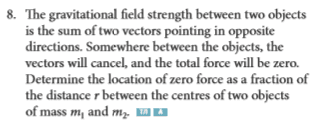
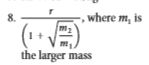
I tried doing (Gm1)/a2 = (Gm2)/(r-a)2 where a is equal to the distance from the position we're trying to find to the center of the most massive object but end up getting a quadratic in the denominator on the right side. The answer in the back of the textbook is this:
rfsYdeU.png


Thank you!
 
Physics news on Phys.org
HornetHades said:
I tried doing (Gm1)/a2 = (Gm2)/(r-a)2
Would taking the square root of both sides help? First, you might want to get all of the "squared stuff" on one side of the equation and everything else on the other side.
 
TSny said:
Would taking the square root of both sides help? First, you might want to get all of the "squared stuff" on one side of the equation and everything else on the other side.
Thanks for your (very) prompt reply! Yeah that helps but now i have (r-a)/a±√(m1/m2). It's very close to the answer but I have no idea what to do with the a :/
 
HornetHades said:
Thanks for your (very) prompt reply! Yeah that helps but now i have (r-a)/a±√(m1/m2). It's very close to the answer but I have no idea what to do with the a :/
Did you leave out an equals sign somewhere in (r-a)/a±√(m1/m2) ?

Decide whether the + or the - should be used here.

Then, solve for ##a##.
 
Since you're solving for a fraction of the distance r, why not let a be that fraction so that 0 < a < 1. Then one distance will be ar and the other (1-a)r. Otherwise I think you're going to struggle more than necessary to get the distance differences into fractional form.
 

Similar threads

  • · Replies 4 ·
Replies
4
Views
2K
  • · Replies 23 ·
Replies
23
Views
4K
  • · Replies 5 ·
Replies
5
Views
2K
  • · Replies 9 ·
Replies
9
Views
4K
  • · Replies 4 ·
Replies
4
Views
3K
Replies
1
Views
3K
  • · Replies 1 ·
Replies
1
Views
2K
  • · Replies 16 ·
Replies
16
Views
1K
  • · Replies 1 ·
Replies
1
Views
2K
  • · Replies 3 ·
Replies
3
Views
4K