Finite Integral Domains .... Adkins & Weintraub, Propn 1.5

Click For Summary
SUMMARY

The discussion focuses on Proposition 1.5 from "Algebra: An Approach via Module Theory" by William A. Adkins and Steven H. Weintraub, specifically regarding the proof that every finite integral domain is a field. The key conclusion is that the equation \( ax = 1 \) is solvable for every \( a \neq 0 \) due to the bijectiveness of the function \( \phi_a \), which is both injective and surjective, leading to \( \phi_a(R) = R \). The proof illustrates that every nonzero element in a finite integral domain possesses a multiplicative inverse, confirming its status as a field.

PREREQUISITES
  • Understanding of integral domains and fields
  • Familiarity with bijective functions and their properties
  • Knowledge of basic algebraic structures and proofs
  • Experience with the concepts of injectivity and surjectivity
NEXT STEPS
  • Study the properties of finite integral domains in depth
  • Learn about bijective functions and their implications in algebra
  • Explore the relationship between groups and fields in abstract algebra
  • Review the proof techniques used in algebraic structures, particularly in module theory
USEFUL FOR

Mathematics students, algebra enthusiasts, and educators seeking to deepen their understanding of integral domains and fields, particularly in the context of module theory.

Math Amateur
Gold Member
MHB
Messages
3,920
Reaction score
48
I am reading "Algebra: An Approach via Module Theory" by William A. Adkins and Steven H. Weintraub ...

I am currently focused on Chapter 2: Rings ...

I need help with an aspect of the proof of Proposition 1.5 ... ...

Proposition 1.5 and its proof read as follows:
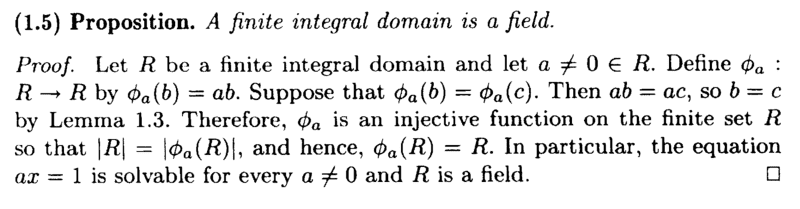
A&W - Proposition 1.5 ... .png
At the end of the above proof from Adkins and Weintraub we read the following:

" ... ... and hence ##\phi_a (R) = R##. In particular, the equation ##ax = 1## is solvable for every ##a \neq 0## and ##R## is a field. ... ... "
Can someone please explain to me how the conclusion that "the equation ##ax = 1## is solvable for every ##a \neq 0## and ##R## is a field" follows from the arguments preceding it ...

Basically I do not understand how the arguments before this statement lead to the conclusion ...Help will be much appreciated ...

Peter
 

Attachments

  • A&W - Proposition 1.5 ... .png
    A&W - Proposition 1.5 ... .png
    20.2 KB · Views: 588
Physics news on Phys.org
The author showed, that ##\phi_a## is bijective, because it is injective and surjective: ##\phi_a(R)=R##.
That means ##a \cdot x = \phi_a(x) = 1## has exactly one solution ##x \in \phi_a^{-1}(\{1\})##.
 
Last edited:
  • Like
Likes   Reactions: Math Amateur
fresh_42 said:
The author showed, that ##\phi_a## is bijective, because it is injective and surjective: ##\phi_a(R)=R##.
That means ##a \cdot x = \phi_a(x) = 1## has exactly one solution ##x \in \phi_a^{-1}(\{1\})##.
Thanks fresh_42 ...

Reflecting on what you have said ...

But ... hmm ... yes ... seems right ...

Thanks again ...

Peter
 
Integral domains and Fields has a nice proof that every finite integral domain is a field. It is much like the proof that every element of a finite group has a finite order. One takes some nonzero element a and multiplies it by itself until one comes with two exponents m and n such that am = an. Then,

am - an = an * (am-n - 1) = 0

From the definition of integral domain, either an = 0 or am-n - 1 = 0. In the first case, an = a * an-1, and if it equals 0, then either a or a an-1 equals 0. Continuing for an-1, we find that a = 0, contrary to our condition for a.

But if am-n - 1 = 0, then a * am-n-1 = 1. Thus, a has a multiplicative inverse, and thus every finite integral domain is a field.
 
  • Like
Likes   Reactions: Math Amateur

Similar threads

Replies
2
Views
1K
  • · Replies 7 ·
Replies
7
Views
2K
  • · Replies 2 ·
Replies
2
Views
1K
  • · Replies 3 ·
Replies
3
Views
2K
  • · Replies 3 ·
Replies
3
Views
2K
  • · Replies 3 ·
Replies
3
Views
2K
Replies
1
Views
1K
  • · Replies 6 ·
Replies
6
Views
2K
Replies
1
Views
1K
  • · Replies 7 ·
Replies
7
Views
3K