Discussion Overview
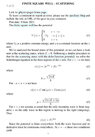
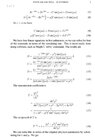
The discussion revolves around the transmission coefficient in the context of a finite potential well, exploring the implications of particle energy levels (E) on reflection and transmission probabilities. Participants examine the behavior of particles with energies both above and below the potential well's depth, considering quantum mechanical phenomena such as tunneling and reflection.
Discussion Character
- Exploratory
- Technical explanation
- Debate/contested
- Mathematical reasoning
Main Points Raised
- Some participants express confusion about the meaning of the transmission coefficient and its implications for scattering states with E>0, questioning whether particles can be reflected.
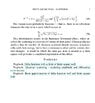
- It is noted that when the sine term in the transmission coefficient formula is zero, T=1, indicating no reflection, but this raises questions about the behavior of particles with E>0.
- Some participants clarify that even with E>0, there is a non-zero chance of reflection due to quantum mechanical effects.
- Discussion includes the distinction between potential wells and barriers, with participants noting that a potential well can still reflect particles with E>0.
- There is mention of bound states, with one participant stating that a particle with E<0 is trapped in the well, while others discuss the implications of exponentially decaying wave functions outside the well.
- One participant explores the rearrangement of an equation related to transmission, questioning if a specific energy condition allows for 100% transmission.
- Clarifications are made regarding the applicability of certain equations to bound states versus scattering states, with some asserting that E>0 states will always have a non-zero probability of transmission.
Areas of Agreement / Disagreement
Participants generally agree that quantum mechanics allows for reflection even when E>0, but there is no consensus on the specifics of how the transmission coefficient applies across different energy states. Multiple competing views remain regarding the conditions for transmission and reflection.
Contextual Notes
There are unresolved aspects regarding the mathematical steps and definitions of terms used in the discussion, particularly concerning the conditions under which certain equations apply to bound versus scattering states.