Flow as a fluid-orthogonal foliation

  • Context: Graduate 
  • Thread starter Thread starter Apashanka
  • Start date Start date
  • Tags Tags
    Flow
Click For Summary

Discussion Overview

The discussion revolves around the concept of flow as a fluid-orthogonal foliation within a 4-D manifold framework, focusing on the metric representation of the space and the implications of four-velocity in relation to hypersurfaces. Participants explore the mathematical and conceptual underpinnings of these ideas, referencing a specific paper for further context.

Discussion Character

  • Technical explanation
  • Conceptual clarification
  • Debate/contested
  • Homework-related

Main Points Raised

  • One participant describes a 4-D manifold with a 3-D sub-manifold, detailing the metric as a function of time and spatial coordinates, and the implications for four-velocity vectors.
  • Another participant requests clarification on a specific sentence from a referenced paper, indicating a lack of understanding regarding the projections mentioned.
  • Several participants express confusion about the concept of projections in differential geometry, suggesting that the referenced paper may be too advanced without a solid foundation in the subject.
  • A participant explains that the metric of a local spacelike hypersurface is determined by the choice of timelike vectors, but cautions that further detail may exceed the thread's scope.
  • There is a discussion about the nature of spacelike vectors and their relationship to the timelike vector ##\hat{t}##, with one participant asserting that spacelike vectors cannot align with a timelike vector.

Areas of Agreement / Disagreement

Participants express varying levels of understanding regarding the concepts discussed, with some indicating that the material may be too advanced for the original poster. There is no consensus on the clarity of the projections or the specific content of the referenced paper.

Contextual Notes

Participants note that a solid understanding of differential geometry is necessary to engage with the concepts presented in the referenced paper, highlighting limitations in background knowledge among some contributors.

Apashanka
Messages
427
Reaction score
15
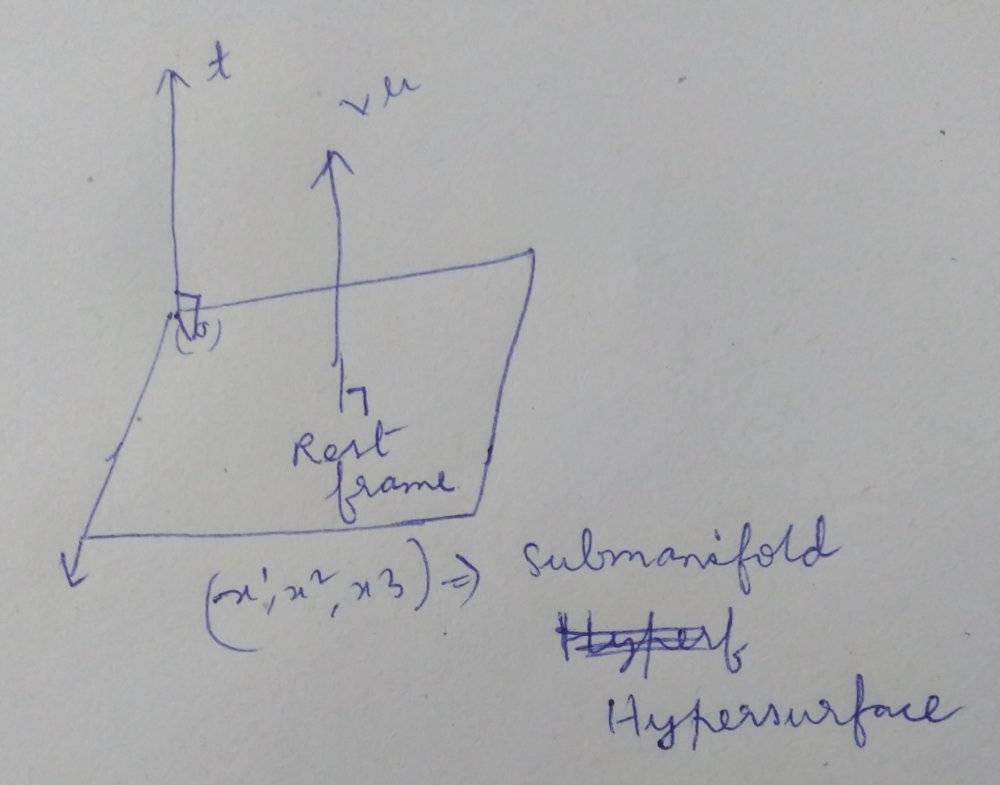
If considering the 4-D manifold(##x^1,x^2,x^3,t##) in which the sub-manifold dimensionality is 3(##x^1,x^2,x^3##)(hypersurface)
We are writting the metric of this space as ##ds^2=g(t)dt^2+f(t)\gamma_{ij}{dx^idx^j}\delta_{ij}## where the term ##\gamma_{ij}dx^idx^j\delta_{ij}## is the metric of the hypersurface assuming that ##\frac{∂}{∂t}=\hat t## is orthogonal to the hypersurface .
A very elementary rough diagram is this
IMG_20190303_170746.jpg

Now from the four velocity ##V^\mu=\gamma##{c,##v_{spatial}##}
If a particle is at rest in one frame then it's ##V^\mu## points along ##\hat t## (perpendicular to the hypersurface) and if it is having some spatial velocity in another frame then the velocity four vector ##V^\mu## is now tilted at an angle to the hypersurface(e.g roughly we can say there are two components ,along ##\hat t## and ##V_{hypersurface})##
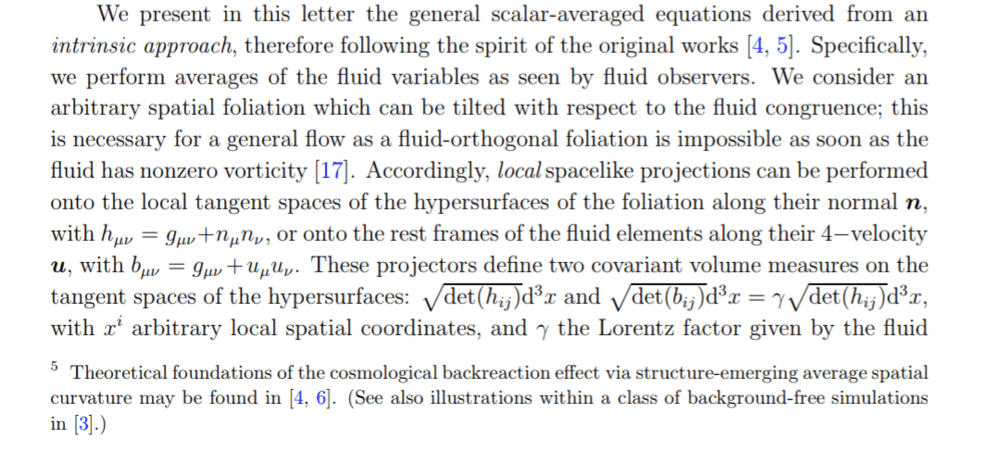
Till now it's ok but these lines from a paper I am unable to understand and connects ,to the above
Screenshot_20190303-173050~2.png

From ''Accordingly .....to ##b_{\mu \nu}##'' here ##n## is along ##\hat t## and ##u## is the four velocity.
Can anyone help me in sort out this
 

Attachments

  • IMG_20190303_170746.jpg
    IMG_20190303_170746.jpg
    38.9 KB · Views: 824
  • Screenshot_20190303-173050~2.png
    Screenshot_20190303-173050~2.png
    84.4 KB · Views: 812
Physics news on Phys.org
Apashanka said:
a paper

What paper? Please give a reference.
 
Moderator's note: Thread level changed to "A" based on the reference given.
 
Apashanka said:
If considering the 4-D manifold(##x^1,x^2,x^3,t##) in which the sub-manifold dimensionality is 3(##x^1,x^2,x^3##)(hypersurface)
We are writting the metric of this space as ##ds^2=g(t)dt^2+f(t)\gamma_{ij}{dx^idx^j}\delta_{ij}## where the term ##\gamma_{ij}dx^idx^j\delta_{ij}## is the metric of the hypersurface assuming that ##\frac{∂}{∂t}=\hat t## is orthogonal to the hypersurface .
A very elementary rough diagram is this View attachment 239632
Now from the four velocity ##V^\mu=\gamma##{c,##v_{spatial}##}
If a particle is at rest in one frame then it's ##V^\mu## points along ##\hat t## (perpendicular to the hypersurface) and if it is having some spatial velocity in another frame then the velocity four vector ##V^\mu## is now tilted at an angle to the hypersurface(e.g roughly we can say there are two components ,along ##\hat t## and ##V_{hypersurface})##
Till now it's ok but these lines from a paper I am unable to understand and connects ,to the aboveView attachment 239633
From ''Accordingly .....to ##b_{\mu \nu}##'' here ##n## is along ##\hat t## and ##u## is the four velocity.
Can anyone help me in sort out this
Can anyone please help me...
 
What exactly is the question? In that sentence there are no computations or any arguments/reasoning to explain. They only introduce the standard notations and names for the projections.
 
martinbn said:
What exactly is the question? In that sentence there are no computations or any arguments/reasoning to explain. They only introduce the standard notations and names for the projections.
I didnt understand the projections they're taking about??
 
Apashanka said:
I didnt understand the projections they're taking about??

If you don't understand the general concept of projections, then the paper you referenced is probably too advanced for you. And trying to explain that concept from scratch is probably too much for a PF thread.

What textbooks on differential geometry have you studied? Projections are a basic concept of differential geometry. You really need to have a good understanding of differential geometry before trying to work through a paper like the one you linked to.
 
Apashanka said:
I didnt understand the projections they're taking about??

The basic idea is that, if you have a timelike vector at a given event, then the metric of a local spacelike hypersurface orthogonal to that timelike vector at that event is given by the formulas in what you quoted. The formulas are given for two different choices of timelike vector: ##n##, the vector that points along the timelike lines of the chosen foliation, and ##u##, the vector that points along the fluid flow lines.

Going into much more detail than that is probably, as I said before, beyond the scope of a PF thread.
 
  • Like
Likes   Reactions: Apashanka
  • #10
Sir one question, space like vectors can't be along ##\hat t## ,isn't it??they are outside the light cones
 
Last edited:
  • #11
Apashanka said:
space like vectors can't be along ##^\hat{t}## ,isn't it??

Not if ##\hat{t}## is timelike, no.
 
  • #12
Thread closed as the subject matter is "A" level and the OP does not appear to have the required background.

@Apashanka, based on your repeated threads on subjects related to this one, it really appears that you need to spend some time developing your understanding of differential geometry and how it is used in General Relativity. Here at PF we can help with specific questions, but we are not equipped to give a complete graduate level course in differential geometry and GR, and it's difficult to answer questions that require that background knowledge if the person asking them does not have it.
 

Similar threads

  • · Replies 3 ·
Replies
3
Views
2K
  • · Replies 7 ·
Replies
7
Views
2K
  • · Replies 16 ·
Replies
16
Views
3K
  • · Replies 24 ·
Replies
24
Views
2K
  • · Replies 7 ·
Replies
7
Views
3K
  • · Replies 1 ·
Replies
1
Views
1K
  • · Replies 1 ·
Replies
1
Views
1K
  • · Replies 53 ·
2
Replies
53
Views
4K
  • · Replies 38 ·
2
Replies
38
Views
2K
  • · Replies 8 ·
Replies
8
Views
2K