Fluids acceleration on inclined plane

Click For Summary
SUMMARY

The discussion centers on the behavior of a body with the same density as a liquid inside a closed box placed on an inclined plane. Participants concluded that the body may remain stationary relative to the liquid, move up, or move down depending on the angle of inclination and whether the box is fully or partially filled with liquid. The consensus indicates that if the box is fully filled and both the fluid and body are incompressible, the body does not move relative to the liquid. However, if the box is not completely filled, the body may exhibit movement due to wave dynamics or changes in pressure distribution.

PREREQUISITES
  • Understanding of buoyancy principles and Archimedes' principle
  • Knowledge of fluid dynamics, particularly in non-inertial reference frames
  • Familiarity with the concept of pressure differences in fluids
  • Basic grasp of inclined plane mechanics and forces acting on bodies in motion
NEXT STEPS
  • Study the effects of inclined planes on fluid behavior in "Fluid Mechanics" textbooks
  • Explore "Non-inertial Reference Frames" to understand forces acting on fluids
  • Research "Wave Dynamics in Fluids" to comprehend how waves affect buoyant bodies
  • Investigate "Pressure Distribution in Fluids" to learn about pressure differences and buoyancy
USEFUL FOR

Students of physics, engineers working with fluid dynamics, and anyone interested in the principles of buoyancy and motion in fluids will benefit from this discussion.

jonny23
Messages
33
Reaction score
0
Missing homework template due to originally being posted elsewhere.
A body is capable of remaining stationary inside a liquid in a closed box (that means its density is same as that of liquid) . If the whole system is placed on inclined plane and allowed to slide down then:
1. body moves up relative to liquid
2. moves down relative to liquid
3. stationary wrt to liquid
4. move up for some angle and move down for some other angle..

ATTEMPT
at first i thought density is same so body doesnot move relative to liquid but the answer is 4... can anyone explain...??
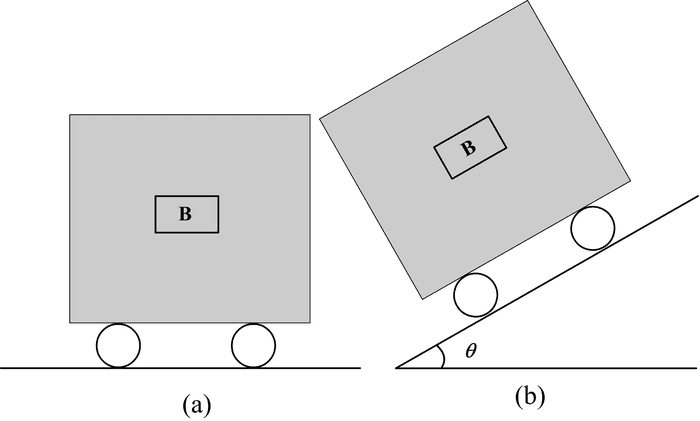
119638.png
 
Physics news on Phys.org
jonny23 said:
its density is same as that of liquid
i.e., it is indistinguishable from the liquid for purposes of this experiment, and remains ...
jonny23 said:
3. stationary wrt to liquid
There may have been a previous version of the question in which the box was not filled completely, and the answer key has not been brought up to date.
 
but what will be the shape of free surface of liquid...
and suppose free surface of liquid comes below the box then i think box will have to move down...
 
Bystander said:
in which the box was not filled completely
suppose it was partially filled then can you explain it please
 
The drawing/sketch of the problem shows liquid filling the box, so it can't be moved relative to the liquid.
jonny23 said:
suppose it was partially filled
On a frictionless plane, it still won't move. Every volume increment of water is accelerating at the same rate.
With friction, it still doesn't move.
This is beginning to look very much like an "intuitive solution" to a counter-intuitive analytical result.
 
  • Like
Likes jonny23
thanks...but will there be any case when the block moves up or down ...if so please tell
 
When the box is not fully filled, and someone starts rocking it back and forth setting up waves, the block will follow the wave motion, but other than that, unless we start postulating compressible fluids or a compressible block, nothing --- watch wait staff in restaurants carrying beverages sometime.
 
  • Like
Likes jonny23
I think it will rotate and move down because the force that is holding the body up in the liquid is pressure and pressure is a function of the depth ,namely H, when the box is put on an inclined plane, to have the same pressure ,the depth must increase because (sign theta times H is smaller than H)
 
ime0n said:
I think it will rotate and move down because the force that is holding the body up in the liquid is pressure and pressure is a function of the depth ,namely H, when the box is put on an inclined plane, to have the same pressure ,the depth must increase because (sign theta times H is smaller than H)
Buoyancy doesn't depend on depth.
 
  • #10
ime0n said:
to have the same pressure ,the depth must increase

the buyount force doesnot depend on absolute pressure rather it depends on pressure difference and it will be same
 
  • #11
jonny23 said:
the buyount force doesnot depend on absolute pressure rather it depends on pressure difference and it will be same
You're right that it doesn't depend on depth (ignoring any compressibility of the fluid), but thinking of it as depending on pressure difference is a bit awkward. Pressure difference between where and where, exactly? If you want to express it in terms of pressure, you would need to consider the integral of the pressure over the surface, bearing in mind that the surface area elements are vectors: ##\int_S P \vec{dA}##. More useful, probably, to stick with the usual 'weight of the fluid displaced' formulation.

Btw, if we consider compressibility, a body that manages to sit in the middle of a fluid under neutral buoyancy by virtue of having not just the same density as the fluid but also the exact same compressibility is physically unrealistic. More reasonably, the body is less compressible than the fluid, allowing it to sit stably at the depth where the densities match. This may admit a different answer to the question, though maybe none of those offered.
 
  • Like
Likes jonny23
  • #12
haruspex said:
usual 'weight of the fluid displaced' formulation.

so for a non compressible ideal fluid can the body B rotate or move ??
 
  • #13
jonny23 said:
so for a non compressible ideal fluid can the body B rotate or move ??
If neither the fluid nor the object are compressible, and they have the same density, there is no reason why the acceleration of the box down the slope would cause the object to move within the fluid. You can arrive at this by a simple thought experiment. Imagine the object as just a notional parcel of the fluid within a box full of fluid. Why should that parcel move relative to the rest of the fluid?
Of course, in tipping the box prior to letting it slide down the slope, the body might change its orientaion relative to the box.
 
  • Like
Likes jonny23
  • #14
ImageUploadedByTapatalk1420190847.200005.jpg


I misused the word 'depth'. well in comparison to the liquid surface the position of the body doesn't change but it does change in comparison to the top of the box.
In this illustration the blue line shows the liquid level, the Orange dotted line shows the position of the body and the dashed – line shows the position in comparison to the top of the box.
 
  • #15
ime0n said:
View attachment 77129

I misused the word 'depth'. well in comparison to the liquid surface the position of the body doesn't change but it does change in comparison to the top of the box.
In this illustration the blue line shows the liquid level, the Orange dotted line shows the position of the body and the dashed – line shows the position in comparison to the top of the box.
Why do you assume (a) that the fluid does not fill the box and (b) that the top of the liquid will be level as the box accelerates down the slope?
 
  • #16
That is only for stationary box, actually I don't understand the question quite well!
 
  • #17
ime0n said:
That is only for stationary box

ya it will be horizontal when stationary but please explain what happens when it accelerates
 
  • #18
ime0n said:
That is only for stationary box,
Ok, but looking at distance from the top of the sloping box isn't relevant. The question asks how/if the object moves relative to the liquid.
jonny23 said:
please explain what happens when it accelerates
Perhaps the easiest way to see how it will behave is to consider a small blob of the liquid at its surface. It is surrounded by other liquid below and 360 degrees around. So which way does the net force on it from the rest of the liquid point?
 
  • #19
i guess that it will be parallel to inclined surface .as the net force should be perpendicular to liquid free surface and the so liquid sholud be parallel to surface.
Untitled.jpg
am i right?
 
  • #20
jonny23 said:
i guess that it will be parallel to inclined surface .as the net force should be perpendicular to liquid free surface and the so liquid sholud be parallel to surface.View attachment 77176 am i right?
In the absence of friction on the slope, yes - well done.
(Can you work out what would happen with some kinetic friction?)
 
  • #21
it should be tan^-1(u) with the incline...
 
  • #22
jonny23 said:
it should be tan^-1(u) with the incline...
How do you arrive at that? I get something a bit different.

Edit: I get the same now. :oops:
 
Last edited:
  • #23
jonny23 said:
i guess that it will be parallel to inclined surface .as the net force should be perpendicular to liquid free surface and the so liquid sholud be parallel to surface.View attachment 77176 am i right?
Why would this happen?
 
  • #24
haruspex said:
How do you arrive at that? I get something a bit different.

in frame of the vessel we apply pseduo force on a liquid particle that is ma = mgsin(thetha) - u mgcos(thetha) and the downward force i.e. mg .

The resultant of the two should be perpendicular to the surface.
 
  • #25
ime0n said:
Why would this happen?
For the reasons given. If the body of water is unchanging in shape as the box slides down the ramp, a parcel of water at the surface must have forces acting on it to result in the same acceleration. This implies a matching slope to the surface.
 
  • #26
jonny23 said:
it should be tan^-1(u) with the incline...
That looks correct to me.

An interesting modification of the problem is to allow the incline to slide on a frictionless, horizontal surface. Suppose a horizontal force of arbitrary magnitude is applied to the incline. If there is no friction between the box and the incline, what is the orientation of the surface of the water? (A special case of this would be to let F = 0 so that the incline recoils to the right as the box slides down the slope.) I get a simple answer (for arbitrary F, M, and m).
 

Attachments

  • Incline with box of water.png
    Incline with box of water.png
    5.4 KB · Views: 507
  • #27
Untitled.jpg
i got this
 
  • #28
jonny23 said:

That's what I get if the box does not slip along the incline (due to sufficient static friction, say). But if there is no friction between the box and the incline, then generally the box will either slide down or up the incline depending on the strength of the force F.
 
  • #29
can somebody please summarize this??
 
  • #30
aashutosh said:
can somebody please summarize this??
Up to about post #13, the thread was mostly in relation to the original problem. Nobody could come up with an explanation for the supposed correct answer. Instead, the consensus is that the body would not move relative ro the liquid.
After that, the thread broadened into interesting discussion of how the liquid would behave if it does not fill the box, under various conditions of friction and applied forces.
 

Similar threads

Replies
3
Views
3K
  • · Replies 16 ·
Replies
16
Views
5K
Replies
8
Views
3K
  • · Replies 19 ·
Replies
19
Views
3K
  • · Replies 2 ·
Replies
2
Views
3K
Replies
8
Views
2K
Replies
18
Views
3K
  • · Replies 11 ·
Replies
11
Views
3K