For OmCheeto (astrospectroscopy)

  • Context: High School 
  • Thread starter Thread starter Andy Resnick
  • Start date Start date
Click For Summary

Discussion Overview

The discussion revolves around astrospectroscopy, specifically the participants' experiences and techniques for capturing and analyzing spectra from celestial objects like Jupiter, Spica, and Arcturus. The scope includes practical applications of diffraction gratings, challenges faced in amateur astrophotography, and comparisons of different equipment.

Discussion Character

  • Exploratory
  • Technical explanation
  • Debate/contested
  • Experimental/applied

Main Points Raised

  • One participant shared their attempt at astrospectroscopy using a diffraction grating taped to a lens flange, noting that their older Sony camera performed better than a Nikon due to sensor placement.
  • Another participant recounted a talk from a local Astro Society member who successfully captured spectra with a diffraction grating, highlighting the temperature curves and absorption lines of stars.
  • One participant mentioned their modification of a diffraction grating to fit their lens and expressed interest in "night lights" spectroscopy.
  • There was a discussion about the RSpec Explorer Spectrometer, with one participant expressing concerns about its price and spectral range, suggesting they would prefer a device that measures IR and UV as well.
  • Another participant noted the use of inexpensive diffraction gratings for educational purposes, emphasizing hands-on experiences over computer involvement.
  • A later reply indicated success in capturing spectra of Jupiter, Spica, and Arcturus using a grating sheet, discussing the challenges of making quantitative measurements and analyzing the spectral data.

Areas of Agreement / Disagreement

Participants express a variety of techniques and experiences in astrospectroscopy, with no clear consensus on the best methods or equipment. Some participants share successful outcomes while others discuss challenges, indicating a mix of agreement on the interest in the topic but disagreement on specific approaches and tools.

Contextual Notes

Participants mention various assumptions about equipment performance and the optical arrangements used, but these details remain unresolved. The discussion also reflects a range of personal experiences and preferences regarding the tools and methods for astrospectroscopy.

Andy Resnick
Science Advisor
Education Advisor
Insights Author
Messages
7,750
Reaction score
3,988
Tried to do some astrospectroscopy last night (fail), but figured I'd share the results anyway.

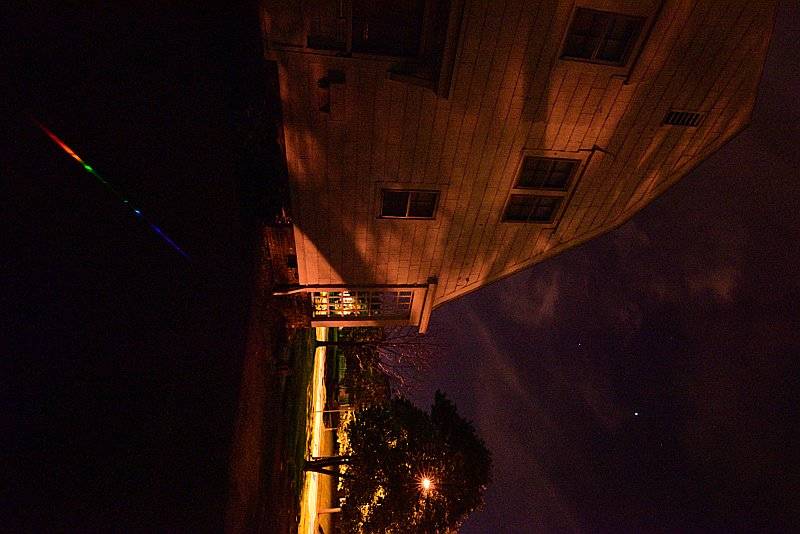
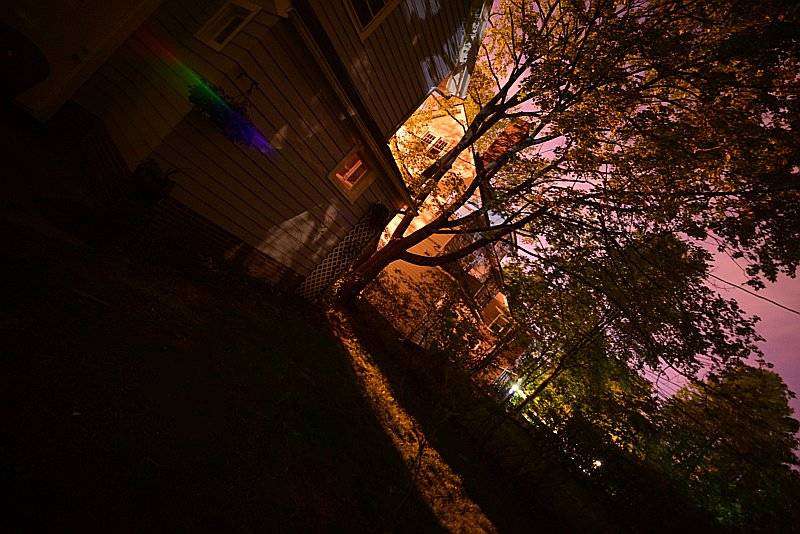
I taped a diffraction grating onto the lens flange (lens side, not camera side) to image some spectra- I was hoping to compare Jupiter, Spica, and Arcturus. For whatever reason, my old Sony worked much better for this- I think that Sony puts their sensor much closer to the lens flange than Nikon so the spectra still fall onto the chip. I ended up having to use a wide-angle lens to capture the spectrum, the trade-off being much less throughput. Images from my backyard- one of a streetlight (with Jupiter and Spica visible), and the other a neighbor's back porch light. These are 6s ISO 1000 exposures:
DSC_1799_zpsurajoicq.jpg


DSC_1810_zpsbfzsmxww.jpg


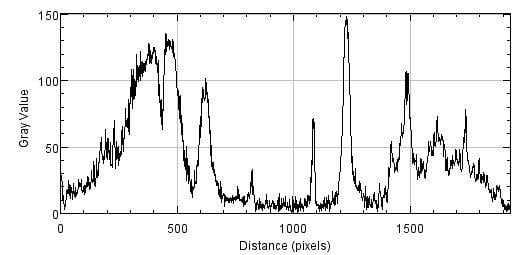
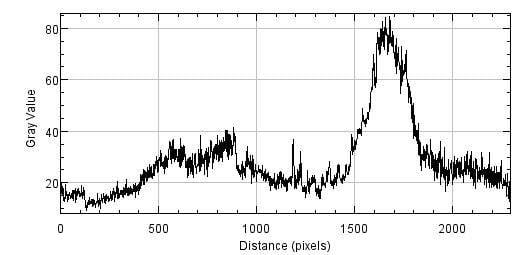
Unfortunately, the planet/starlight was just too faint for me to capture. The lights, however, have measurably different spectra (first one is the streetlight, most likely a Sodium lamp), the second an LED. Note also, the horizontal axis goes from red to blue and you can clearly see the Sodium lamp spectral peaks:
Plot%20of%20DSC_1799_zpsj5e4fhsk.jpg


Plot%20of%20DSC_1810_zps2lqsimfr.jpg


(for comparison: https://image.slidesharecdn.com/201...-all-you-need-to-know-7-638.jpg?cb=1358421058)
 
  • Like
Likes   Reactions: DennisN, OmCheeto, BvU and 1 other person
Science news on Phys.org
A guy at my local Astro Society gave a talk about Spectroscopy and he had some great pictures and graphs of spectra he'd obtained with a diffraction grating, using a section of the digital colour i mage. You could distinctly see the overall curve which corresponded to the temperature of the chosen star and also some absorption lines. All from a humble back yard!
Andy Resnick said:
I think that Sony puts their sensor much closer to the lens flange than Nikon so the spectra still fall onto the chip.
We didn't discuss the optical arrangement but I sort of assumed he was using prime focus and just put the grating 'somewhere' up the tube and it all came out right. (I should have known better. Nothing just comes out right with Astrophotography.
 
  • Like
Likes   Reactions: Andy Resnick
I carved my diffraction grating to fit my lens.

2017.05.16.camera.customized.diffraction.grating.png


I'm also a big fan of "night lights" spectroscopy:

2017.01.09.0306.OmCheeto.porch.light.spectroscopy.png


hmmmm...
Was this thread inspired by the Pamela Gay interview from yesterday?
By the end of it, I had half a dozen new tabs on my browser open.
 
  • Like
Likes   Reactions: DennisN
OmCheeto said:
<snip>
Was this thread inspired by the Pamela Gay interview from yesterday?

Nope- I was photographing the Markarian Chain and clouds started to move in, so I grabbed the opportunity to goof around.
 
  • Like
Likes   Reactions: OmCheeto
Andy Resnick said:
Nope- I was photographing the Markarian Chain and clouds started to move in, so I grabbed the opportunity to goof around.
The last thing she mentioned was the upcoming eclipse.
That prompted me to check out the society she mentioned that she belongs to; "...I’m the Director of Technology and Citizen Science at the Astronomical Society of the Pacific."
There I found that they had the RSpec Explorer Spectrometer for sale. Only $440.
I thought that would be cool to own, but the price was a bit too much, so I'll probably stick with my $1.25 diffraction grating.
The RSpec Spectrometer also doesn't appear to have the range I'm looking for:
Spectral range is approximately 390 to 700 nanometers. Accuracy is generally 1% or better. Spectroscopic features as narrow as 3 nanometers can be measured.
That looks suspiciously like the visual range. If I'm going to spend more than $100 on something, it had better also measure IR & UV.
Perhaps 200 to 1500 nanometers.
I'm not really sure. Some day I'll research that.
(google google google)

Ok. After I win the lottery.
Low Cost GREEN-Wave Spectrometer
350-1150nm wavelength range
$1,948.00​
 
  • Like
Likes   Reactions: sophiecentaur
OmCheeto said:
There I found that they had the RSpec Explorer Spectrometer for sale. Only $440.
I thought that would be cool to own, but the price was a bit too much, so I'll probably stick with my $1.25 diffraction grating.`

Yeah, I'm with you- we hand out those cheap gratings to students (we buy in bulk, I think they end up about $0.50 each) and let them look at spectra themselves- why involve a computer?

Just decided to get a big sheet/roll of grating (like https://www.onlinesciencemall.com/p...=27348598342&gclid=CLOsw_nn-dMCFY-BaQod4x0CuA) to put over the front element of my telephoto. Not sure it will work, but I can afford the $6.50 to try. Science!
 
  • Like
Likes   Reactions: OmCheeto
Success!

As per the image in post #4, I put a grating sheet in front of the lens and was easily able to get spectra of Jupiter, Spica, and Arcturus. The spectra are about 10 degrees off normal, so it took me a bit to realize that I can't look at the object itself in order to capture the spectra. By happenstance, the spectra of Jupiter and Spica appear together- Jupiter is off the frame to the upper right, Spica is off to the left to the lower left:
Jupiter%20and%20Spica_zpsutluojmu.jpg


Here's Arcturus:
Arcturus_zpsh1hguf8k.jpg


Now, using this to make quantitative measurements is tricky: Bayer filter, etc. Here are RGB lineplots through the spectra of Jupiter, Spica, and Arcturus:

Profiles%20of%20Jupiter_zpsd3boo5ah.jpg


Profiles%20of%20Jupiter%20and%20Spica_zpsrfzg9vrn.jpg


Profiles%20of%20Arcturus_zpsyxqjqcl1.jpg


You can see where Jupiter's spectrum overlapped Spica's (the narrow peak). It's not immediately obvious how these correspond to the different colors, but if I plot the spectral intensity ('brightness') rather than the actual colors in the same order, the difference is more clear:

Plot%20of%20Jupiter_zpsihbcwm7y.jpg


Plot%20of%20Jupiter%20and%20Spica_zpslwvlkf8o.jpg


Plot%20of%20Arcturus_zpsmvmo9y7x.jpg


Now, Spica's curve shows how predominantly blue it is, while Arcturus emphasizes the red end. Not sure why there is a 'notch' in the yellow band...
 
  • Like
Likes   Reactions: OmCheeto and sophiecentaur

Similar threads

  • · Replies 2 ·
Replies
2
Views
2K
  • · Replies 152 ·
6
Replies
152
Views
11K