Force of surface tension quandry?

Click For Summary
SUMMARY

The discussion centers on the concept of surface tension, specifically how it relates to the forces acting on water molecules. Key points include the understanding that the force of surface tension (Fs) acts parallel to the contact point of an object, while the weight of the object (Fw) acts downward. The conversation highlights that surface tension can be visualized as a stretched membrane, with the force per unit length remaining constant regardless of surface area changes. Additionally, the inward force created by surface tension leads to a spherical shape in water droplets, minimizing surface area for a given volume.

PREREQUISITES
  • Understanding of basic physics concepts, particularly forces and pressure.
  • Familiarity with molecular interactions, specifically hydrogen bonding in water.
  • Knowledge of the principles of surface tension and its effects on liquids.
  • Basic comprehension of geometric shapes and their properties, such as spheres and surface area.
NEXT STEPS
  • Research the mathematical formulation of surface tension and its units of measurement.
  • Explore the relationship between surface tension and temperature in liquids.
  • Study the effects of surface tension on different liquids, comparing water with oils or alcohols.
  • Investigate practical applications of surface tension in everyday phenomena, such as capillary action and droplet formation.
USEFUL FOR

Students and educators in physics or chemistry, researchers studying fluid dynamics, and anyone interested in the molecular behavior of liquids and their surface properties.

jlyu002@ucr.e
Messages
60
Reaction score
0
I have went through the thread and looked at the explanations for surface tension, and I have also went online to about 10 different websites, but I have not yet been able to figure out this concept. I think it is just my inability to understand and I need perhaps a different way of explaining.
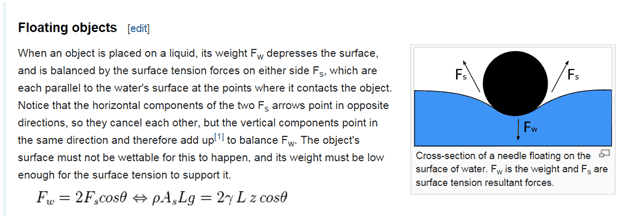
I am trying to see how the force of surface tension is pointing
Here is what I know.
upload_2014-10-15_21-26-54.png


Fw is the weight of the object, and Fs is parallel at the point where it contacts the object which is the force due to surface tension.

Also, the water wants to stay at it's most energetically favorable state. And a sphere will allow minimum surface area for a given volume.

Given all this information, I think the answer to my question is, 1. due to the net inward force, the outer water molecules, e.g. in space, are brought inward and into a sphere in which the outerwater molecules are more tightly bound in an inward fashion. Therefore, due to the fact that water is incompressible, there is a pressure inside the water molecule sphere and the pressure is also radiating outward.(I'm not sure if this pressure idea is right)

2. The energy wants to keep it at this nice mode, therefore if say an object like a needle sits on the water, the water wants to maintain the energy that it was at.

Please, if anyone can assist, I would be extremely thankful!Jonathan
 
Physics news on Phys.org
I like to think of surface tension as the same as that of a stretched membrane acting along the free surface. In the case of a spherical drop, it is like a balloon that is stretched around the drop. The surface tension is the force per unit length within the surface of the balloon. Unlike an ordinary balloon, however, no matter how much the surface area increases, the force per unit length doesn't change. In the case of the needle, the surface tension is the force per unit length along the line of contact between the fluid free surface and the needle. The surface tension always acts in the direction tangent to the free surface. Hope this helps.

Chet
 
  • Like
Likes   Reactions: shangriphysics
Hi Sir Chet,

From your explanation I feel very close to understanding. I just have two more questions: I was wondering if there was no needle, if the direction of force per unit length would be horizontal with the neighboring outer water molecules for the outer most water layer for ex. a ball of water in space. Lastly, is the force due to the hydrogen bonds of neighboring atom?

Thank you Chet!
 
jlyu002@ucr.e said:
Hi Sir Chet,

From your explanation I feel very close to understanding. I just have two more questions: I was wondering if there was no needle, if the direction of force per unit length would be horizontal with the neighboring outer water molecules for the outer most water layer for ex. a ball of water in space.
I don't understand this question, particularly the part about the ball.

On a flat horizontal free-surface, the surface tension acts horizontally within the surface.
Lastly, is the force due to the hydrogen bonds of neighboring atom?
I'm not knowledgeable about the molecular explanation. What I do know is how to model surface tension effects.

Chet
 
Ahh I think I get the satisfying gist of the concept! Thank you so much Chet for your benevolent help!
 

Similar threads

  • · Replies 1 ·
Replies
1
Views
2K
  • · Replies 2 ·
Replies
2
Views
2K
  • · Replies 4 ·
Replies
4
Views
5K
  • · Replies 4 ·
Replies
4
Views
3K
  • · Replies 5 ·
Replies
5
Views
2K
  • · Replies 4 ·
Replies
4
Views
1K
  • · Replies 2 ·
Replies
2
Views
2K
Replies
2
Views
2K
  • · Replies 11 ·
Replies
11
Views
3K
Replies
3
Views
2K