Force Required to Stretch a Rubber Band to a Certain Diameter

Click For Summary
SUMMARY

The discussion focuses on calculating the un-stretched diameter of a rubber band-like product designed to stretch over a 9.875" diameter circle with a force of 10 lbs. The calculations utilize Hooke's Law, with the elastic modulus for Silicone 60A Durometer set at 3.6e6 Pa and a cross-sectional area of 1.2834 in². The derived un-stretched diameter is approximately 9.72 inches. Participants suggest further research into the Mooney-Rivlin model and provide additional resources for understanding stress-strain relationships in rubber materials.

PREREQUISITES
  • Understanding of Hooke's Law and its limitations
  • Knowledge of elastic modulus and its application in material science
  • Familiarity with stress-strain curves for rubber materials
  • Basic proficiency in dimensional analysis and unit conversions
NEXT STEPS
  • Research the Mooney-Rivlin model for rubber elasticity
  • Study the stress-strain curve for latex rubber and its implications
  • Explore advanced material properties of Silicone 60A Durometer
  • Learn about hysteresis effects in elastic materials
USEFUL FOR

Engineers, product designers, and material scientists involved in the design and analysis of elastic products, particularly those working with rubber materials and requiring precise force calculations.

rdijulio
Messages
3
Reaction score
0
Summary: Looking of someone to double check my work on this design issue.

I am posting this here because I am no longer a student, but it is similar to a simple homework problem

Problem: I am designing a rubber-band like product for a client. He wants to take a durable rubber band and stretch it over a circle that is 9.875" diameter and 1.75" wide. He wants it to be easily installed and removed, enough for a child or elderly person of 70 years. So I estimated 10 lbs of force would be ideal. The question I am trying to solve is: (At what un-stretched diameter is 10 lbs of force required to stretch this band to 9.875")

Relevant Equations: F =( [Ln-Lo]/Lo) * E * A

A=Cross Sectional Area (The band is not a rectangle)
E=Elastic Modulus
Ln=Length New (9.875"*π - 31.023" or .78798m)
Lo=Variable
F=Force (10lbs or 44.5N)

This is just Hooke's law, and I know that elastic bands don't behave under hooke's law at a certain point, but this was the best approximation I could find. Solving for Lo gives you:

Lo=Ln/(1 + (F / (E*A) ) )

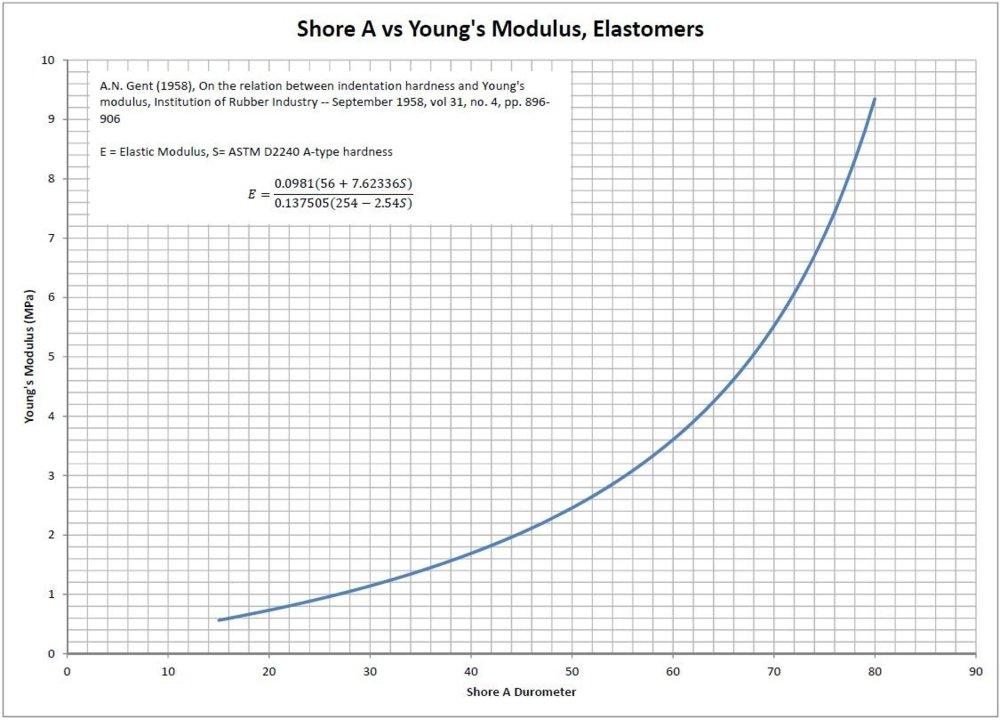
The material I chose to calculate is Silicone 60A Durometer. I pulled the elastic modulus from this graph:
244379


Which gives me an E=3.6e6 pa.

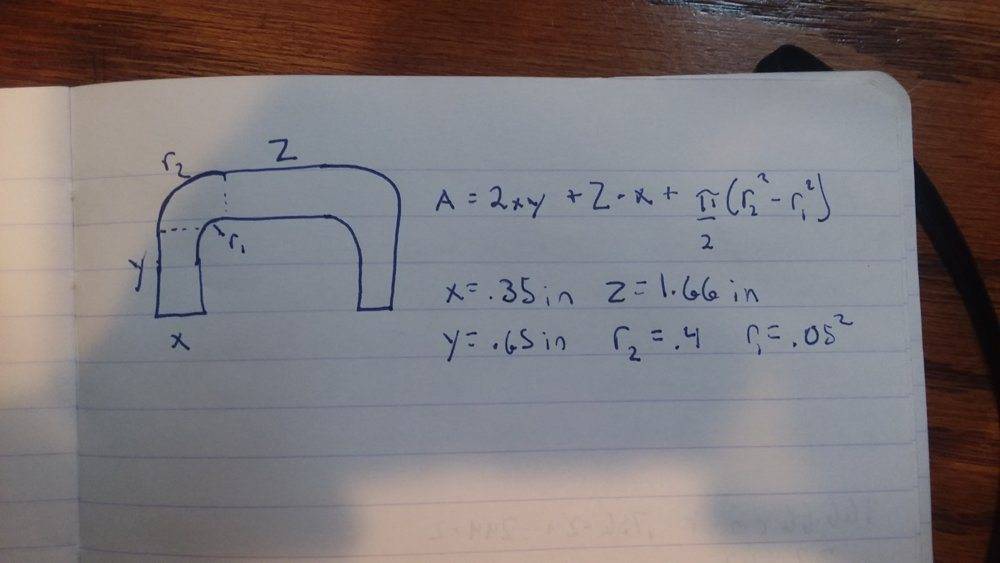
The next step was to calculate the cross sectional area: Here is the drawing with the equations and variables:
244380


Plugging in gives 1.2834in2 or 8.28e-4m2

Now we have all our values:
Lo = .78798 / (1 + 44.5 / (3.6e6*8.28e-4) ) = .77638

D = .77638/pi = .2471m or 9.72inchesJust looking for someone to check my work. Provide possibly any more feedback, or an alternative way to calculate what I need. Thanks!
 
Physics news on Phys.org
For latex rubber (used with fishing line to launch radio control gliders), an archived plot of the stress/strain curve looks like:

https://web.archive.org/web/20070808211048/http://www.hollyday.com/rich/hd/sailplanes/rubberdata.htm
This matches the data i got from my own measurements:

Code:
   strain versus tension / initial unit cross sectional area: (strain == pull distance)

     0% =   0 lb / in^2
    50% =  70 lb / in^2
   100% =  95 lb / in^2
   150% = 115 lb / in^2
   200% = 135 lb / in^2
   250% = 160 lb / in^2
   300% = 175 lb / in^2
   350% = 195 lb / in^2
   400% = 205 lb / in^2  (not recommended).
 
Last edited:
rcgldr said:
For latex rubber (used with fishing line to launch radio control gliders), an archived plot of the stress/strain curve looks like:

https://web.archive.org/web/20070808211048/http://www.hollyday.com/rich/hd/sailplanes/rubberdata.htm
This matches the data i got from my own measurements:

Code:
   strain versus tension: (strain == pull distance)

     0% =   0 lb / in^2
    50% =  70 lb / in^2
   100% =  95 lb / in^2
   150% = 115 lb / in^2
   200% = 135 lb / in^2
   250% = 160 lb / in^2
   300% = 175 lb / in^2
   350% = 195 lb / in^2
   400% = 205 lb / in^2  (not recommended).

Good to know. Latex is an option we had been considering so this is helpful.
 
rcgldr said:
For latex rubber (used with fishing line to launch radio control gliders), an archived plot of the stress/strain curve looks like:

https://web.archive.org/web/20070808211048/http://www.hollyday.com/rich/hd/sailplanes/rubberdata.htm
This matches the data i got from my own measurements:

Code:
   strain versus tension: (strain == pull distance)

     0% =   0 lb / in^2
    50% =  70 lb / in^2
   100% =  95 lb / in^2
   150% = 115 lb / in^2
   200% = 135 lb / in^2
   250% = 160 lb / in^2
   300% = 175 lb / in^2
   350% = 195 lb / in^2
   400% = 205 lb / in^2  (not recommended).
I assume those stresses are per initial cross sectional area (i.e., engineering stress), correct?
 
Chestermiller said:
I assume those stresses are per initial cross sectional area (i.e., engineering stress), correct?
It's latex tubing, and the strain is the increase in length. Say the tubing is 1 meter long, then 50% strain is stretching the tubing so that total length becomes 1.5 meters long, 100% 2 meters long, ..., 300% 4 meters long. For a rubber band, the length would be the circumference.

For 10 lbs of tension at 300% strain, the cross sectional area would be (10/175) ~= 0.057 in^2.
 
rcgldr said:
It's latex tubing, and the strain is the increase in length. Say the tubing is 1 meter long, then 50% strain is stretching the tubing so that total length becomes 1.5 meters long, 100% 2 meters long, ..., 300% 4 meters long. For a rubber band, the length would be the circumference.

For 10 lbs of tension at 300% strain, the cross sectional area would be (10/175) ~= 0.057 in^2.
So those stresses would be the "true stresses", not the "engineering stresses."
 
Chestermiller said:
So those stresses would be the "true stresses", not the "engineering stresses."

Chestermiller said:
I assume those stresses are per initial cross sectional area (i.e., engineering stress), correct?

Correct, the cross sectional area is the initial (zero tension) cross sectional area.

I missed the earlier post. I updated my original post to clarify this.

No attempt was made to measure the hysteresis. Each measurement was done after a stretch. A table of tensions versus return path from various stretches was not made.
 
Last edited:

Similar threads

  • · Replies 12 ·
Replies
12
Views
3K
  • · Replies 1 ·
Replies
1
Views
2K
  • · Replies 26 ·
Replies
26
Views
6K
  • · Replies 11 ·
Replies
11
Views
3K
  • · Replies 11 ·
Replies
11
Views
2K
  • · Replies 3 ·
Replies
3
Views
7K
Replies
16
Views
4K
  • · Replies 3 ·
Replies
3
Views
5K
  • · Replies 6 ·
Replies
6
Views
22K
  • · Replies 7 ·
Replies
7
Views
3K