Force vs. Displacement graph question

Click For Summary
The discussion revolves around calculating kinetic energy and speed from a force vs. displacement graph for an object with a mass of 2.0 kg. Participants clarify that the kinetic energy at a given moment equals the work done from the start to that moment, which can be determined by the area under the curve of the graph. Initial calculations for work and kinetic energy are debated, particularly regarding the correct application of formulas when negative forces are involved. The correct approach involves calculating the area under the graph accurately to find work done, which then translates to kinetic energy. The conversation emphasizes the importance of correctly applying the kinetic energy formula to derive speed, highlighting errors in initial velocity calculations.
Plasm47
Messages
10
Reaction score
0
In the graph below, forces labelled positive act in the direction of motion of the object, forces labelled negative oppose the motion. The object under consideration has a mass of 2.0kg and was initially at rest. Calculate its kinetic energy and speed when
a) d= 2.0m
b) d= 4.0m
c) d=6.0m
d) d= 8.0m
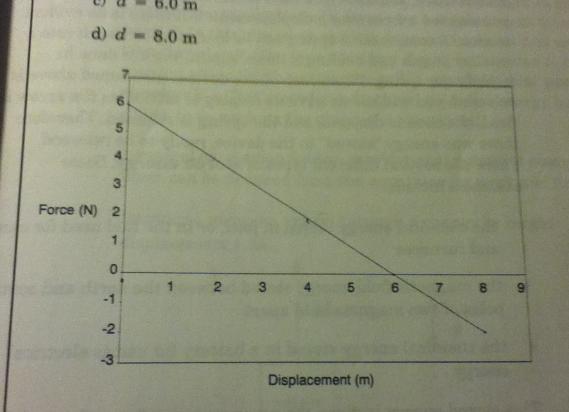
1CQ8P.jpg


I know W is area under the graph, but not positive how to apply it. I assume the question is only asking for that moment in time, and NOT a time period.
so for (a) it would be W= 4.0N x 2.0m = 8J; which would also be Ek
and V= 2.83m/s
if this is correct then b and c follow the same method, so i got those right aswell.
Not sure of the procedure when the Force is negative.
 
Last edited:
Physics news on Phys.org
No, this is not right. The kinetic energy at a given moment is equal to the work done from the beginning to that moment - given that it starts from rest so in the beginning has zero KE.
The work done can be calculated form the area under the curve, as you said (but did not do).
 
nasu said:
No, this is not right. The kinetic energy at a given moment is equal to the work done from the beginning to that moment - given that it starts from rest so in the beginning has zero KE.
The work done can be calculated form the area under the curve, as you said (but did not do).

okay, in that case:
a)to calculate work, solve for area under curve
W= l x w + (bXh)/2
W= 2m x 4N + (2m x (6N-4N)/2
W= 8J + 2J
w= 10 J
The Ek is equivilant to w since there is no work lost in the process.
Ek= 10J

now, solve for velocity
Ek= 0.5 (m)v2
v2= 0.5(2.0kg)/10J
v2= 0.1
v= √0.1
v=0.3m/s (to two sig digs)

if this is correct, then (b), (c), and (d) follow the same process
 
The value of the work looks OK.
Solving for v is not done properly (you can convince yourself calculating the KE with v=0.3m/s and m=2 kg).
Look again at the equation to solve.
 
I do not have a good working knowledge of physics yet. I tried to piece this together but after researching this, I couldn’t figure out the correct laws of physics to combine to develop a formula to answer this question. Ex. 1 - A moving object impacts a static object at a constant velocity. Ex. 2 - A moving object impacts a static object at the same velocity but is accelerating at the moment of impact. Assuming the mass of the objects is the same and the velocity at the moment of impact...

Similar threads

  • · Replies 8 ·
Replies
8
Views
3K
Replies
6
Views
2K
  • · Replies 5 ·
Replies
5
Views
1K
  • · Replies 3 ·
Replies
3
Views
7K
  • · Replies 12 ·
Replies
12
Views
11K
Replies
1
Views
2K
  • · Replies 10 ·
Replies
10
Views
3K
Replies
4
Views
5K
  • · Replies 2 ·
Replies
2
Views
3K
Replies
12
Views
2K