Forces, Acceleration Hard Stuff (HELP)

Click For Summary
SUMMARY

The discussion focuses on solving a physics problem involving forces and acceleration of a trailer being pulled by a vehicle. The key equations derived include the vertical component of the pulling force (Py) expressed in terms of the gravitational force (Fg), acceleration (a), distance (d), length (L), and height (h). The solution involves breaking down the pulling force into its components, applying Newton's laws, and calculating net forces and torques about the trailer's center of mass. The final expression for Py is given as Py = (Fg/L)*(d - a*h/g).

PREREQUISITES
  • Understanding of Newton's laws of motion
  • Familiarity with torque and its calculation
  • Knowledge of force components in physics
  • Basic algebra for rearranging equations
NEXT STEPS
  • Study the principles of torque in static equilibrium
  • Learn about force decomposition in physics problems
  • Explore the relationship between mass, weight, and acceleration
  • Review Newton's second law of motion in detail
USEFUL FOR

Students studying physics, particularly those focusing on mechanics, as well as educators seeking to clarify concepts related to forces and acceleration in practical scenarios.

klopez
Messages
21
Reaction score
0
[SOLVED] Forces, Acceleration...Hard Stuff (HELP!)
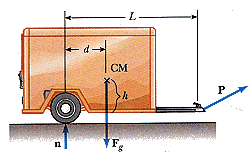
p12-69.gif


A trailer with loaded weight Fg is being pulled by a vehicle with a force P. The trailer is loaded such that its center of mass is located as shown. Neglect the force of rolling friction and let a represent the x component of the acceleration of the trailer.


(a) Find the vertical component of P in terms of the given parameters. (Use F_g for Fg, a, d, L, h, and g as appropriate in your equation.)


I have no idea on how to use come up with an expression that involves acceleration. In matter of fact I do not know where to start because this looks confusing. Can anyone give me advice?

Thanks,
Kevin
 

Attachments

  • p12-69.gif
    p12-69.gif
    11.2 KB · Views: 427
Physics news on Phys.org
What can you deduce about the total torque about any point on the trailer?
 
Here is how I found the correct answer:

First, break down force P into two components: Px and Py


Second, consider the center of mass to be your axis point.


Third, derive an equation for the the net forces in y-components, \sumFy, and let that equal to 0.

Py + n - Fg = 0 (1)


Fourth, derive an equation for the only force in the x-component.

Px = m*a

(and since the force of gravity on the whole truck is mg, than m = Fg/g)
So...

Px = (Fg/g)*a (2)


Fifth, derive an equation for the net torques, \sum\tau acting on the center of mass, which when summed, should equal 0.

Py*(L-d) + Px*h -n*d = 0 (3)

(Both Px and Py produce torque in the same direction so therefore they should be added and then subtracted by the normal force, which is producing torque in the opposite direction.)


Now using equation (3), rearrange the equation so that you have it in terms of n.

n = [(Px*h) + Py*(L-d)]*(1/d)

Since you know Px from equation (2), then you can plug that into the equation above.

n = [(Fg*a*h/g) + Py*(L-d)]*(1/d)

Simplified a bit further...

n = [(Fg*a*h) + Py*g*(L-d)]/(d*g)

Now using the n above, rearrange equation (1) in terms of Py, and then plug in your derived expression for n, and you have the following:

Py = Fg - [(Fg*a*h) + Py*g*(L-d)]/(d*g)

Simplify a bit so you have your Py on one side...

Py*d*g + Py*g*(L-d) = Fg*d*g - Fg*a*h

When you pull out Pyg and divide L on both sides...

Py*g = Fg*(d*g - a*h)/L

Divide g by both sides and your left with your answer...


Py = (Fg/L)*(d - a*h/g)


I hope this helps others who were stuck on this problem.

Kevin
 

Similar threads

  • · Replies 5 ·
Replies
5
Views
2K
Replies
15
Views
2K
  • · Replies 7 ·
Replies
7
Views
5K
Replies
8
Views
5K
  • · Replies 42 ·
2
Replies
42
Views
4K
  • · Replies 97 ·
4
Replies
97
Views
6K
Replies
6
Views
3K
  • · Replies 18 ·
Replies
18
Views
2K
  • · Replies 6 ·
Replies
6
Views
10K
  • · Replies 3 ·
Replies
3
Views
2K