Forces acting on a support point after the system is released

Click For Summary

Homework Help Overview

The discussion revolves around determining the force acting on a support point immediately after a system consisting of a light bar with two unequal masses (m1 and m2) is released. Participants explore the dynamics of the system, including forces and torques involved in the motion.

Discussion Character

  • Exploratory, Conceptual clarification, Mathematical reasoning, Assumption checking

Approaches and Questions Raised

  • Participants discuss the application of Euler's equations of motion and the relationship between net force and acceleration of the center of mass. Questions arise regarding the introduction of motion and acceleration into the problem. There is a suggestion to consider the center of mass and the implications of the system's rotation due to the unequal masses.

Discussion Status

Participants are actively engaging with the problem, offering insights and suggestions for approaching the analysis. Some have expressed a desire to work through the problem independently, while others have provided guidance on considering torque and the choice of an axis of rotation.

Contextual Notes

There is an emphasis on not providing direct solutions, with participants acknowledging the importance of understanding the underlying principles before arriving at a conclusion. The discussion reflects a collaborative effort to explore the dynamics of the system without resolving the problem outright.

IgorT75
Messages
4
Reaction score
2
Summary:: What is the force N which acts on a support point at the moment just after system is released?

[Thread moved from the technical forums, so no Homework Template is shown]

A light bar with m1 and m2 masses (m1≠m2) at the ends placed on the support point (in the middle of the bar).
Initially it is held in this position (by hands let's say). Then it's released.
What is the force N which acts on a support point at the moment just after system is released?
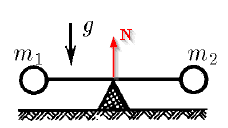
LightBarProblem.png
 
Last edited by a moderator:
Physics news on Phys.org
It is customary that you show an attempt; however I will offer three bits of information that might be useful.

1. The net force on a body equals the total mass of the body multiplied by the acceleration of it's centre of mass. See Euler's equations of motion.

2. The net torque on a rigid body about a chosen origin equals the rate of change of its angular momentum about that origin (or here better expressed with moment of inertia & angular acceleration...?)

3. The acceleration of a point on the rigid body w.r.t. point on the rigid body that is fixed in the lab frame is ##\vec{a} = \vec{\alpha} \times \vec{r} + \vec{\omega} \times (\vec{\omega} \times \vec{r})##. But what is the initial ##\vec{\omega}##?

A few things to think about!
 
@etotheipi : I really was thinking about this problem, and all your points are valid.
But I don't see a motion in this problem - better say I don't see how to introduce it.
Neither do I understand how to introduce acceleration.
Any suggestion will help.
 
OK. First of all, let us suppose WLOG that ##m_1 > m_2##. Hopefully you can see that this will cause the configuration to go into rotation.

Now, let your system consist of the rod and the two masses. This system is acted upon by two gravitational forces, ##m_1 \vec{g}## and ##m_2 \vec{g}##, as well as a normal contact force ##\vec{N}## from the hinge. The vector sum of these forces is then ##(m_1 + m_2)\vec{a}_{cm}##.

Second of all, where is the centre of mass w.r.t. the hinge? And finally, what is the angular acceleration of the configuration (apply ##\tau = I\alpha## about the hinge!).

Try and write down some equations, and go from there!
 
  • Like
Likes   Reactions: Lnewqban and IgorT75
Let me try to back up a step explain how one might attack the problem and thereby decide to do what @etotheipi is suggesting.

You have an unknown force acting at the support point. You have a problem involving rotation. This is a big clue that you should choose an axis of rotation at the support point. Then do a torque balance and see if you can solve for something. Net torque, Angular acceleration, Whatever you can solve for.

Rule of thumb: put your axis of rotation where the unknown force acts. That way the unknown force will not produce any torque.

The hope is that once you solve for what you can solve for, the result will help you calculate what you are really after.
 
  • Like
Likes   Reactions: IgorT75 and etotheipi
@jbriggs444 & @etotheipi : Thanks for actually not giving me solution because I really want to solve it myself.
Will try your suggestions little later and let you know.
Thanks!
 
  • Like
Likes   Reactions: jbriggs444 and etotheipi
Figured it out. Use of center mass was an idea which helped me a lot.
$$(m_2−m_1)gr=Iε=(m_2+m_1)r^2\varepsilon$$Force ##F## and accelaration ##a_c=\varepsilon x## at center of mass:
$$F=Ma_c=(m_1+m_2)a_c$$Forces acting:$$F=(m_1+m_2)g−N$$Assume ##m_2>m_1## and center of mass is at distance x from support point. Then:
$$x=\frac {l(m_2−m_1)} {2(m_1+m_2)}$$Finally:$$N=(m1+m2)∗g−F=...=\frac {4m_1m_2g} {m_1+m_2}$$Thanks to all!
 
Last edited:

Similar threads

  • · Replies 14 ·
Replies
14
Views
2K
Replies
17
Views
2K
  • · Replies 2 ·
Replies
2
Views
1K
Replies
2
Views
2K
  • · Replies 11 ·
Replies
11
Views
4K
Replies
6
Views
2K
  • · Replies 21 ·
Replies
21
Views
1K
  • · Replies 3 ·
Replies
3
Views
3K
  • · Replies 4 ·
Replies
4
Views
2K
Replies
15
Views
4K