Forces for bodies connected by a wire on inclined surface

Join the discussion
Ask a follow-up here, or get your own question answered by working scientists, mathematicians and engineers — people, not an autocomplete.
Real named experts · corrections over time · the nuance an AI answer skips
4 replies · 1K views
Heexit
Messages
10
Reaction score
3
Homework Statement
Two bodies (masses 2 kg and 4 kg) are joined by a wire. The system is laid along a rough inclined plane (the angle of inclination is 30 degrees). For the upper, lighter body, the coefficient of friction is 0.2 and for the lower it is 0.12. what is the thread force after the system is left to itself?
Relevant Equations
F=ma, F=mg, cos, sin,
Hello PhysicsForums!
Here is my attempt at a solution for the problem stated above:
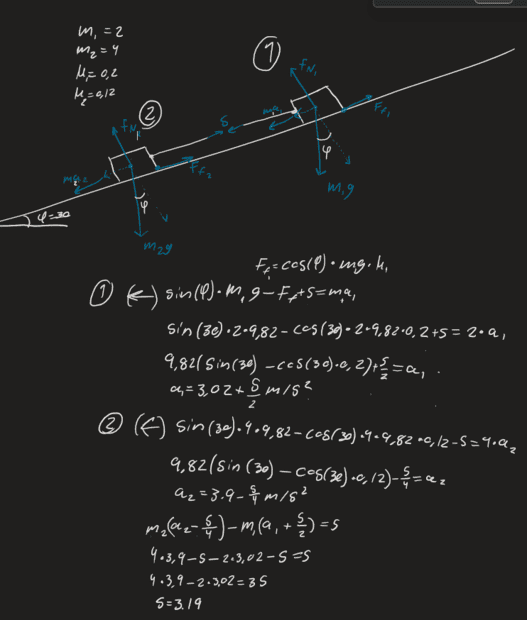
1684412696253.png

Where m1 and m2 are the masses
Where Ff1 and Ff2 are friction for each mass
Where a1 and a2 is the resulting acceleration
Where S is the fore of the wire (threadforce)
Where FN is the normal force

The answear should be 0.91 Newton

Any clues on what I need to change?

Thanks on beforehand for your help!
 
on Phys.org
There are two possibilities that I can see.
  1. The two masses accelerate with the wire under tension (thread force) they must the same acceleration because the wire is assumed inextensible. This means that the velocity of one block does not change relative to the velocity of the other.
  2. The trailing mass is accelerating faster than the leading mass in which case the tension is zero.
You need to determine which possibility is the case here and then write the appropriate equations. Specifically, if (1) is the case, you must use ##a_1=a_2=a## in the equations.
 
Reply
  • Like
Likes   Reactions: MatinSAR and Heexit
Thanks for your help!

Here is my new solution to the problem (with the correct answear!)
1684415965177.png


Thanks for you help and time!
 
Reply
  • Like
Likes   Reactions: kuruman
Hi @Heexit. I'd like to add a minor point. Writing an angle without units, e.g. ##\sin (30)##, implies the angle is in radians. You should include the degrees symbol if the angle is in degrees, i.e. ##\sin(30º)##.

Not distinguishing between radians and degrees - and not ensuring calculators are in the correct mode (radians-mode or degrees-mode) easily leads to errors.

Also, if you are calculating intermediate values, work and record values to two (or more) extra significant figures in the intemediate steps; this reduces rounding error in the final answer. Or better still, work symbolically till near the end, as suggested by @kuruman.

Edit: typo' corrected.
 
Last edited:
Reply
  • Like
Likes   Reactions: Heexit, MatinSAR and Lnewqban