Forces for bodies connected by a wire on inclined surface

Click For Summary
SUMMARY

The discussion focuses on solving a physics problem involving two masses connected by a wire on an inclined surface. The correct answer is determined to be 0.91 Newton. Key considerations include the necessity for both masses to have the same acceleration due to the inextensibility of the wire and the importance of distinguishing between radians and degrees when calculating angles. Additionally, it is advised to maintain higher significant figures during calculations to minimize rounding errors.

PREREQUISITES
  • Understanding of Newton's laws of motion
  • Knowledge of forces including tension and friction
  • Familiarity with trigonometric functions and their applications in physics
  • Ability to perform calculations with significant figures
NEXT STEPS
  • Study the principles of tension in inextensible strings in physics
  • Learn about calculating forces on inclined planes
  • Explore the concept of significant figures in scientific calculations
  • Review the differences between radians and degrees in trigonometry
USEFUL FOR

Students of physics, educators teaching mechanics, and anyone involved in solving problems related to forces and motion on inclined surfaces.

Heexit
Messages
10
Reaction score
3
Homework Statement
Two bodies (masses 2 kg and 4 kg) are joined by a wire. The system is laid along a rough inclined plane (the angle of inclination is 30 degrees). For the upper, lighter body, the coefficient of friction is 0.2 and for the lower it is 0.12. what is the thread force after the system is left to itself?
Relevant Equations
F=ma, F=mg, cos, sin,
Hello PhysicsForums!
Here is my attempt at a solution for the problem stated above:
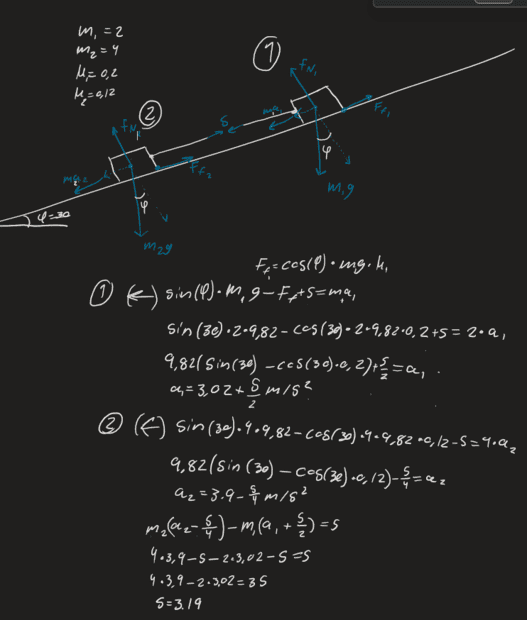
1684412696253.png

Where m1 and m2 are the masses
Where Ff1 and Ff2 are friction for each mass
Where a1 and a2 is the resulting acceleration
Where S is the fore of the wire (threadforce)
Where FN is the normal force

The answear should be 0.91 Newton

Any clues on what I need to change?

Thanks on beforehand for your help!
 
Physics news on Phys.org
There are two possibilities that I can see.
  1. The two masses accelerate with the wire under tension (thread force) they must the same acceleration because the wire is assumed inextensible. This means that the velocity of one block does not change relative to the velocity of the other.
  2. The trailing mass is accelerating faster than the leading mass in which case the tension is zero.
You need to determine which possibility is the case here and then write the appropriate equations. Specifically, if (1) is the case, you must use ##a_1=a_2=a## in the equations.
 
  • Like
Likes   Reactions: MatinSAR and Heexit
Thanks for your help!

Here is my new solution to the problem (with the correct answear!)
1684415965177.png


Thanks for you help and time!
 
  • Like
Likes   Reactions: kuruman
If you had solved the problem symbolically to find an algebraic expression in the form ##s =\dots~##, you would have avoided round off errors and your answer would have been closer to the given one. Anyway, good job!
 
  • Like
Likes   Reactions: MatinSAR and Heexit
Hi @Heexit. I'd like to add a minor point. Writing an angle without units, e.g. ##\sin (30)##, implies the angle is in radians. You should include the degrees symbol if the angle is in degrees, i.e. ##\sin(30º)##.

Not distinguishing between radians and degrees - and not ensuring calculators are in the correct mode (radians-mode or degrees-mode) easily leads to errors.

Also, if you are calculating intermediate values, work and record values to two (or more) extra significant figures in the intemediate steps; this reduces rounding error in the final answer. Or better still, work symbolically till near the end, as suggested by @kuruman.

Edit: typo' corrected.
 
Last edited:
  • Like
Likes   Reactions: Heexit, MatinSAR and Lnewqban

Similar threads

  • · Replies 3 ·
Replies
3
Views
2K
Replies
23
Views
2K
  • · Replies 5 ·
Replies
5
Views
6K
  • · Replies 10 ·
Replies
10
Views
3K
  • · Replies 5 ·
Replies
5
Views
2K
  • · Replies 1 ·
Replies
1
Views
2K
Replies
17
Views
2K
Replies
3
Views
2K
Replies
2
Views
2K
Replies
2
Views
2K