Forces on Dielectrics: Understanding Griffith's Equations

Click For Summary
SUMMARY

The discussion centers on the forces acting on dielectrics as described by Griffith's equations, particularly focusing on the role of fringing fields and uniform electric fields. Participants agree that the attractive force on the dielectric is primarily due to the fringing field, while the uniform field does not perform work on the dielectric due to its perpendicular orientation. The energy stored in the uniform field changes during the process, but the fringing field's energy remains constant, leading to the conclusion that the fringing field is responsible for the work done on the dielectric. The participants emphasize the importance of distinguishing between the forces and the energy changes involved.

PREREQUISITES
  • Understanding of Griffith's equations related to dielectrics
  • Knowledge of electric fields, specifically uniform and fringing fields
  • Familiarity with concepts of work and energy in physics
  • Basic grasp of conservative and non-conservative forces
NEXT STEPS
  • Study Griffith's equations in detail, focusing on dielectric behavior
  • Learn about the implications of fringing fields in electrostatics
  • Explore the relationship between work and energy in electric fields
  • Investigate the differences between conservative and non-conservative forces in physical systems
USEFUL FOR

Students and professionals in physics, electrical engineering, and materials science who are studying dielectric materials and their interactions with electric fields.

Pushoam
Messages
961
Reaction score
53
Forces on dielectrics
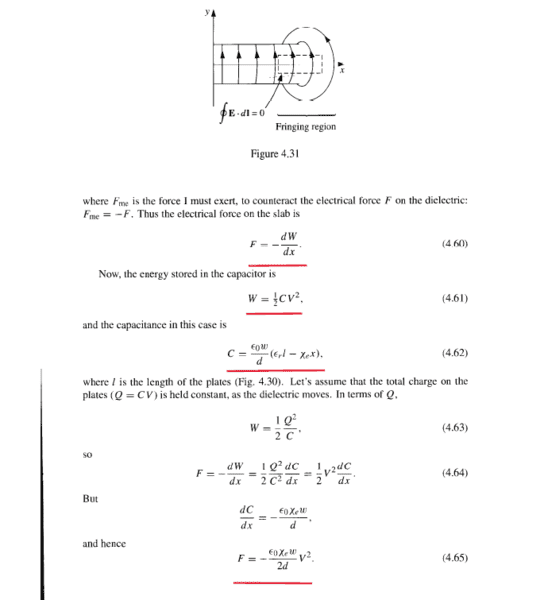
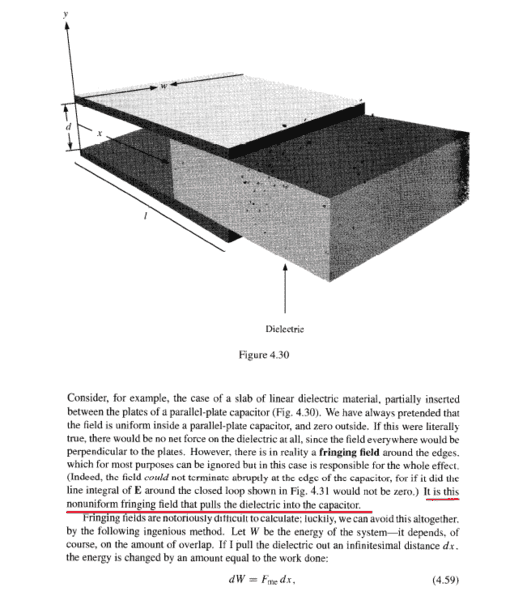
I found difficulty in understanding this topic from Griffith.
upload_2017-8-13_8-3-23.png

upload_2017-8-13_8-6-27.png


Here, while calculating F, in eqn. 4.61 , Griffith doesn't bother about energy stored in fringing field.
So, even if I assume that there is no fringing field, then following the above procedure, I can say that there is an attractive force acting on the dielectric and this force must be due to something other than fringing field.
upload_2017-8-13_8-16-22.png

Are the following conclusions correct?
1) The force due to fringing field pulls the dielectric as the force due to the uniform field is perpendicular to the dielectric surface.

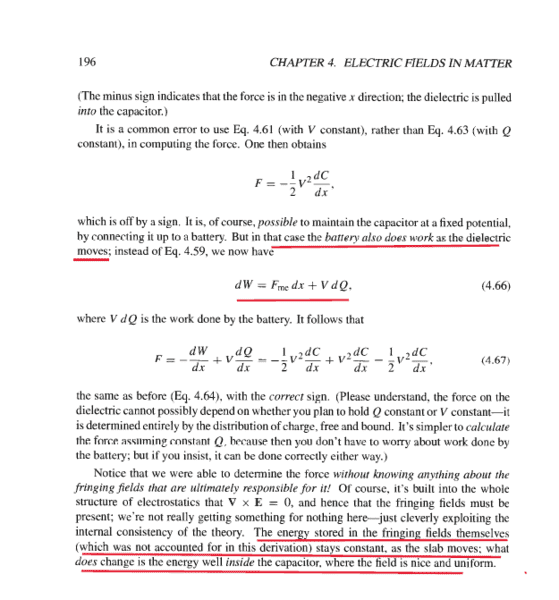
2) The energy stored in the uniform field gets changed in this process. The energy stored in fringing field remains constant. This means that work is being done by the force due to uniform field. But the first conclusion says that the force due to uniform field doesn't work on the dielectric.

I need help here in understanding this point.

In eq. 4.7, force due to battery is constant (as both V and ## \frac { dC } { dx} ## are constant ) . So, the surface charge density changes. Right?
 
Physics news on Phys.org
Interesting point. I believe the issue here is that energy arguments often hide the details of the forces and how the work is being done. There are many examples of this. Take for example how we calculate the speed of a block at the bottom of a frictionless ramp. With an energy argument we ignore everything the ramp does in redirecting the block into horizontal motion, but we still get the right speed.

I think you have the crux of the point when you say that the fringing field doesn't change (at least not until the outer edge of the dielectric gets significantly into the fringing field). The energy calculated without the fringing field is not the total energy, but since the fringe part doesn't change, using just the uniform part of the energy will give the correct change in energy between states, and so it's derivative shows the force. However just because the energy calculation ignored the fringe field doesn't mean that isn't where the force is being generated.

So I think your first statement is correct and the first two sentences of your second statement are correct. However, the conclusion that the uniform field is therefore applying the force seems unwarranted.

I will add that you clearly already see that there is no way around your first statement. The fringe field has to be doing the work.
 
Cutter Ketch said:
Interesting point. I believe the issue here is that energy arguments often hide the details of the forces and how the work is being done. There are many examples of this. Take for example how we calculate the speed of a block at the bottom of a frictionless ramp. With an energy argument we ignore everything the ramp does in redirecting the block into horizontal motion, but we still get the right speed.

Thanks for the above insight as this is something I was looking for.
So, what I conclude from the above two posts is:
If the net work done by the non- conservative forces is 0, then ## \vec F = - ∇ U ## gives the net conservative force acting on the system.
It doesn't tell us about the particular forces acting on the system.
Here, on the dielectrics, the force which keeps the dielectric in the fixed vertical position does no work on it. The only force which works on the dielectric is force due to the electric field and hence it is conservative. Thus, ## \vec F = - ∇ U ## gives here the net conservative force acting on the system.
This doesn't tell us whether the force is due to uniform electric field or due to fringing electric field.
Here, Griffith use this argument that since the force due to uniform field is perpendicular to the dielectric surface, it can't do any work. So, ## \vec F ## must be force due to fringing field.
While calculating U, Griffith doesn't consider the work done due to fringing field as he says that the work done by fringing field remains constant (But, he doesn't prove it.). So, to me, this seems an assumption. So, won't it be better if I simply take work done due to fringing field negligible compared to work done due to uniform field ( and hence, work done due to fringing field is ignored in calculating U.)?

Now, the point which I can't make clear is:
It is the force due to fringing field which pulls the dielectric but it is the energy contained in the uniform field which gets reduced.
I think there is something wrong with the following phrase: "It is the force due to fringing field which pulls the dielectric" because if this happens then it means that there is a component of this force which is along the direction in which the dielectric is being pulled. Hence, there is a component of this force in the direction of displacement and hence using ## W = \int _{\vec s_i }^ { \vec s_f} \vec F. d \, \vec s ## I can say that the work done due to the force due to fringing field is non-zero ( as there is no other force opposing this component of force due to fringing field.).
Is this correct?
 

Similar threads

  • · Replies 6 ·
Replies
6
Views
1K
  • · Replies 6 ·
Replies
6
Views
2K
  • · Replies 5 ·
Replies
5
Views
2K
  • · Replies 3 ·
Replies
3
Views
2K
  • · Replies 1 ·
Replies
1
Views
3K
  • · Replies 2 ·
Replies
2
Views
2K
  • · Replies 3 ·
Replies
3
Views
930
  • · Replies 1 ·
Replies
1
Views
2K
  • · Replies 3 ·
Replies
3
Views
1K
  • · Replies 19 ·
Replies
19
Views
3K