Calc Forces on Pulleys: 200N, 300N Masses, No Friction

  • Thread starter Thread starter Est120
  • Start date Start date
  • Tags Tags
    Forces Pulleys
Click For Summary
SUMMARY

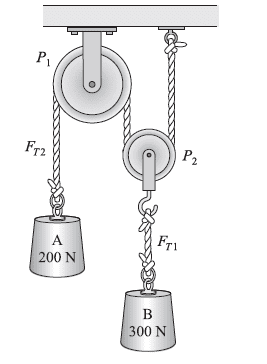
The discussion focuses on calculating the tensions FT1 and FT2 in a pulley system with weights of 200 N and 300 N, as described in Schaum's Physics Book, 10th Edition, problem 3.37. The pulleys are frictionless and have negligible mass, with Pulley P1 stationary and Pulley P2 capable of movement. The forces acting on Pulley P2 are defined as 2FT2 upward and FT1 downward, leading to the conclusion that Mass B rises while Mass A falls, establishing a direct relationship between their accelerations.

PREREQUISITES
  • Understanding of Newton's Second Law (F = ma)
  • Basic principles of pulley systems and tension forces
  • Knowledge of kinematic equations for motion analysis
  • Familiarity with the concept of acceleration in relation to mass movement
NEXT STEPS
  • Study the mechanics of pulley systems in detail
  • Learn how to derive equations for tension in multi-pulley setups
  • Explore kinematic relationships between connected masses
  • Investigate real-world applications of frictionless pulley systems
USEFUL FOR

Students studying physics, particularly those focusing on mechanics and pulley systems, as well as educators seeking to explain the dynamics of forces in a classroom setting.

Est120
Messages
54
Reaction score
3
Homework Statement
In Figure 3-25, the weights of the objects are 200 N and 300 N. It is considered
that the pulleys have no friction and that their masses are negligible. Pulley
P1 has a stationary axis, the P2 pulley can raise or lower freely.
Calculate the tensions FT1 and FT2, as well as the acceleration of each body
Relevant Equations
F=m a
Homework Statement: In Figure 3-25, the weights of the objects are 200 N and 300 N. It is considered
that the pulleys have no friction and that their masses are negligible. Pulley
P1 has a stationary axis, the P2 pulley can raise or lower freely.
Calculate the tensions FT1 and FT2, as well as the acceleration of each body
Homework Equations: F=m a

this problem is in the schaum physics book 10 ed 3.37 and says something like this:

Mass B rises and mass A falls. This can be seen if it is observed that the forces acting on the P2 pulley are 2FT2 up and FT1 down

WHY does the forces acting on P2 pulley are 2FT2?
1565856519648.png
 
Last edited by a moderator:
Physics news on Phys.org
You want to write out your relevant equation to show this.
How far does B go up if A lowers ##x## m ?
So how fast does B go up when A lowers with speed ##v## m/s?
What does that mean for the acceleration of B wrt that of A ?
 

Similar threads

  • · Replies 5 ·
Replies
5
Views
1K
  • · Replies 10 ·
Replies
10
Views
5K
  • · Replies 2 ·
Replies
2
Views
2K
  • · Replies 4 ·
Replies
4
Views
3K
  • · Replies 4 ·
Replies
4
Views
4K
  • · Replies 8 ·
Replies
8
Views
5K
Replies
2
Views
5K
  • · Replies 20 ·
Replies
20
Views
4K
  • · Replies 2 ·
Replies
2
Views
5K
  • · Replies 6 ·
Replies
6
Views
2K