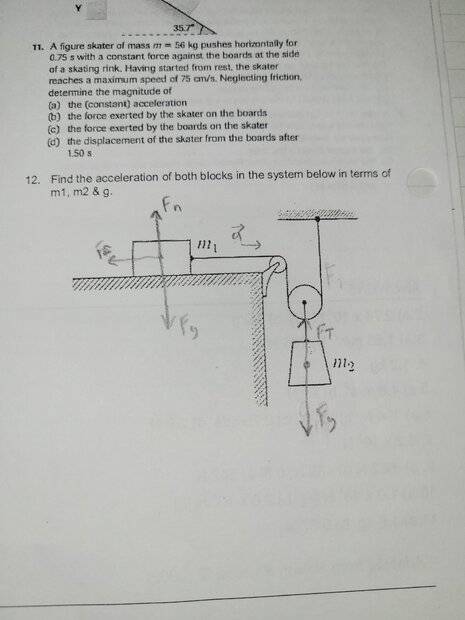
Forces on two different blocks with two pulleys

Click For Summary
SUMMARY

The discussion centers on analyzing forces acting on two blocks connected by pulleys, specifically focusing on the concepts of net force, tension, and acceleration. Participants emphasize that the masses (m1 and m2) do not necessarily have to be equal, and the system can experience acceleration despite the net forces being zero in certain directions. Key assumptions include the absence of friction, the inextensibility of the string, and the massless nature of the pulleys. The importance of free-body diagrams is highlighted for understanding the forces acting on each mass.

PREREQUISITES
  • Understanding of Newton's laws of motion
  • Knowledge of free-body diagrams
  • Familiarity with concepts of tension and acceleration
  • Basic principles of kinematics
NEXT STEPS
  • Study the application of Newton's second law in pulley systems
  • Learn how to construct and analyze free-body diagrams for multiple masses
  • Explore the effects of friction on pulley systems and how to calculate it
  • Investigate the relationship between tension and acceleration in connected masses
USEFUL FOR

Students of physics, educators teaching mechanics, and anyone interested in understanding dynamics in pulley systems.

Amphibia
Messages
6
Reaction score
1
Homework Statement
Question 12
Relevant Equations
Scalar equations
I don't know what to do as I know the forces acting on it but not the scalar like I just don't understand the question with two different pulleys I know the tension same everywhere
20220321_231155.jpg
 
Physics news on Phys.org
Welcome!
How would you apply what you have studied about forces and masses and accelerations to this problem?
Don't let those pulleys confuse you.
 
Lnewqban said:
Welcome!
How would you apply what you have studied about forces and masses and accelerations to this problem?
Don't let those pulleys confuse you.
Well the forces in fnetx and fnety the m1 fnety is 0 so there's fnetx and Ft-Ff for the m1 fnetx and m2 has fnetx=0 and the Fnety is Ft-Fg my only known is gravity
 
Amphibia said:
Well the forces in fnetx and fnety the m1 fnety is 0 so there's fnetx and Ft-Ff for the m1 fnetx and m2 has fnetx=0 and the Fnety is Ft-Fg my only known is gravity
If all Fnet's are zero, there is no movement or acceleration.
But the wording of the problem suggests that there is certain acceleration, and nothing is told about coefficient of friction.
 
Lnewqban said:
If all Fnet's are zero, there is no movement or acceleration.
But the wording of the problem suggests that there is certain acceleration, and nothing is told about coefficient of friction.
Oh so there's no friction the objects are stationary and m1 and m2 are the same masses or I think m1 is = to more than the tension
 
Nothing suggests that m1 and m2 are the same masses.
I believe that you can assume that there is no friction force between m1 and the flat surface, that the string is non-extensible and that the pulleys are massless and free of friction at their pivots.

Then, the weight of m2 is not balanced by any other force and it should induce acceleration of the whole system (m1 and m2).

However, m1 and m2 can't move at the same velocity, and that should be considered and the forces acting on each should be analyzed by free-body diagrams of each mass.
 
Lnewqban said:
Nothing suggests that m1 and m2 are the same masses.
I believe that you can assume that there is no friction force between m1 and the flat surface, that the string is non-extensible and that the pulleys are massless and free of friction at their pivots.

Then, the weight of m2 is not balanced by any other force and it should induce acceleration of the whole system (m1 and m2).

However, m1 and m2 can't move at the same velocity, and that should be considered and the forces acting on each should be analyzed by free-body diagrams of each mass.
Ok so what I see now is that they don't have the same acceleration, the rope is a constant that doesn't extend, velocity is different, the masses are different and that I only see related are the normal force and the tension force of each other
 
  • Like
Likes   Reactions: Lnewqban
Amphibia said:
they don't have the same acceleration
Right, but what is the relationship between the two accelerations?
 
haruspex said:
Right, but what is the relationship between the two accelerations?
That both of their fnet are the same or they have the same amount of forces on each other
 
  • #10
Amphibia said:
That both of their fnet are the same or they have the same amount of forces on each other
No. The forces on the objects are not related in any such way.

Rather than guessing, start by drawing the free body diagrams for each mass. Then ask yourself what information you get out of that and what information you get from the string being inextensible.
 
  • #11
Amphibia said:
That both of their fnet are the same or they have the same amount of forces on each other
The relationship is kinematic, nothing to do with forces.
 

Similar threads

Replies
15
Views
2K
  • · Replies 2 ·
Replies
2
Views
2K
  • · Replies 23 ·
Replies
23
Views
3K
Replies
4
Views
866
  • · Replies 18 ·
Replies
18
Views
2K
  • · Replies 1 ·
Replies
1
Views
3K
  • · Replies 17 ·
Replies
17
Views
3K
  • · Replies 102 ·
4
Replies
102
Views
8K
  • · Replies 10 ·
Replies
10
Views
5K
  • · Replies 5 ·
Replies
5
Views
1K