Fourier Series involving Hyperbolic Functions

Click For Summary
SUMMARY

The discussion revolves around finding the Fourier series of the function f(x) = cosh(x - 2π) defined on the interval [π, 3π] with a period of 2π. The user initially misidentified the function's parity as even, but it was clarified that the function is neither odd nor even. The correct approach to derive the Fourier complex form involves integrating cosh(x) over the interval [-π, π] and using the formula for Fourier coefficients, cn = (1/2π) ∫(−π to π) f(x) e^(inx) dx, which simplifies the process compared to the real Fourier series.

PREREQUISITES
  • Understanding of hyperbolic functions, specifically cosh(x)
  • Knowledge of Fourier series and their applications
  • Familiarity with integration techniques, particularly integration by parts
  • Basic concepts of periodic functions and their properties
NEXT STEPS
  • Study the derivation of Fourier series for periodic functions
  • Learn about the properties of hyperbolic functions and their graphs
  • Practice integration by parts with various functions
  • Explore the differences between real and complex Fourier series
USEFUL FOR

Students studying advanced mathematics, particularly those focusing on Fourier analysis, as well as educators and tutors assisting with complex function analysis and integration techniques.

Sharya19
Messages
21
Reaction score
0
Hello everyone first time here. don't know if it's the correct group... Am having some issues wiz my maths homework that going to count as a final assessment. Really Really need help.
The function (f), with a period of 2π is : f(x) = cosh(x-2π) if x [π;3π]..
I had to do a graph as the first part for the interval of [-π;5π] so that part is ok. PLEASE HELP WITH THE OTHER ISSUES...
NOTE: cosh x =(e^x + e^-x)/2

1st - Have to find out if the function is an odd or even parity... i worked it out and my answer is an even parity... But since i like to cross check(before moving on the next part) on the online calculator, it says that the function is neither odd nor even... Can someone pleasez help and then tell me How to proceed for the Fourier complex form of the function (f) if the answer is neither odd or even?

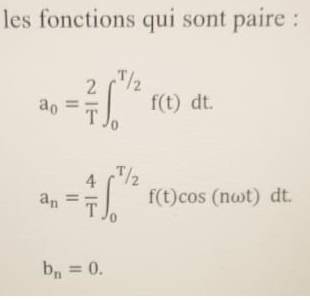
2nd - Have to find out about the Fourier complex form of the function (f).. Since i found it even parity so i used those function as seen in the picture. For ao i already did it, for the an please help wiz the integration by parts... The T in the formula i replaced by 2pi... Is it the correct way to do it?
Formula for pair function.jpg


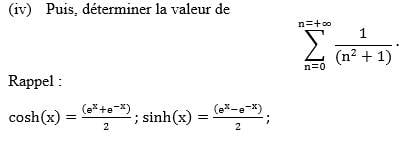
3rd - The Part Four in Roman Numeral(iv), that a total black out for me
Part 5.jpg

PLZ PLZ PLZ really need help...
 
Physics news on Phys.org
Sharya19 said:
Hello everyone first time here. don't know if it's the correct group... Am having some issues wiz my maths homework that going to count as a final assessment. Really Really need help.
The function (f), with a period of 2π is : f(x) = cosh(x-2π) if x [π;3π]..
I had to do a graph as the first part for the interval of [-π;5π] so that part is ok. PLEASE HELP WITH THE OTHER ISSUES...
NOTE: cosh x =(e^x + e^-x)/2

1st - Have to find out if the function is an odd or even parity... i worked it out and my answer is an even parity... But since i like to cross check(before moving on the next part) on the online calculator, it says that the function is neither odd nor even... Can someone pleasez help and then tell me How to proceed for the Fourier complex form of the function (f) if the answer is neither odd or even?

2nd - Have to find out about the Fourier complex form of the function (f).. Since i found it even parity so i used those function as seen in the picture. For ao i already did it, for the an please help wiz the integration by parts... The T in the formula i replaced by 2pi... Is it the correct way to do it?
View attachment 11183

3rd - The Part Four in Roman Numeral(iv), that a total black out for me
View attachment 11182
PLZ PLZ PLZ really need help...
Hi Sharya19 and welcome to MHB! Since this assignment is for assessment, we ought not to give you too much help. But here are a few hints.

I agree with you that the function is even. (The online calculator may possibly not be able to handle the way that the function is defined as being periodic with period $2\pi$, with the initial period being the interval $[\pi,3\pi]$.)

The question asks for the complex form of the Fourier series, but you have given the formula for the real Fourier series. Assuming that you want to work with the real Fourier series, you will need to find integrals of the form $$\int_0^\pi \cosh x\cos(nx)\,dx.$$ To evaluate that you need to integrate by parts twice, as follows: $$\begin{aligned}\int_0^\pi \cosh x\cos(nx)\,dx &= \Bigl[\sinh x\cos(nx)\Bigr]_0^\pi + n\!\!\int_0^\pi \sinh x\sin(nx)\,dx \\ &= (-1)^n\sinh\pi + n\Bigl[\cosh x\sin(nx)\Bigr]_0^\pi - n^2\!\!\!\int_0^\pi \cosh x\cos(nx)\,dx.\end{aligned}$$ It follows that $$(1 + n^2)\!\!\int_0^\pi \cosh x\cos(nx)\,dx = (-1)^n\sinh\pi.$$ If you then use the fact that the function is equal to the sum of its Fourier series, you can evaluate the function at a suitable point (say at $x = \pi$) and you will get a formula that involves $\displaystyle \sum_{n=0}^\infty \frac1{n^2+1}.$
 
Opalg said:
To evaluate that you need to integrate by parts twice, as follows:

Hello. Thanks for the clarification on the even parity. The part where it says u need to integrate by part... sorry if it sound stupid but i still can't grasp it. do i integrate cosh(x) or cosh(x-2pi)... This part is so tough to understand... pleasez help...
 
Sharya19 said:
Hello. Thanks for the clarification on the even parity. The part where it says u need to integrate by part... sorry if it sound stupid but i still can't grasp it. do i integrate cosh(x) or cosh(x-2pi)... This part is so tough to understand... pleasez help...
The function has period $2\pi$, which means that $f(x-2\pi) = f(x)$. Also, the function takes the same values on the interval $[-\pi,\pi]$ as it does on the interval $[\pi,3\pi]$. To find the Fourier series, it is easiest to base the calculation on the fact that $f$ satisfies $f(x) = \cosh x$ on the interval $[-\pi,\pi]$.
 
Opalg said:
The function has period $2\pi$, which means that $f(x-2\pi) = f(x)$. Also, the function takes the same values on the interval $[-\pi,\pi]$ as it does on the interval $[\pi,3\pi]$. To find the Fourier series, it is easiest to base the calculation on the fact that $f$ satisfies $f(x) = \cosh x$ on the interval $[-\pi,\pi]$.
Sorry if the question sound stupid again... My limit is pi to zero?
 
Sharya19 said:
Sorry if the question sound stupid again... My limit is pi to zero?
Yes, the function is even, so you can take twice the integral over the interval $[0,\pi]$ to get the integral over $[-\pi,\pi]$.
 
Opalg said:
Yes, the function is even, so you can take twice the integral over the interval $[0,\pi]$ to get the integral over $[-\pi,\pi]$.
Thanks a lot dr
 
Opalg said:
Yes, the function is even, so you can take twice the integral over the interval $[0,\pi]$ to get the integral over $[-\pi,\pi]$.
Hello. sorry to disturb again. so if i have to find the complex form of the Fourier serie for the function (f) above.
The equation will be cn=1/2pi integral (pi to -pi) f(x) e^inx dx?? Please confirm..
 
Sharya19 said:
Hello. sorry to disturb again. so if i have to find the complex form of the Fourier serie for the function (f) above.
The equation will be cn=1/2pi integral (pi to -pi) f(x) e^inx dx?? Please confirm..
Yes. You will find that it is much easier to calculate the complex Fourier coefficients than the real ones. It is no longer necessary to use integration by parts.
 
  • #10
Opalg said:
Yes. You will find that it is much easier to calculate the complex Fourier coefficients than the real ones. It is no longer necessary to use integration by parts.
Thanks a lot dr. God bless u
 

Similar threads

  • · Replies 1 ·
Replies
1
Views
1K
  • · Replies 13 ·
Replies
13
Views
27K
  • · Replies 23 ·
Replies
23
Views
5K
  • · Replies 4 ·
Replies
4
Views
1K
  • · Replies 1 ·
Replies
1
Views
1K
  • · Replies 1 ·
Replies
1
Views
2K
  • · Replies 9 ·
Replies
9
Views
3K
  • · Replies 7 ·
Replies
7
Views
2K
  • · Replies 3 ·
Replies
3
Views
2K
  • · Replies 10 ·
Replies
10
Views
5K