Fourier series of a step function

Join the discussion
Ask a follow-up here, or get your own question answered by working scientists, mathematicians and engineers — people, not an autocomplete.
Real named experts · corrections over time · the nuance an AI answer skips
5 replies · 3K views
chikou24i
Messages
44
Reaction score
0
Hello, can we make a Fourier series expansion of a (increasing or decreasing) step function ? like the one that I attached here. I just want to know the idea of that if it is possible.
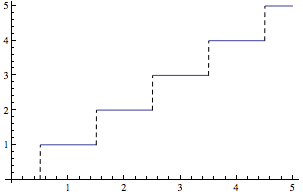
shNoy.png
 
Physics news on Phys.org
You can write down the integral, but with an infinite step function like this the integrals will diverge. With a finite step function it works.
 
  • Like
Likes   Reactions: chikou24i
mfb said:
You can write down the integral, but with an infinite step function like this the integrals will diverge. With a finite step function it works.
So you mean that I should take each portion appart (where f(x) is constant) and calculate the integral. Then, I add them all together ?
Is there any other method where I can calculate Fourier series normally and then I multiply them by another factor which will make them increase or decrease ?
 
The sum will diverge as well for most frequencies, and the approach is at best questionable for frequencies where it does not diverge.

Why do you want to Fourier transform that function?
 
I want to extract the mathematical function for this graph of voltage response. Could you please help me or guide me in doing that ?
https://fb-s-d-a.akamaihd.net/h-ak-xlp1/v/t1.0-0/p526x296/17457874_1911500359125961_8184758272904545979_n.jpg?oh=50117debf8fd6047caf1f0795e0a9254&oe=59500784&__gda__=1498980987_b71e34fea90ba330474f88d4a58f82d9
 
Last edited by a moderator:
You could write it as sum of a linear or parabolic function and some periodic term.

I'm not sure if that is really useful, I'm quite sure a piecewise definition of the function will work better.
 
  • Like
Likes   Reactions: chikou24i