Discussion Overview
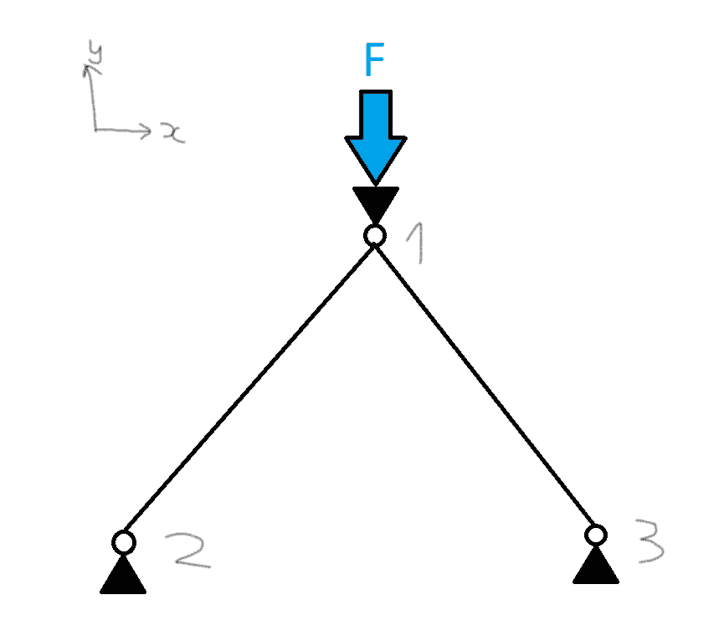
The discussion revolves around the analysis of a structure composed of two-force members and the appropriate reaction forces at various points. Participants explore the implications of treating certain members as two-force members versus considering the entire structure as a single rigid body. The scope includes theoretical considerations of mechanics and structural analysis.
Discussion Character
- Technical explanation
- Conceptual clarification
- Debate/contested
Main Points Raised
- One participant questions whether it is appropriate to treat the left and right sides of the structure as individual two-force members, suggesting that this would imply reaction forces in both x and y directions at points 2 and 3.
- Another participant argues that since there are three points that can counter moments, only vertical reaction forces should exist at points 2 and 3, with no horizontal forces.
- Some participants propose that the presence of a rigid link between points 2 and 3 could allow links 1-2 and 1-3 to be treated as two-force members, resulting in only y-reaction forces at those points.
- Others challenge this by stating that if the rigid link does not exist, then x-reaction forces would be necessary to prevent the structure from collapsing.
- There is a discussion about the implications of internal moments and bending in a rigid body, with some participants suggesting that these factors would affect the reaction forces at points 2 and 3.
- One participant draws an analogy to a bicycle frame, indicating that internal moments would prevent horizontal forces from arising at points 2 and 3 if the body is supported correctly.
- Clarifications are made regarding the nature of forces in different types of mechanisms, with distinctions drawn between axial forces in separate members versus reaction forces in a solid member.
Areas of Agreement / Disagreement
Participants express differing views on whether the structure can be treated as a collection of two-force members or as a single rigid body. The discussion remains unresolved, with multiple competing perspectives on the nature of the forces involved.
Contextual Notes
Participants highlight the importance of assumptions regarding the rigidity of the body and the presence of internal moments, which may not have been clearly defined in the initial posts. The discussion also reflects varying interpretations of the mechanics involved in the structure.
 ##\qquad## !