Should one include friction in this free-body diagram?

  • Context: Engineering 
  • Thread starter Thread starter Qube
  • Start date Start date
  • Tags Tags
    Diagram Friction
Click For Summary

Discussion Overview

The discussion revolves around whether frictional forces should be included in a free-body diagram (FBD) for a truck connected by a chain. Participants explore the implications of including or excluding friction in the context of the truck's motion, acceleration, and the forces acting on it.

Discussion Character

  • Debate/contested

Main Points Raised

  • One participant suggests that not including frictional forces at contact patches A and B does not indicate a lack of understanding, as the tension in the chain could be zero.
  • Another participant argues that tension in the chain arises from inertial forces acting on the truck, rather than frictional forces.
  • A different viewpoint posits that friction must be present if the truck is stationary, as tension in the chain would not exist without friction when the truck is accelerating.
  • Concerns are raised about the scenario where the truck rolls forward without friction, potentially leading to damage when the chain becomes taut.
  • One participant introduces the possibility that the parking brake could be engaged, which would affect the forces acting on the truck and the tension in the chain.
  • This participant also notes that if the parking brake is on, the tension in the chain would create an opposite friction force at the contact patches of the locked wheels.

Areas of Agreement / Disagreement

Participants express differing opinions on the necessity of including friction in the FBD, with no consensus reached on whether it should be included or not. The discussion remains unresolved regarding the role of friction in this context.

Contextual Notes

Participants highlight various assumptions, such as the state of motion of the truck (stationary vs. accelerating) and the potential effects of the parking brake, which may influence the forces involved.

Qube
Gold Member
Messages
461
Reaction score
1
Homework Statement
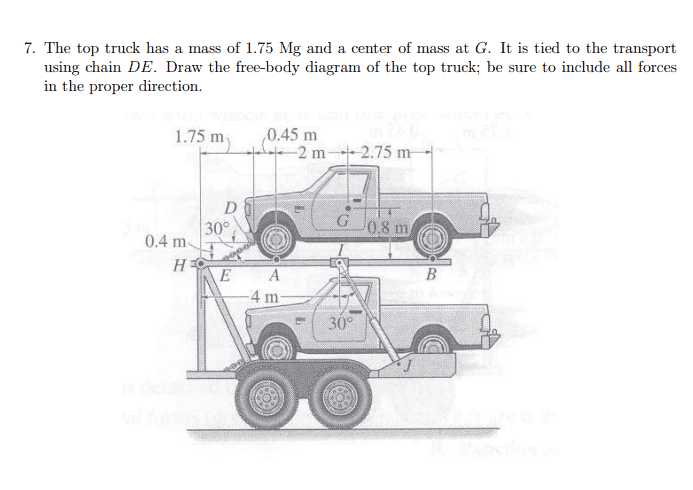
Draw a free-body diagram for the top truck. Image below.
Relevant Equations
sum of forces in x-direction = 0
sum of forces in y-direction = 0
sum of moments = 0
Problem statement:
W2MMX0T.png


Attempt at a solution:

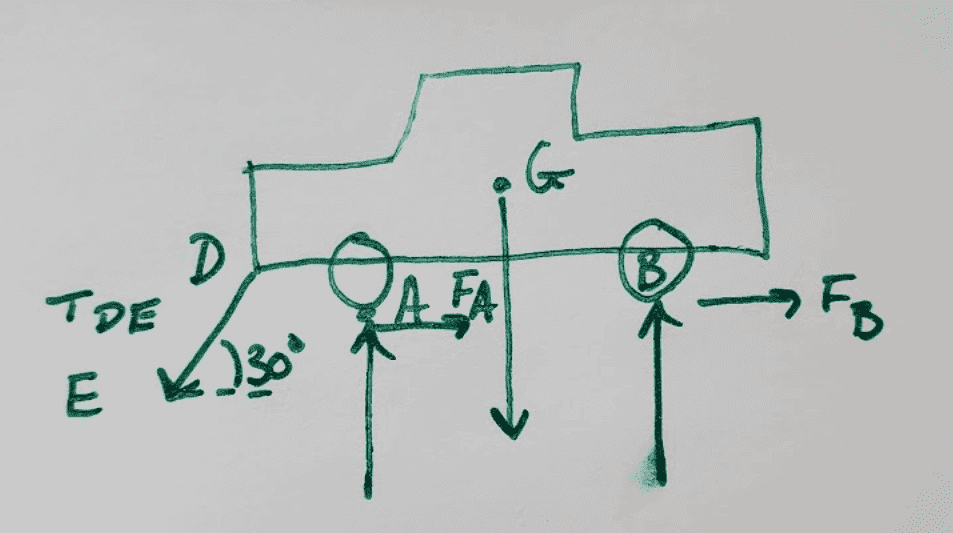
1) There are no relevant moments that need to be drawn in this free-body diagram.

2) There is tension in the chain DE that is pointed away from the truck, i.e. from D to E.

3) There are "ground" reaction forces at points A and B pointed up toward the truck.

4) There is an arrow starting from G and pointing away from the truck; this arrow represents the Fw, or the weight of the truck.
AdUrNwp.png


Question:

Should one include frictional forces at points A and B when drawing the FBD?

The question is vague enough that I think that not including frictional forces at contact patches A and B would not represent a failure of understanding. There's no indication that there's actually any tension in the chain, i.e. the tension in the chain could very well be 0.

On the other hand, I think that a 100% complete solution would include arrows that are perpendicular to the ground reaction forces at A and B pointed toward the "right," or opposite that of the sense of the chain tension.

The end-of-book answer key does not include friction in the FBD. Would including friction make the FBD incorrect in any way?
 
Physics news on Phys.org
You could include any forces that you wish, but their magnitude could prove to be zero.
If there is tension on the chain is not because friction forces, but because inertial forces acting on G.

Imaging replacing the top truck with a huge block of ice: if the trailer is being accelerated, the block of ice would tend to stay behind (no friction), inducing some tension on the chain.
 
I'm no expert on FBDs, but I'd have thought there needs to be friction and you should show it.

If the truck is stationary, there can be no tension in the chain if there is no friction. So maybe there is only tension in the chain when the truck is accelerating. But then it must decelerate at some point. Then there is nothing to restrain it and it will roll forward about 1.4 m before the chain jerks tight. That seems an unlikely scenario to me. I expect they can leave a suitable gap, so that it is stopped by the chain before it hits the car in front. But having it roll that far (frictionlessly) then be stopped, not by a nice elastic tie, but a steel chain, seems a good way to cause damage.

I see Lnewqban has come up with a very sensible comment (about the FBD), with which I'd agree.
 
Last edited:
  • Like
Likes   Reactions: Lnewqban
Merlin's comment made me re-think the whole thing.
It could also be that the parking brake is on and that post-tension has been added to the chain.
In such a set up, the truck should not be able to roll back or forth under acceleration.

If that is true, the tension on the chain would induce an opposite friction force at the contact patches of the locked wheels, plus downwards forces on the front contact patches in addition to their share of the truck's weight (which compresses the suspension some more that weight alone).
 

Similar threads

Replies
4
Views
1K
  • · Replies 2 ·
Replies
2
Views
3K
  • · Replies 2 ·
Replies
2
Views
2K
Replies
3
Views
8K
Replies
24
Views
3K
  • · Replies 7 ·
Replies
7
Views
2K
  • · Replies 8 ·
Replies
8
Views
2K
  • · Replies 3 ·
Replies
3
Views
3K
  • · Replies 4 ·
Replies
4
Views
3K
  • · Replies 25 ·
Replies
25
Views
2K