Hydrostatic Pressure in Freefalling Water Tank: Comparing Point A and B

  • Context: Graduate 
  • Thread starter Thread starter Aeronautic Freek
  • Start date Start date
  • Tags Tags
    Tank Water Water tank
Click For Summary

Discussion Overview

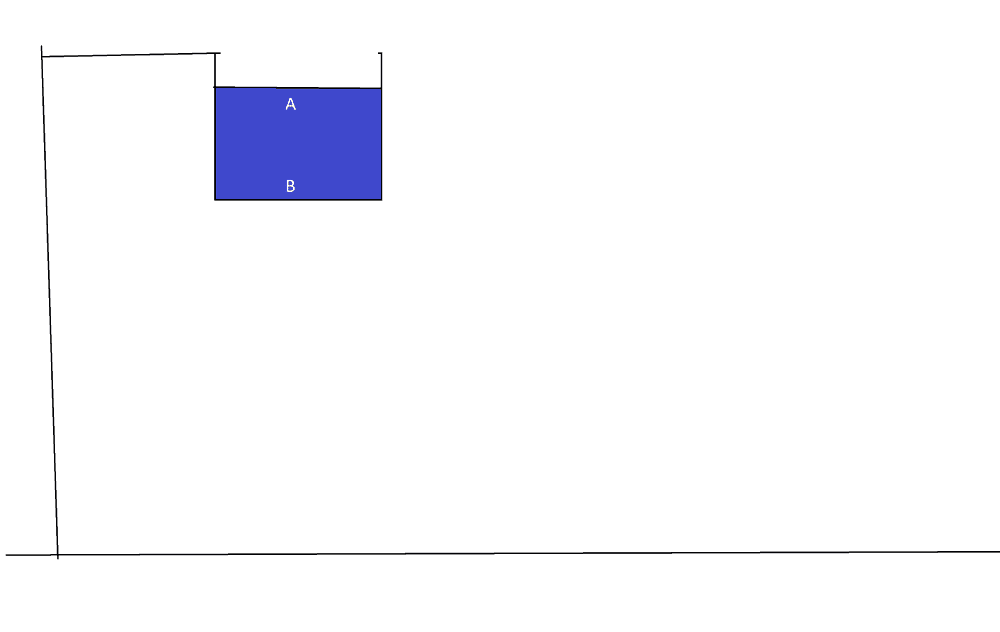
The discussion revolves around the hydrostatic pressure in a water tank that is in freefall, specifically comparing the pressure at two points: A at 0.1m depth and B at 10m depth. Participants explore the effects of acceleration and constant velocity on hydrostatic pressure, addressing both theoretical and conceptual aspects of fluid dynamics in a freefall scenario.

Discussion Character

  • Exploratory
  • Technical explanation
  • Conceptual clarification
  • Debate/contested

Main Points Raised

  • Some participants question whether hydrostatic pressure at point A is greater than at point B during the acceleration phase (0-5 seconds).
  • Others assert that after 5 seconds, when the tank is moving at constant speed, the hydrostatic pressure at both points should be the same.
  • One participant suggests that during freefall, the water does not exert pressure on the layers below it due to the lack of vertical forces, creating no pressure difference until steady speed is reached.
  • Another participant raises the issue of normal force and air drag during freefall, questioning how these forces interact with the water's behavior.
  • Some participants discuss the sensation of weightlessness during freefall and how it relates to the behavior of internal organs and pressure sensations.
  • There is a suggestion that during the accelerating phase, air resistance affects the tank's acceleration, potentially leading to a slight increase in pressure at point B compared to point A.
  • A later reply discusses the extreme pressure conditions when the water hits the ground at terminal velocity, including the dynamics of splashing and energy transfer upon impact.

Areas of Agreement / Disagreement

Participants express differing views on the relationship between hydrostatic pressure at points A and B during the acceleration phase and after reaching constant speed. There is no consensus on the effects of air resistance and the implications for pressure differences. The discussion remains unresolved regarding the exact nature of pressure changes throughout the freefall process.

Contextual Notes

Participants mention various assumptions, such as the effects of air resistance and the definition of freefall, which may influence their arguments. The discussion includes references to the transition between freefall and terminal velocity, highlighting the complexity of the fluid dynamics involved.
Aeronautic Freek
Messages
121
Reaction score
7
tank with water is pushed from construction into freefall,
A is at 0.1m depth
B is at 10m depth (so manometer will show aprox 1bar of hydrostartic pressure when tank is at rest on construction)
from 0-5sec tank is accelrating,after 5sec tank is falling with constant speed..1)is hydrostatic pressure during accelaration phase (0-5sec) greater at point A compare to point B?
2)after 5sec,tank is going with constant speed,so hydrostatic pressure at A and B is the same,but what value will show manometer?
Untitled.png
 
Physics news on Phys.org
Aeronautic Freek said:
View attachment 265126
tank with water is pushed from construction into freefall,
...
1)is hydrostatic pressure during accelaration phase (0-5sec) greater at point A compare to point B?
No

Aeronautic Freek said:
2)after 5sec,tank is going with constant speed,so hydrostatic pressure at A and B is the same
No
 
  • Like
Likes   Reactions: etotheipi
If the apparatus is accelerating due to gravity, the water falls with the vessel at the same speed, which implies that a thin layer of water does not apply any forces to the layer of water below it vertically, and therefore creates no pressure difference. When the speed becomes steady, the water layer begins to press the layer under it, which creates pressure on the bottom layer.
 
Last edited:
Leo Liu said:
If the apparatus is accelerating due to gravity, the water falls with the vessel at the same speed, which implies that a thin layer of water does not apply any forces to the layer of water below it vertically, and therefore creates no pressure difference. When the speed becomes steady, the water layer begins to press the layer under it, which creates pressure at the bottom layer.
but where is normal force during freefaling at constant speed?air drag at bottom of tank?
 
A.T. said:
NoNo
why If feel my stomach lif up when I jump legs first,during acceleration phase?
 
Aeronautic Freek said:
but where is normal force during freefaling at constant speed?air drag at bottom of tank?
This situation is the same as stationary. Therefore, the bottom of the vessel holds the water.
 
Leo Liu said:
This situation is the same as stationary. Therefore, the bottom of the vessel holds the water.
what does "freefall" refers,falling with acceleration or when constant speed is reached?
 
Aeronautic Freek said:
what does "freefall" refers,falling with acceleration or when constant speed is reached?
You should have figured it out before asking. I think it means the acceleration of the equipment is g provided that there is no air resistance.
 
Leo Liu said:
This situation is the same as stationary. Therefore, the bottom of the vessel holds the water.
yes you are right when elevator moves down with constant speed in skyscraper i feel my weight..

why when you jump from high spot legs first you feel how stomach lift up,doesnt organs accelearte with same rate as body?
 
  • #10
Aeronautic Freek said:
yes you are right when elevator moves down with constant speed in skyscraper i feel my weight..

why when you jump from high spot legs first you feel how stomach lift up,doesnt organs accelearte with same rate as body?
It does, but generally it is compressed due to gravity so as you jump it, you feel it stretched.
 
  • #11
Leo Liu said:
If the apparatus is accelerating due to gravity, the water falls with the vessel at the same speed, which implies that a thin layer of water does not apply any forces to the layer of water below it vertically, and therefore creates no pressure difference. When the speed becomes steady, the water layer begins to press the layer under it, which creates pressure on the bottom layer.
in acceralting phase tank feel some air resitance when falling so his accelration is less than gravity=9.81,so does that mean that pressure B will be slightly bigger than A?
 
  • #12
Aeronautic Freek said:
in acceralting phase tank feel some air resitance when falling so his accelration is less than gravity=9.81,so does that mean that pressure B will be slightly bigger than A?
Yes.

Somewhat realistically, you will find that the supporting force from air resistance starts out negligible and then exponentially approaches a fixed limit with just enough to force to support the tank at constant velocity. There is no sudden cutoff from one condition to the other. It is a smooth transition.

The part where air resistance is negligible is "free fall".
The part where air resistance is nearly equal to gravity and speed has stablized is "terminal velocity".

[The transition from "tank of water supported by a rope" to "falling tank with snapped rope" is sudden, of course, but unlikely to immediately result in any dramatic splashes]
 
  • Like
Likes   Reactions: davenn and Aeronautic Freek
  • #13
Now the question is... What happens to the water pressure when it hits the ground at terminal velocity?
 
  • #14
Thomasdahandyman said:
Now the question is... What happens to the water pressure when it hits the ground at terminal velocity?
[Sherman, let's go to the WayBack machine]

It splashes. Pressure is momentarily extreme.

If we assume a perfectly rigid container that lands upright and comes to an immediate stop, the water at the bottom of a tank comes to an immediate stop. Water is not perfectly incompressible, so it piles up at the bottom. But water is not very incompressible, so not much piles up before the pressure becomes extreme.

Exercise: Look up the bulk modulus for water (2 seconds on Google) and determine how much percentage reduction in volume is required to store the kinetic energy from water in a bucket that was falling at, say, 100 miles per hour. How much pressure does that take?

The rebound from this compression turns into a sound wave or perhaps even a shock wave in the water. There is plenty of energy in that shock wave -- most of the energy in the falling water is now embodied in the wave. When the wave reaches the surface, the surface water detaches as a splash. At terminal velocity, I'd expect wave energy to be adequate so that the entire contents of the bucket would splash out immediately.

Sounds like a fun experiment. Drop buckets of water from a tower and get slow motion video of the impacts.
 
Last edited:
  • Like
Likes   Reactions: diogenesNY, russ_watters and Thomasdahandyman

Similar threads

Replies
60
Views
7K
  • · Replies 4 ·
Replies
4
Views
3K
  • · Replies 8 ·
Replies
8
Views
5K
  • · Replies 13 ·
Replies
13
Views
12K
  • · Replies 14 ·
Replies
14
Views
2K
  • · Replies 7 ·
Replies
7
Views
2K
  • · Replies 7 ·
Replies
7
Views
3K
  • · Replies 2 ·
Replies
2
Views
2K
  • · Replies 3 ·
Replies
3
Views
2K
  • · Replies 10 ·
Replies
10
Views
3K