Friction loss in water flowing through a globe valve?

Click For Summary

Discussion Overview

The discussion revolves around the friction loss in water flowing through a globe valve and related components, exploring concepts of energy loss, pressure drop, and turbulence in fluid dynamics. Participants examine theoretical and practical aspects of fluid flow in valves, meters, and filters, including the implications of design choices on energy efficiency.

Discussion Character

  • Exploratory
  • Technical explanation
  • Conceptual clarification
  • Debate/contested
  • Mathematical reasoning

Main Points Raised

  • Some participants suggest that energy loss in fluid flow is related to pressure drop and viscosity, with references to the Darcy-Weisbach equation and equivalent length for fixtures.
  • Others argue that the design of a valve, such as a globe valve, inherently causes energy conversion into turbulence and heat, questioning the possibility of a lossless valve.
  • A participant raises the question of how pressure drop occurs in water meters and whether turbulence contributes to energy loss.
  • Some participants discuss the relationship between flow rate and pressure drop, noting that increased restrictions lead to higher pressure requirements from pumps.
  • There is mention of laminar flow and its characteristics, with a distinction made between pressure drop due to viscosity versus turbulence.
  • Concerns are raised about the pressure drop in sediment filters and whether they can operate with minimal loss, depending on flow rate and filter loading.

Areas of Agreement / Disagreement

Participants generally agree that friction loss and pressure drop are inherent in fluid flow systems, but multiple competing views remain regarding the specifics of how these losses occur and the implications for valve and filter design. The discussion remains unresolved on several points, particularly concerning the potential for lossless flow in practical applications.

Contextual Notes

Limitations include varying definitions of lossless flow, dependence on specific valve and filter designs, and the complexity of fluid dynamics that may not be fully addressed in the discussion.

Who May Find This Useful

This discussion may be useful for engineers, fluid dynamics students, and professionals involved in plumbing, valve design, and water filtration systems, as well as those interested in the theoretical aspects of fluid mechanics.

Secan
Messages
141
Reaction score
11
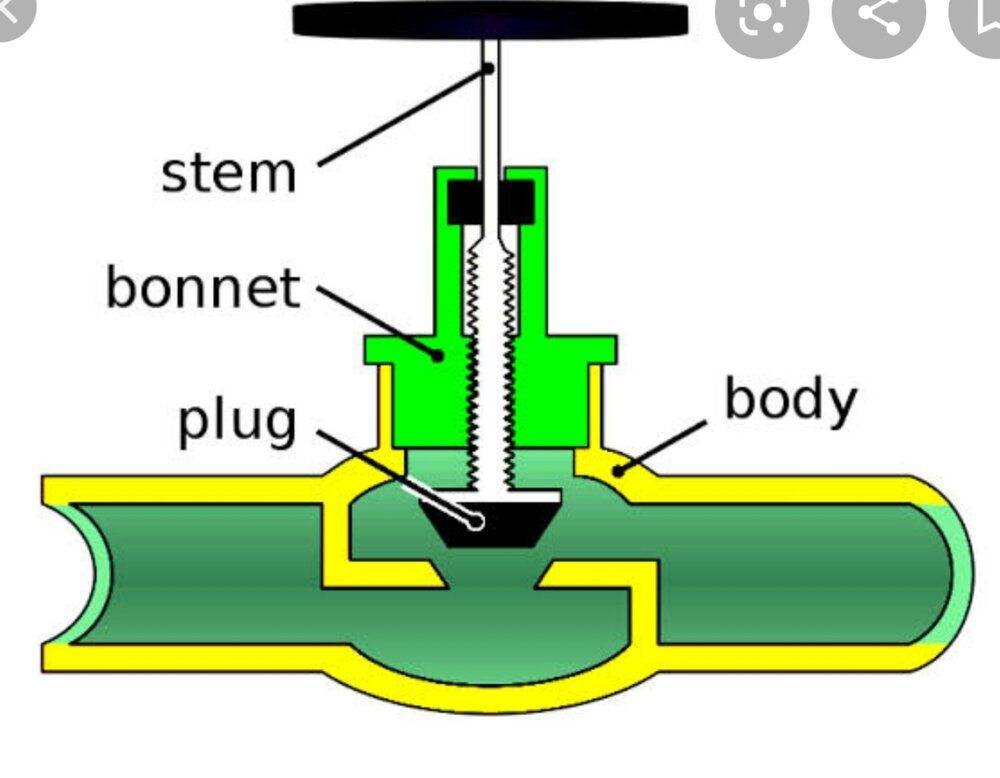
Imagine water flowing inside this from say left to right.
20200907_121404.jpg


Energy can't be destroyed or created. Pressure can reduce due to the three 90 degree turns. Is the pressure or energy loss due to the heat or deformation or kinetic energy loss of the water to the wall inside? What must be the wall be to make it lossless? Like perhaps all atoms bouncing back the kinetic energy?
 
Physics news on Phys.org
Enregy loss is pressure drop for incompressible fluid flow such as water flow.

Pressure drop in flow is proportional to viscosity.

For pipes there is Darcy-Weisbach, for fixtures like elbows or valves there is the equivalent length.
In other words: bouncing back kinetic energy isn't going to help. Smoothing the path (large radius of curvature, wide openings) might, but that's against a valve's purpose 😁

Secan said:
What must be the wall be to make it lossless?
A valve is meant to make the stream loose energy: with a given volume flow ##\Delta E = V \Delta p##.

When designing a valve one can try to minimize energy loss for the situation where the valve is fully open, but that's all.
 
  • Like
Likes   Reactions: Secan, berkeman and Lnewqban
Please, see:
https://www.engineeringtoolbox.com/major-loss-ducts-tubes-d_459.html

More restrictions to the flow, in the form of surface friction and changes of directions (accelerations of mass), means that your pump must push harder to keep the same volumetric rate of flow.

If the pump or its motor are unable of delivering more mechanical energy into the fluid, more restrictions to the flow means reduced volumetric rate of flow.
 
  • Like
Likes   Reactions: Secan
If you want a valve that is lossless when fully open, look at a full port ball valve:
Full Port Ball Valve.jpg

The globe valve in the OP converts fluid kinetic energy into turbulence, then into heat. The energy is not destroyed, but is converted to heat.
 
  • Informative
  • Like
Likes   Reactions: Secan and berkeman
How about a water meter? If my input water pressure is 18psi.. how much is the output psi? Where is the energy loss?

20200907_220414.jpg
 
Did you google "water meter pressure drop" before posting :wink: ?
 
  • Like
Likes   Reactions: russ_watters and Lnewqban
BvU said:
Did you google "water meter pressure drop" before posting :wink: ?

Didnt know the words. But googling it now the physics is not explained. Maybe got to do with turbulence again.

I read liquid helium can flow into anything with
out friction or losses. If they flow into those globe valve and water meter. No losses and no pressure lows and slow downs?
 
The one shown in the picture is an impeller type water meter.
It is bassically a pump in reverse, stealing energy from the flow of water to move the gears mechanism, while inducing turbulence and heat losses as well.

The pressure drop depends on the rate of flow and the specific meter.
Look for the pressure curve in this example:
http://www.industrial-watermeter.co...meter-thread-50c-horizontal-installation.html

:cool:
 
  • Like
Likes   Reactions: Secan
jrmichler said:
If you want a valve that is lossless when fully open, look at a full port ball valve:
View attachment 268994
The globe valve in the OP converts fluid kinetic energy into turbulence, then into heat. The energy is not destroyed, but is converted to heat.

A globe valve with three 90 degree turns converts fluid kinetic energy into turbulence, then into heat as you said. How about the following when there is no 90 degree turn but the opening only very small even at maximum open? Turbulence too?

20200909_083125.jpg
 
  • #10
Anything that causes turbulence also increases pressure drop. You can also get a pressure drop by making the fluid flow through a small hole. Search Bernoulli Equation to learn more.

Anticipating your next question: Is it possible to get a pressure drop without turbulence? Answer: Yes. Search laminar flow to learn about this. Note that pressure drop in laminar flow is due to viscosity, and that all normal fluids have viscosity.
 
  • Like
Likes   Reactions: Secan
  • #11
jrmichler said:
Anything that causes turbulence also increases pressure drop. You can also get a pressure drop by making the fluid flow through a small hole. Search Bernoulli Equation to learn more.

Anticipating your next question: Is it possible to get a pressure drop without turbulence? Answer: Yes. Search laminar flow to learn about this. Note that pressure drop in laminar flow is due to viscosity, and that all normal fluids have viscosity.

20200911_054010.jpg


Plumbers and people i talked all said as velocity increases in the water hose nozzle. Pressure increases or how else will the velocity increase. Do you have simple counterarguments using the concept of water nozzle to disprove their wrong assumptions (which i can correct them) and not using from airplane wings?
 
  • #12
When you have a hose with the end open, the pressure is high at the beginning of the hose, and low at the open end of the hose. The total flow is high, and the velocity out of the hose is low.

A similar hose with a small nozzle on the end will have lower total flow. Because the flow is less, the pressure drop in the hose is less. Good search terms to learn more are liquid flow line loss. Because the total flow is less, and the pressure high, the pressure into the nozzle is high.

Nozzle.jpg

In both cases, the static water pressure after the hose or nozzle is zero. The static pressure is what a pressure gauge measures. Velocity pressure is what you feel when the water flow is aimed at you. The velocity pressure is low with the open hose, and high with the nozzle.

The nozzle changes static pressure into velocity according to the Bernoulli Equation as mentioned above.
 
  • Like
Likes   Reactions: Secan
  • #13
jrmichler said:
When you have a hose with the end open, the pressure is high at the beginning of the hose, and low at the open end of the hose. The total flow is high, and the velocity out of the hose is low.

A similar hose with a small nozzle on the end will have lower total flow. Because the flow is less, the pressure drop in the hose is less. Good search terms to learn more are liquid flow line loss. Because the total flow is less, and the pressure high, the pressure into the nozzle is high.

View attachment 269179
In both cases, the static water pressure after the hose or nozzle is zero. The static pressure is what a pressure gauge measures. Velocity pressure is what you feel when the water flow is aimed at you. The velocity pressure is low with the open hose, and high with the nozzle.

The nozzle changes static pressure into velocity according to the Bernoulli Equation as mentioned above.

Ok. Thanks a bunch. Are you familiar with sediments filter? They come with flow rate. Does it mean water from the source can pass through them with almost no loss? Is there any turbulence or pressure loss in passing through the sediment filter? Or are sediment filters designed so water can just flow in without hindrance. Or does the flow rate can only be taken advantage if you use a pump?

20200911_103816.jpg

I bought 3 slim 20"filter housing and filters and thinking whether to get the so called Big Blue twice bigger.
 
  • #14
All filters have pressure drop. That pressure drop is a function of flow rate - more flow equals more pressure drop. The pressure drop increases as the filter gets loaded with dirt. If you want more information, good search terms are filter beta ratio and water filter pressure drop.

The flow rating for a home water filter is a number that tells you where to use it. A whole house filter needs a larger flow rating than a filter that's used for a kitchen faucet.
 
  • Like
Likes   Reactions: Secan
  • #15
jrmichler said:
All filters have pressure drop. That pressure drop is a function of flow rate - more flow equals more pressure drop. The pressure drop increases as the filter gets loaded with dirt. If you want more information, good search terms are filter beta ratio and water filter pressure drop.

The flow rating for a home water filter is a number that tells you where to use it. A whole house filter needs a larger flow rating than a filter that's used for a kitchen faucet.

Most instant tankless multipoint water heater has plastic pressure valve where you can control the water pressure either in the inlet or outlet (by turning the scew below). If you make the flow weaker, does it make the water colder or hotter given the same thermostat setting)? What does Bernolli principle say about temperature?

20200913_094441.jpg
 
  • #16
Secan said:
Most instant tankless multipoint water heater If you make the flow weaker, does it make the water colder or hotter given the same thermostat setting)? What does Bernolli principle say about temperature?
Bernoulli's Principle says nothing about temperature (at least not directly). However if you add a pressure drop it will increase the temperature of the water a little.
 
  • #17
The temperature rise is the difference between the outlet temperature and inlet temperature. The temperature rise is the amount of heat added divided by the water flow rate. Less flow equals higher temperature.

Unless a thermostat inside the water heater controls the amount of heat so as to get a desired outlet temperature. In that case, the outlet temperature will stay the same over a range of flow rates. Until the flow rate gets too large for the size of the heater. The instant water heater can only put out a certain amount of heat, so can only maintain the desired outlet temperature up to a certain flow rate. If the temperature drops when you draw water too fast, and the valve allows you to restrict the flow just enough to keep the temperature up.
 
  • #18
jrmichler said:
When you have a hose with the end open, the pressure is high at the beginning of the hose, and low at the open end of the hose. The total flow is high, and the velocity out of the hose is low.

A similar hose with a small nozzle on the end will have lower total flow. Because the flow is less, the pressure drop in the hose is less. Good search terms to learn more are liquid flow line loss. Because the total flow is less, and the pressure high, the pressure into the nozzle is high.

View attachment 269179
In both cases, the static water pressure after the hose or nozzle is zero. The static pressure is what a pressure gauge measures. Velocity pressure is what you feel when the water flow is aimed at you. The velocity pressure is low with the open hose, and high with the nozzle.

The nozzle changes static pressure into velocity according to the Bernoulli Equation as mentioned above.

The following is middle of a hose. The water passes by a small enlarged area midway. Will there be turbulence introduced and slight pressure drop?

20200916_221223.jpg
 
  • #19
Yes. There could be a little drop or a lot, depending on velocity, and size and shape of the enlarged area. And there is no easy way to calculate the amount of pressure drop.
 
  • Like
Likes   Reactions: Secan
  • #20
jrmichler said:
Yes. There could be a little drop or a lot, depending on velocity, and size and shape of the enlarged area. And there is no easy way to calculate the amount of pressure drop.

Have you heard of a device that looks like a pressure switch but actually it's a flow strength swtich? That is. In the following, the pin will only move if there is water flow. But if you plug the other end, the pin will return back. In ordinary pressure switch. It's the opposite where without flow, there is maximum pressure and so the pin will extend. In the following without flow, the pin will not extend. Only with flow of certain minimum strength will pin extend. Or know any other device where it is enabled by the flow velocity pressure? Note that water enters here at center. Jet from the center to the nearest hole and exit the other side.

20200919_080209.jpg
20200919_080222.jpg
20200918_180042.jpg
20200918_180128.jpg
 
  • #21
Secan said:
Have you heard of a device that looks like a pressure switch but actually it's a flow strength swtich? That is. In the following, the pin will only move if there is water flow. But if you plug the other end, the pin will return back. In ordinary pressure switch. It's the opposite where without flow, there is maximum pressure and so the pin will extend. In the following without flow, the pin will not extend. Only with flow of certain minimum strength will pin extend. Or know any other device where it is enabled by the flow velocity pressure? Note that water enters here at center. Jet from the center to the nearest hole and exit the other side.

View attachment 269669View attachment 269670View attachment 269671View attachment 269672

To illustrate the above. Here is the great puzzle. In the following youtube video you can see the pin of the flow switch diaphragm extended when the faucet is flowing (the valve is after the flow or pressure switch).


Supposedly in a normal pressure switch. As someone described. The pressure will be a maximum when there's no flow, precisely because at zero flow there is no pressure drop anywhere in the system, so the pressure here will be full mains pressure. When the shower-head is on and there's flow, the pressure here will drop.

But in this flow switch diaphragm. It's the opposite. What is in the design in the diaphragm such that when there is no flow (pressure maximum), pressure won't push the pin. The pin will only extend when there is flow.

Any ideas?
 
Last edited:

Similar threads

  • · Replies 4 ·
Replies
4
Views
4K
  • · Replies 9 ·
Replies
9
Views
4K
  • · Replies 3 ·
Replies
3
Views
18K
  • · Replies 31 ·
2
Replies
31
Views
5K
  • · Replies 18 ·
Replies
18
Views
3K
  • · Replies 6 ·
Replies
6
Views
3K
  • · Replies 2 ·
Replies
2
Views
3K
  • · Replies 8 ·
Replies
8
Views
4K
  • · Replies 3 ·
Replies
3
Views
3K
  • · Replies 5 ·
Replies
5
Views
3K