shankman
- 4
- 0
Hello! First time, long time!
This is kind of a long post. I did what I could to keep it clear. TYIA!
I was marked totally wrong on a test question and I think I may have been correct. I'm trying to get my ducks in a row before I ask the professor to review this with/for me. Everyone in the class seems to have gotten different answers so I don't have anything to compare it to.
I believe that in this system, there is no acceleration because the friction is too great. This calculator I found online agrees with my answers:
http://hyperphysics.phy-astr.gsu.edu/hbasees/incpl2.html#c1
Any thoughts or advice would be helpful.
Please, help me stick it to the man! Or, keep me from making a jerk out of myself.
The hanging 300g mass is connected to a 500g mass on a 35 degree downwards incline by an ideal string/pulley arrangement. Calculate the acceleration of the masses and the tension in the string when the system is released. The friction coefficient between the 500g mass and the ramp is Mk=.150.
Here is a picture of the situation:
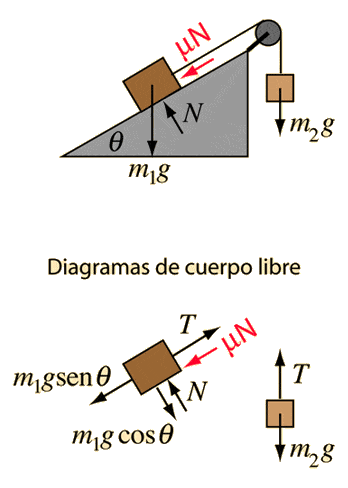
m1=500g
m2=300g
F=ma
w=mg
N=mg(cos@) <----- @=theta
Force parallel to ramp = mg(sin@)
Friction=(N)(Mk)
For the 500g block:
W = (.5)(9.8) = 4.9N
N = (.5)(9.8)(cos35) = 4.01N
Force parallel to ramp = (.5)(9.8)(sin35) = 2.81N
Friction on ramp = (4.01)(.150) = .601N
For the 300g (hanging) block:
W = (.3)(9.8) = 2.94N
OK, if we were totally frictionless we would get: Fnet = 2.94 - 2.81 = .13N towards the hanging 300g block. This means:
.13N = (.8kg)a
a = .1625 m/s^2
But, we have friction and friction works against any motion. I believe that in this system, the friction is too great to overcome with these masses. We are in the zone where the blocks will not move.
Since the system wants to move towards the 300g mass, friction opposes it:
Fnet = 2.94N – 2.81N - .601N = -.471N
Therefore, it will not accelerate towards the 300g hanging mass because the friction is too great.
AND, I just don’t get to add the friction as a force going down the hill and say:
Fnet = 2.81N + .601N – 2.94N = .471N
This due to the fact that the friction would then oppose the downhill motion and bring me back to the first situation.
Therefore, we have too much friction in this system.
Am I correct in my logic and reasoning?
Since there is no movement, the Tensions are equal to the weights of the masses.
T1 = 2.81N
T2 = 2.94N
This is kind of a long post. I did what I could to keep it clear. TYIA!
I was marked totally wrong on a test question and I think I may have been correct. I'm trying to get my ducks in a row before I ask the professor to review this with/for me. Everyone in the class seems to have gotten different answers so I don't have anything to compare it to.
I believe that in this system, there is no acceleration because the friction is too great. This calculator I found online agrees with my answers:
http://hyperphysics.phy-astr.gsu.edu/hbasees/incpl2.html#c1
Any thoughts or advice would be helpful.
Please, help me stick it to the man! Or, keep me from making a jerk out of myself.
Homework Statement
The hanging 300g mass is connected to a 500g mass on a 35 degree downwards incline by an ideal string/pulley arrangement. Calculate the acceleration of the masses and the tension in the string when the system is released. The friction coefficient between the 500g mass and the ramp is Mk=.150.
Here is a picture of the situation:
m1=500g
m2=300g
Homework Equations
F=ma
w=mg
N=mg(cos@) <----- @=theta
Force parallel to ramp = mg(sin@)
Friction=(N)(Mk)
The Attempt at a Solution
For the 500g block:
W = (.5)(9.8) = 4.9N
N = (.5)(9.8)(cos35) = 4.01N
Force parallel to ramp = (.5)(9.8)(sin35) = 2.81N
Friction on ramp = (4.01)(.150) = .601N
For the 300g (hanging) block:
W = (.3)(9.8) = 2.94N
OK, if we were totally frictionless we would get: Fnet = 2.94 - 2.81 = .13N towards the hanging 300g block. This means:
.13N = (.8kg)a
a = .1625 m/s^2
But, we have friction and friction works against any motion. I believe that in this system, the friction is too great to overcome with these masses. We are in the zone where the blocks will not move.
Since the system wants to move towards the 300g mass, friction opposes it:
Fnet = 2.94N – 2.81N - .601N = -.471N
Therefore, it will not accelerate towards the 300g hanging mass because the friction is too great.
AND, I just don’t get to add the friction as a force going down the hill and say:
Fnet = 2.81N + .601N – 2.94N = .471N
This due to the fact that the friction would then oppose the downhill motion and bring me back to the first situation.
Therefore, we have too much friction in this system.
Am I correct in my logic and reasoning?
Since there is no movement, the Tensions are equal to the weights of the masses.
T1 = 2.81N
T2 = 2.94N
Last edited: