Frictional forces between ropes

  • Thread starter Thread starter tcd89
  • Start date Start date
  • Tags Tags
    Forces
Click For Summary
SUMMARY

The discussion centers on calculating the tension in the rope connecting blocks A and B, as well as determining the weight of block C and the acceleration of block C if the rope is cut. Blocks A and B each weigh 23.2 N, and the coefficient of kinetic friction is 0.31. The system is in equilibrium with block C descending at a constant velocity, indicating that the tension in the rope equals the frictional force acting on block A. If the rope is cut, the available force will cause both blocks A and B to accelerate.

PREREQUISITES
  • Understanding of Newton's laws of motion
  • Knowledge of frictional forces and coefficients
  • Ability to apply free body diagrams
  • Familiarity with tension in ropes and pulleys
NEXT STEPS
  • Calculate the frictional force using the formula F_friction = μ * weight
  • Learn about free body diagrams for multi-block systems
  • Study the effects of cutting tension in connected systems
  • Explore the relationship between tension and acceleration in physics
USEFUL FOR

Students studying physics, particularly those focusing on mechanics, as well as educators and anyone interested in understanding the dynamics of connected objects and frictional forces.

tcd89
Messages
2
Reaction score
0
Blocks A, B, and C are placed as in the figure (Intro 1 figure) and connected by ropes of negligible mass. Both A and B weigh 23.2 N each, and the coefficient of kinetic friction between each block and the surface is 0.31. Block C descends with constant velocity.
Find the tension in the rope connecting blocks A and B.
What is the weight of block C?
If the rope connecting A and B were cut, what would be the acceleration of C?
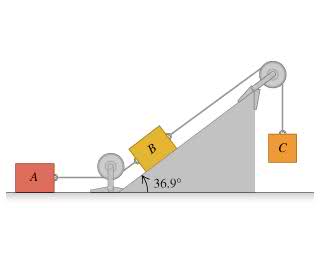
25plgf7.jpg


[tex]\sum[/tex]Fx=T1sin36.9-[tex]\mu[/tex]
[tex]\sum[/tex]Fy=T1cos36.9-w

I tried to find the tension between A and B, but it turned out wrong. I think there is something wrong with the equation I used. =/
And I'm completely at a lost as to how you answer the other two questions.
Help is appreciated! Thanks! =)
 
Physics news on Phys.org
Welcome to PF.

For the first question the key is that it is moving at constant velocity. Hence Ma is only being pulled with Tension that equals the frictional force retarding it which will be μ*Ma*g isn't it?

If you cut the rope, then that force would then be available to accelerate both blocks wouldn't it?
 

Similar threads

Replies
2
Views
1K
Replies
19
Views
5K
  • · Replies 47 ·
2
Replies
47
Views
4K
  • · Replies 38 ·
2
Replies
38
Views
5K
  • · Replies 3 ·
Replies
3
Views
2K
  • · Replies 9 ·
Replies
9
Views
7K
Replies
46
Views
7K
  • · Replies 25 ·
Replies
25
Views
6K
Replies
6
Views
1K
Replies
1
Views
3K