Frictionless Disk Supported by Massless String

Click For Summary

Discussion Overview

The discussion revolves around the mechanics of a frictionless disc supported by a massless string, specifically focusing on the tension in the string and how it relates to the mass of the disc. Participants explore various setups and their implications on the tension experienced in the string.

Discussion Character

  • Exploratory
  • Technical explanation
  • Debate/contested

Main Points Raised

  • Some participants question why the tension in the string is stated to be Mg/2, suggesting it should be Mg since the string supports the entire mass of the disc.
  • One participant proposes three different setups to analyze the tension in the string, indicating that the configuration of the string attachment affects the tension experienced.
  • Another participant acknowledges that each half of the string supports half the mass, but raises a concern about the interaction between the two halves of the string in the absence of a balancing force.
  • It is noted that if both ends of the string are attached to the ceiling, the tension is halved compared to a scenario where only one end is attached.
  • One participant states that since the object is not accelerating, the net force must be zero, leading to the conclusion that vertical forces must sum to zero.
  • A later reply suggests that if the cylinder were rotating with friction, the tension in the strings would differ but still sum to the weight of the disc.

Areas of Agreement / Disagreement

Participants express differing views on the nature of tension in the string, with no consensus reached on the implications of the various setups or the role of balancing forces.

Contextual Notes

Some assumptions about the system's behavior under different conditions (e.g., rotation, friction) remain unresolved, and the implications of the setups on tension are not fully clarified.

hringsak
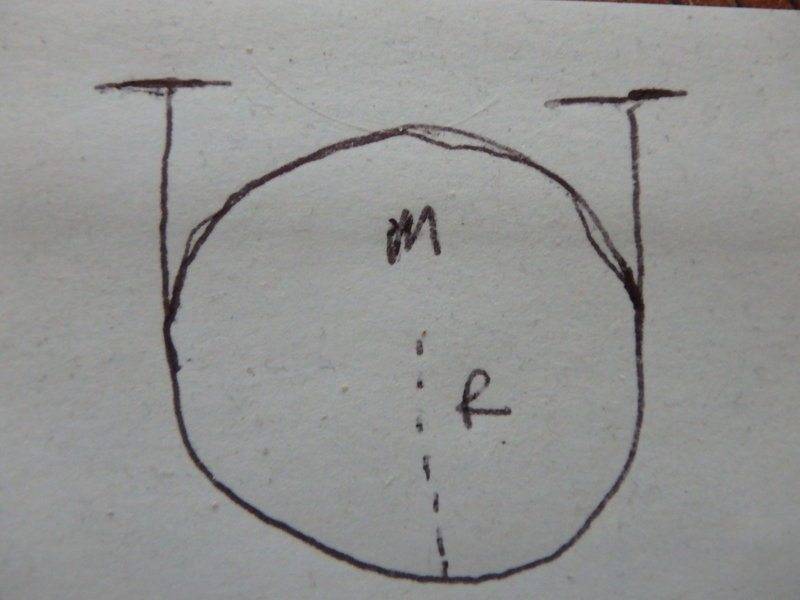
In the following diagram, a frictionless disc is supported by a massless string. This problem was given by the author of a book, and a solution was given to some questions that were asked about this diagram. One thing the author said in one of the solutions, was that the tension in the string was equal to Mg/2. Why is this? I would have thought that since the one string is supporting the entire mass of the disc that it should just be Mg.
P9300001.jpg
 
Physics news on Phys.org
hringsak said:
One thing the author said in one of the solutions, was that the tension in the string was equal to Mg/2. Why is this? I would have thought that since the one string is supporting the entire mass of the disc that it should just be Mg.
Consider three setups:
1) The one in your diagram.
2) The one in your diagram, except that we've permanently fixed the string to the disk with a glob of glue at the lowest point.
3) Like #2, except that instead of one string passing through the glob of glue we have two strings both ending in the glob of glue and held onto the disk by the glue.

In #3 we clearly have two strings. Is the tension going to be the same or different in the three cases?
 
  • Like
Likes   Reactions: hringsak
Okay, that makes sense that each half of the string is supporting half of the mass. Instead of one end of the string being attached to the ceiling and one end to the disc, where the tension would be Mg, you have just half of the tension at each end. However, because in the midpoint of the string there is no glob of glue, which would provide a balancing force to both halves of the string as in setup #2, doesn't one half pull on the end of the other half, therefore making the tension Mg?

I do get your point that the glue in the middle in setup #2 is not even necessary, but isn't that because the tension from one half is balanced by tension from the other half?
 
Wait, I get it now - because both ends are attached to the ceiling, they each are pulling with just half the force as in the example where just one end is attached to the ceiling. In that example you have the full force of Mg pulling in opposite directions. The fact that in the above diagram, both ends are attached to the ceiling, that results in just half the tension in the string.
 
The object isn't accelerating so the net force in any direction must be zero. Therefore the vertical forces must sum to zero.
 
If the cylinder was rotating and there was friction the net vertical force would still be zero. The tension in the two strings wouldn't be the same but would still sum to mg.
 

Similar threads

  • · Replies 19 ·
Replies
19
Views
15K
  • · Replies 3 ·
Replies
3
Views
2K
  • · Replies 14 ·
Replies
14
Views
2K
Replies
13
Views
2K
Replies
5
Views
3K
  • · Replies 3 ·
Replies
3
Views
3K
  • · Replies 7 ·
Replies
7
Views
2K
  • · Replies 24 ·
Replies
24
Views
10K
  • · Replies 6 ·
Replies
6
Views
2K
Replies
6
Views
3K