From a sketch to the compass ; Geometric construction

Click For Summary
SUMMARY

The discussion focuses on geometric construction using a straight edge and compass to locate points D and E such that ACDE forms a trapezium. Participants analyze triangle ACD, establishing it as an isosceles triangle with angles DAC and DCA equal. They also explore the congruence of triangles ABC and MBC, concluding that angle C is divided into two equal angles of 30 degrees. The conversation emphasizes using trigonometry and compass techniques to accurately construct the required points.

PREREQUISITES
  • Understanding of basic geometric concepts such as triangles and trapeziums
  • Familiarity with triangle congruence criteria (SAS)
  • Knowledge of compass and straight edge construction techniques
  • Basic trigonometry (sines, cosines, tangents) for angle and length calculations
NEXT STEPS
  • Study the properties of isosceles triangles and their angle relationships
  • Learn about triangle congruence criteria in detail, focusing on SAS
  • Practice geometric constructions using a compass and straight edge
  • Explore trigonometric functions and their applications in geometric problems
USEFUL FOR

Students and educators in geometry, mathematicians interested in geometric constructions, and anyone looking to improve their skills in using a compass and straight edge for precise geometric tasks.

mathlearn
Messages
331
Reaction score
0
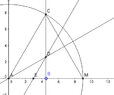
In the traingle ABC, AB = 4.5cm , Ac = 9cm & angle ABC=90; The point D is located on BC such that DA = DC ;

Using only a straight edge with a cm/mm scale and a compass, construct an accurate diagram

Obtain the location of point E on side AB such that ACDE is a trapezium .

This is a rough sketch, (Happy)

View attachment 5924

Now apart from constructing the triangle can you help me to located the point D & Obtain the location of point E on side AB such that ACDE is a trapezium ,only using an straight edge and a compass. (Crying)
 

Attachments

  • QFbPH.jpg
    QFbPH.jpg
    11.8 KB · Views: 121
Mathematics news on Phys.org
mathlearn said:
In the traingle ABC, AB = 4.5cm , Ac = 9cm & angle ABC=90; The point D is located on BC such that DA = DC ;

Using only a straight edge with a cm/mm scale and a compass, construct an accurate diagram

Obtain the location of point E on side AB such that ACDE is a trapezium .

This is a rough sketch, (Happy)
Now apart from constructing the triangle can you help me to located the point D & Obtain the location of point E on side AB such that ACDE is a trapezium ,only using an straight edge and a compass. (Crying)

Hey mathlearn! ;)

What can we say about triangle ACD?
What about its angles and sides?
 
I like Serena said:
Hey mathlearn! ;)

What can we say about triangle ACD?
What about its angles and sides?

(Nod)DA = DC $$\therefore$$ It is an isosceles triangle.

(Happy) $$\angle DAC$$ = $$\angle DCA$$
 
mathlearn said:
(Nod)DA = DC $$\therefore$$ It is an isosceles triangle.

(Happy) $$\angle DAC$$ = $$\angle DCA$$

Good! (Nod)

How about triangle ACM?
 
I like Serena said:
Good! (Nod)

How about triangle ACM?
(Nod)(Thinking) It's a 60 degree I guess.
 
Last edited:
mathlearn said:
(Nod)(Thinking) It's a 60 degree I guess.

Well, we'll have to get rid of the guessing, and also consider how to move forward. (Sweating)

Have you heard of congruence of triangles?
It means that they're the same, just positioned differently.

In particular triangles $\Delta ABC$ and $\Delta MBC$ are congruent.
Can you tell why?

Moreover, since that is the case, the angle at $C$ is divided into 2 equal angles.
So we can say something about the angles in triangle $\Delta ACD$! (Happy)
 
I like Serena said:
Well, we'll have to get rid of the guessing, and also consider how to move forward. (Sweating)

Have you heard of congruence of triangles?
It means that they're the same, just positioned differently.

In particular triangles $\Delta ABC$ and $\Delta MBC$ are congruent.
Can you tell why?

(Happy)

(Nod) $\Delta ABC$ $$\cong$$ $\Delta MBC$ (SAS)

$$CB=CB$$ (Common side)
$$\angle CBA= \angle CBM$$ (CB perpendicular side AM)
$$AB=BM$$ (data)

I like Serena said:
Moreover, since that is the case, the angle at $C$ is divided into 2 equal angles.
So we can say something about the angles in triangle $\Delta ACD$! (Happy)

$$\triangle ABC$$ is half an equilateral triangle

(Nod) As one angle of an equilateral triangle is $60^\circ$; $$\therefore$$ the angle at C is $30^\circ$

$\displaystyle \angle DAC = \displaystyle \angle DCA $So now as the problem states only to construct $\triangle BAC$ , From there I guess what you have to do is copy the angle $\angle DCA$ which is a $30^\circ$ at $\angle BAC$ and to draw a line through point A or the bisecting line of the angle. The point It meets the side BC is named D. Correct? (Thinking)

If so now to move on to constructing point E such that ACED is a trapezium (Sweating)(Crying)
 
Last edited:
mathlearn said:
(Nod) $\Delta ABC$ $$\cong$$ $\Delta MBC$ (SAS)

$$CB=CB$$ (Common side)
$$\angle CBA= \angle CBM$$ (CB perpendicular side AM)
$$AB=BM$$ (data)
$$\triangle ABC$$ is half an equilateral triangle

(Nod) As one angle of an equilateral triangle is $60^\circ$; $$\therefore$$ the angle at C is $30^\circ$

$\displaystyle \angle DAC = \displaystyle \angle DCA $So now as the problem states only to construct $\triangle BAC$ , From there I guess what you have to do is copy the angle $\angle DCA$ which is a $30^\circ$ at $\angle BAC$ and to draw a line through point A or the bisecting line of the angle. The point It meets the side BC is named D. Correct? (Thinking)

Good! (Nod)

However, I'm afraid that with a straight edge with a scale, and a compass, we can't just copy an angle. (Worried)
Instead we can do this in 2 ways.

With the compass we can divide any line segment into 2 equal parts, and draw a line perpendicular through it.
We can do this with $CM$ to find the line $AD$.

Alternatively, we can use trigonometry (sines, cosines, and tangents) to calculate $BD$ and measure it.
If so now to move on to constructing point E such that ACED is a trapezium (Sweating)(Crying)

Simplest is to use trigonometry to calculate $BE$...
 
I like Serena said:
Good! (Nod)

However, I'm afraid that with a straight edge with a scale, and a compass, we can't just copy an angle. (Worried)
Instead we can do this in 2 ways.

With the compass we can divide any line segment into 2 equal parts, and draw a line perpendicular through it.
We can do this with $CM$ to find the line $AD$.

Alternatively, we can use trigonometry (sines, cosines, and tangents) to calculate $BD$ and measure it.

Simplest is to use trigonometry to calculate $BE$...

(Nod) Thank you .

Now to Find the location of point E Such that ACDE is a trapezium a line parallel to CA through the point D should be constructed. Correct ? (Thinking)
 

Similar threads

  • · Replies 10 ·
Replies
10
Views
3K
  • · Replies 6 ·
Replies
6
Views
2K
  • · Replies 6 ·
Replies
6
Views
3K
  • · Replies 1 ·
Replies
1
Views
2K
  • · Replies 1 ·
Replies
1
Views
2K
  • · Replies 1 ·
Replies
1
Views
1K
  • · Replies 1 ·
Replies
1
Views
2K
  • · Replies 10 ·
Replies
10
Views
2K
  • · Replies 2 ·
Replies
2
Views
2K
  • · Replies 40 ·
2
Replies
40
Views
5K