From polar coordinates to heliocentric ecliptic coordinates

Click For Summary
SUMMARY

This discussion focuses on converting polar coordinates of a planet into heliocentric ecliptic coordinates. The process begins with the transformation of polar coordinates into Cartesian coordinates using the formula x = r · cos(v). The discussion emphasizes the importance of rotating the reference plane to align the x-axis with the perihelion direction, incorporating unit vector relations for the axes involved. The final position of the planet in heliocentric coordinates is derived by adjusting for the inclination angle (i) and separating the Cartesian components.

PREREQUISITES
  • Understanding of polar and Cartesian coordinate systems
  • Familiarity with heliocentric ecliptic coordinates
  • Knowledge of trigonometric functions and their applications in coordinate transformations
  • Basic concepts of orbital mechanics, including inclination and perihelion
NEXT STEPS
  • Study the transformation between polar and Cartesian coordinates in detail
  • Learn about the mathematical implications of rotating coordinate systems
  • Research the significance of inclination in orbital mechanics
  • Explore advanced topics in celestial mechanics, focusing on heliocentric coordinate systems
USEFUL FOR

Astronomers, astrophysicists, and students of celestial mechanics who are involved in planetary motion analysis and coordinate transformations.

Shukie
Messages
91
Reaction score
0
So I've calculated the polar coordinates of a planet, with the sun at the origin and the x-axis being the striped line going from the sun towards point P.
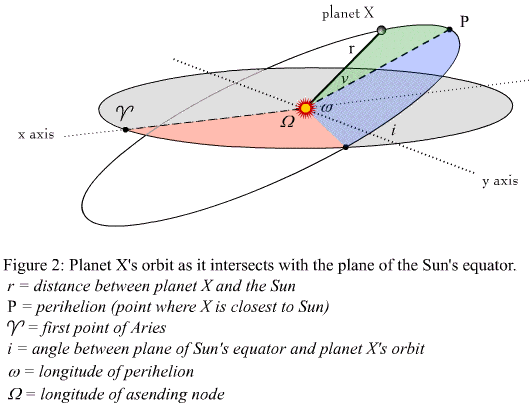
figure6.gif


Now I have to convert these polar coordinates to heliocentric ecliptic coordinates. To do this, I have to convert to cartesian coordinates first and then rotate the plane of reference so that the x-axis will point towards \Upsilon. This is the answer:

figure7.gif


Converting to cartesian coordinates is easy, but then I'm lost. Could anyone tell me how exactly I go from x = r \cdot \cos{v} to (6)?
 
Astronomy news on Phys.org
It is easier to see what's going on if you first look at the situation when the inclination ##i## is zero and then rotate the plane of the orbit away from the ecliptic. This is shown in the figure below. We have auxiliary axes ##p## from the sun to the perihelion and ##q## perpendicular to ##p##. The heliocentric axes are ##x## and ##y##.
Heliocentric.png

We write unit vector relations
$$\begin{align} & \mathbf{\hat q}=\cos\Omega~\mathbf{\hat x}+\sin\Omega~\mathbf{\hat y}\\ & \mathbf{\hat p}=-\sin\Omega~\mathbf{\hat x}+\cos\Omega~\mathbf{\hat y}\end{align}$$The position of the planet is $$\begin{align} \mathbf{r}=r\cos(\omega+v)~\mathbf{\hat q}+r\sin(\omega+v)~\mathbf{\hat p}.\end{align}$$We now consider how these vectors change when the plane of the planet's orbit is rotated away from the ecliptic about the ##q##-axis to inclination angle ##i##. Only unit vecor ##\mathbf{p}## will change form. It will be off the plane of the ecliptic. Noting that its projection on the ecliptic is along its old direction. We have$$\begin{align}\mathbf{\hat p'}=\cos i (-\sin\Omega~\mathbf{\hat x}+\cos\Omega~\mathbf{\hat y})+\sin i~\mathbf{\hat z}.\end{align}$$We obtain the position of the planet in heliocentric coordinates in the inclined plane using equation (3) in which ##\mathbf{\hat p}## is replaced with ##\mathbf{\hat p'}## from equation (4) and ##\mathbf{\hat q}## from equation (1). We get $$ \mathbf{r}=r\cos(\omega+v)~( \cos\Omega~\mathbf{\hat x}+\sin\Omega~\mathbf{\hat y} )+r\sin(\omega+v)~cos i [(-\sin\Omega~\mathbf{\hat x}+\cos\Omega~\mathbf{\hat y})+\sin i~\mathbf{\hat z}]$$Separation of the cartesian components provides the desired relations.
 

Similar threads

  • · Replies 3 ·
Replies
3
Views
5K
  • · Replies 6 ·
Replies
6
Views
2K
  • · Replies 1 ·
Replies
1
Views
2K
  • · Replies 142 ·
5
Replies
142
Views
135K
  • · Replies 9 ·
Replies
9
Views
2K
  • · Replies 2 ·
Replies
2
Views
2K
  • · Replies 2 ·
Replies
2
Views
2K
  • · Replies 8 ·
Replies
8
Views
1K
  • · Replies 1 ·
Replies
1
Views
2K
  • · Replies 3 ·
Replies
3
Views
9K